|
 |
|
Photojournale : Photo documentary and photo journal stories from around the world
| Latest
Photo Documentary Story |
|

|
| Featured Photographer |
|
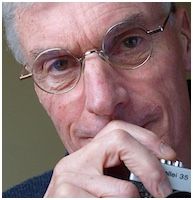
For Jonathan Reynolds, formative teenage years (in the late 1960s) were spent in the City of London, only a stone’s throw from the journalists' hub of Fleet Street, and with fine art accessible everywhere. During that time he fell in love with photography in all its aspects: from the chemistry and optics to the creativity, geometry, humour, surrealism, beauty, humanity and awesome documentary power.
So photography came very close to being his career choice; but in the end a reaction against the crowded, dirty, depressed and still war-damaged London environment took him into a successful career as a wildlife biologist. Now retired from that, he is racing to live the other life that so nearly happened before. Based near Salisbury in rural southern England, he is looking to take on projects both serious and fun.
website: http://www.allmyeye.co.uk
More

|
|
| Images from Latest Story |
|
|
| Random Images From Previous Stories |
|
|
|
|
|
| Select a Photo Story |
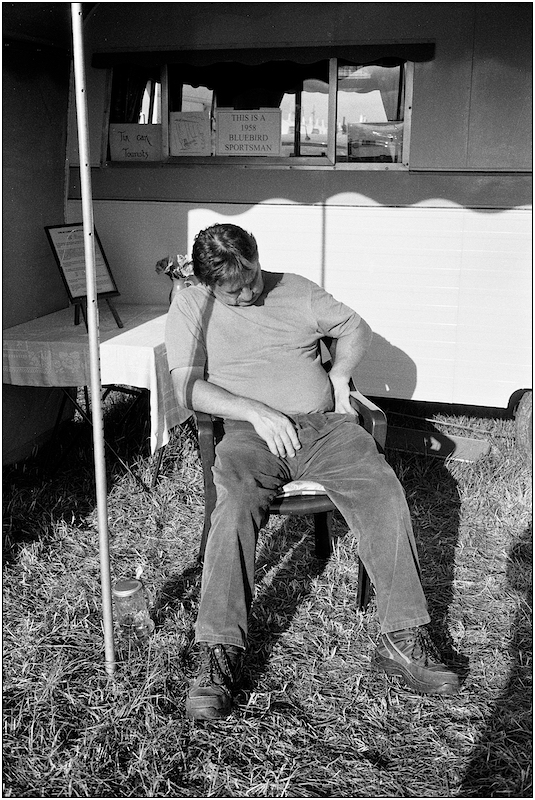
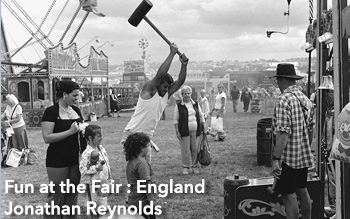
A good holiday Fun Fair should have everything that’s missing from ordinary life: excitement, crowds, noise, colour, joy rides, trials of strength, candies, booze, music, entertainers, stuff to buy, nostalgia, escape, romance.
Besides all that, the Great Dorset Steam Fair in southern England has at its heart a gathering of enthusiasts for working vintage machinery. Pride of place goes to the great coal-fired steam engines that once powered agricultural and civil engineering processes. When not parading or demonstrating working methods, these giants line up at the centre of the showground to create a warm, chugging, wheezing, pulsing heart and a sulphurous fog.
From the top of the helter-skelter or a big Ferris wheel one can look down at them, or into the scaffolding of the roller coasters. For the Fairground show-people are here too, with the rides that they transport from Fair to Fair all over Britain. Some rides are vintage favourites; others are new, technical and terrifying. This Fair claims to be the largest of its kind in the world, taking over 600 acres of land that for the rest of the year grows food crops. There’s something here for everyone, whether it’s a first taste of independence, a laugh, a mild thrill, huge adrenalin surge, a chance to show off, a photo-opportunity, searching for bargains on a junk stall, or just watching others demonstrate big machinery or draught horses.
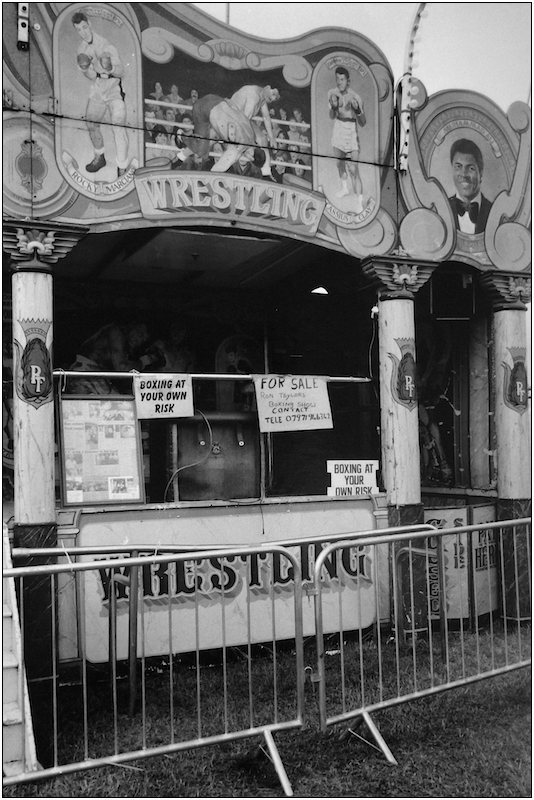
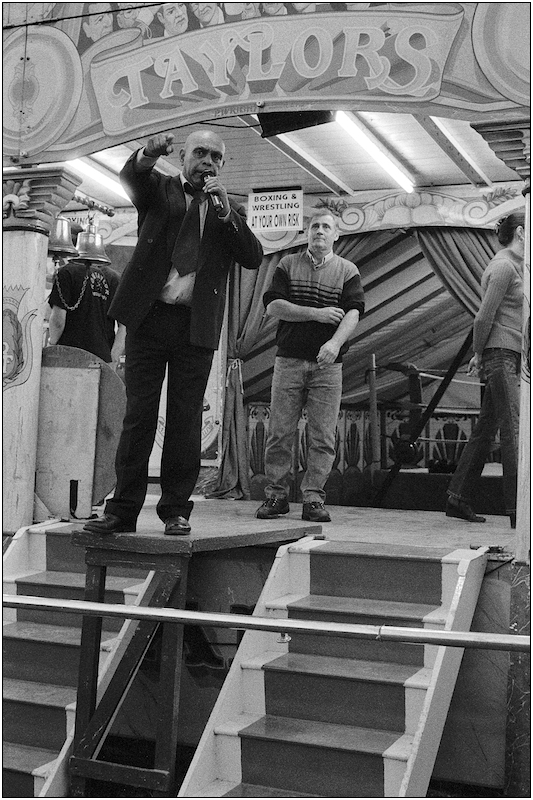
The relentless din of fairground organs, announcements, shouting, screaming, hooting, puffing, grinding and thumping makes your head spin. So in time folk retire to quieter spaces between tents or on the edge of the Fair for a sit-down rest, though the enthusiasts find it hard to leave their beloved machines. At dusk, the entertainments come to life. At Ron Taylor’s theatrical boxing and wrestling booth, a husky employee touts for custom, provoking members of the crowd to step up and test their fighting skills in the ring. The same formula year after year. Then one year this old familiar venue was closed and up for sale, a reminder that the showman’s livelihood too is subject to change. Because of COVID, the Great Dorset Steam Fair has now not taken place for 2 years. But the enthusiasts are only sleeping.
Photo documentary series by Jonathan Reynolds
https://www.allmyeye.co.uk
|
Sept 20th , 2019 Global Climate Strike. #climatestrike
The point of protest is to draw attention “ to wave your arms, shout your demands, make people stop and think. Australia isn't known for these types of spectacles “ a mixture of apathy ' no one cares'), and tall poppy syndrome (I don't want to bignote myself) and fragile privilege keeps people in check, and off the streets. On my way to the School Strike for Climate with my son, a man lent in and suggested we "get a job". I was very happy to see such an amazing turnout “ unprecedented “ with tallies coming in at 150,000. Maybe things are changing. And my son could put paid to that man's comment "No jobs if there"s no planet, Dad."
Photo documentary by Steve Cook
|
I am less famous as a photographer in my locality. Two years ago in a day I was surprised by a knocking at the door, an old man with a stick came to introduce himself at my home and asked about my photography. He was none other than a photographer of age 89 years old. His deep passion in photography, vast knowledge,exceptional memory power, sharing about his analog to digital photographic journey, jovial nature, mingling with people irrespective of generations inspired me. It is a tale of a passionate amateur photographer Mr. S.N. Mondal, aged 91years at present.
In our friendship of two years we both visited each other’s home and I had enjoyed and enriched my knowledge by every such occasion. He was a history teacher of a government-aided high school and he lived 47 years in a hilly district of West Bengal,India because of his job purpose.He was a very dedicated teacher, sincere and loyal to his profession and played a leading role to shape the future of many students by morally and financially. To quench his thirst of Indian history he became a traveller. He visited many neighbouring countries several times to purchase photographic gears and foreign magazines. He had built up a studio and his own darkroom. The developed photos are kept and he shares some of his works of analog period. He is fond of monochrome images, especially portrait. A portrait should depict some story, emotions according to him. “Dream†is one of his favourite portrait works.
Besides photography he loved gardening.His garden was famous for so many flowers specially roses of 65 types, Camellia, Night queen, Bird of paradise which he often bought from Green wood nursery, Meerut, Uttar Pradesh.
Though his life was not a bed full of roses, he lost his only son, a promising gynaecologist who died at the age of 31years due to a massive heart attack. He lost his many near and dear ones within few years of span. The trauma of losing son led his wife into depression and he bound to come to live in our chaotic world leaving the vastness of calm, peaceful hilly forest life to avail better medical support.
Despite of all mental and physical hazards: experiencing with knee osteoarthritis and respiratory problems, photography, gardening and Indian classical music are the things which act as fuel to make him alive.He takes care of a small garden of his neighbour on the roof of his small apartment where he lives only with his wife. As a fan of Nikon gadgets he recently purchases a Nikon d750camera,a Nikon 80 –400 mm f 4.5-5.6G ED VR lens to enjoy bird photography and steps out for birding with his existing gears along with young photographers. We, the photographers of digital generations are lucky and grateful to have such a passionate inspiring photographer in our locality. When the hustle and bustle of photography in social media, current trend of money making workshop based photography and getting faster recognition by it result the sense of art are at the end of my rope,he brings some fresh air to energise my journey of photography. We are longing for his healthy long lived life.I put an end with a wish to capture a moment of his 98thbirthday, hanging camera around his neck.
|
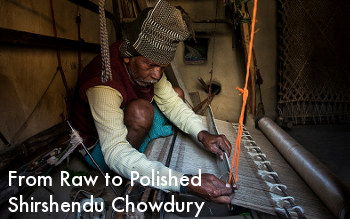
This story is based on a day visit in a rural village of silk makers, India. It is a winter morning and people are busy in several activities to make Tussar silk which has rich texture and natural deep gold colour. I have tried to capture few moments of their lives and activities. It is a very nice experience with my camera as people are so kind, generous, helpful and jovial during their hectic working hours.
Women contribute about 70 % of the workforce for making of natural silk (Seri-culture) in India, the second largest producer of Tussar silk in world. In this village, the villagers are given an initial training in making silk from single- shelled, oval-shaped cocoons and spinning and weaving the silk fabric. The process of extracting raw silk fibre from cocoon in cold and unwinding it onto a holder (Reeling) is very delicate and laborious task as legs of silk makers are exposed during this task in wintry weather. Raw silk threads are soaked in warm water mixed with oil or soap to achieve the distinctive softness and shine. After drying and degumming, the silkthread gets a creamy white colour. Some of the images describe the moments of this process.
After making the silk threads, they make the silk clothes through looms. It takes almost one week to prepare a saree, the most important tussar silk product. Also, it is also used as the base material for handicrafts, furnishing fabrics, and stitched apparel. The group of people involved in this making can earn Rs. 1000/- only for making one saree while these sarees display with a tag of around Rs.10,000/- per piece in showrooms and shopping malls. Moreover finished and designer garments produced from Tussar silk are exported worldwide with very high price tag.
In this circumstance, without getting proper remuneration and appreciation, silk makers are still continuing this profession. They patiently carry the culture and the form of art. Their simplicity, positive emotional states, sympathy for others and struggle for hope of future upliftment make me surprised. Supervision of Government or some helping hands from other organisations are necessary to open a new window of hope in their creative journey.
|
Since the end of the civil war in 2002, the process of reconstruction in Angola is accelerating thanks, in large part, to oil revenues. But not everyone benefits from this wealth. In rural areas, access to healthcare remains difficult and little effort is spent on training
medical personnel.
Lobito, behind its old-fashioned decor, offers a pretty sad contrast: the now shabby rich colonial villas by the sea, strongly contrast with the paradas, of the downtown decayed squats. According to the provincial authorities, these temporary refuges (abandoned toilets, car shells, containers, etc), shelter 450 children, of which 18 girls, left to themselves. In all, over 2500 minors survive from begging and small jobs, prostitution, most often for girls – on the coastline of Benguela-Lobito. Some come from families dispersed during the war, others victims of domestic violence, who chose to run away from their families and seek refuge on the streets.
Text: Guillaume Plassais Journalist
Photo documentary by Stéphane Lehr
Photojournaliste
https://www.lensculture.com/stephane-lehr
|
Traditions, festivals and rituals play a significant role in the conventional way of life in rural Odisha; one of the most culturally diversified states of India. Tiger mask dance is a popular and highly regarded unique folk dance form in Odisha. It is widely practiced in Bhanjanagar sub-division of Ganjam district, Odisha. Apart from Tiger, the Bull, Deer and Horse dance are also typical features of this region.
This fast and dynamic dance needs enthusiasm and energy not only for the dancers but also for the drummers and bell players. Acrobatic movements and hissing sound charm, captivate and excite the audience especially children. Although visibly it seems simple but it needs skills, energy, coordinated staging and skilled direction.
The Tiger dance is performed by two dancers in coordination who get into a cane frame concealed by thick cloth richly decorated with applique work and mirrors. The masks are bigger than the head with colourful traditional paintings and decorations. The masks are made of paper-pulp, cow dung and wood. The legs are visible and have ankles tied to it and form the legs of the tiger. Experts smear the whole body with yellow varnish, black spots and stripes; their costume contains a tiger’s mask and tail made of cloth.
The dancers take part in religious procession especially “Takuraniyatraâ€, “Ramnabamiyatraâ€, “Dolyatra†and other ceremonies where they dance to the rhythm of “Changu†played by traditional drummers. Apart from the festivals it’s also performed in bridegroom’s procession or some rural private parties. The tiger mask is famous and readily available; children love to play with this mask.
I was lucky enough to get a chance of interaction with Budhia Gouda, who is 55 years old and leader of a local animal mask dance group of Bhangnagar district. His main occupation is cultivation and his passion of Tiger dance makes him popular and recognised in the region. Since childhood he is fascinated by this dance form and he started his training when he was 20 years old; after 35 years of practice and performance he is now a proud leader and trainer who transfers this art form to younger generation. But unfortunately earning from this art form is too meagre and inconsistent; therefore younger generations are not interested to learn this art. Budhia Gouda believes that Government support and encouragement is necessary to sustain this local art form of Tiger dance.
Photo documentary by Tania Chatterjee
|
Car headlights struggle through the dense city traffic, slowed by nearing fenders, bumpers and darting pedestrians. Bakeries and fruit stands come alight. Vendors of all kinds display their wares. On the sidewalks and streets, beggars and boys selling colourful balloons try their luck. In tea houses and cafes, young and old socialise, while others - families - gather at home. A final call to prayer scratches from loudspeakers about the city, past bodies of addicts, warming by fires in the dirt. In this dusty urban darkness all are nearly the same - sharing hours of a Kabul City night.
"Kabul Nights" was produced by 10 young, aspiring Afghan photographers for an Afghanistan Photographers Association (APA) photojournalism workshop led by trainers, David Bathgate and Farzana Wahidy. Student photographers included: Ishaq Ali Anis (Kabul), Azizullah Azizyar (Kabul), Mohammad Anwar Danishyar (Nangarhar), Mohammad Aref Karimi (Herat), Zahra Khodadadi (Kabul), Barialai Khoshhal (Kandahar), Ajmal Omari (Baghlan), Tahmina Saleem (Kabul), Muhammad Naseer Turkmani (Parwan)
|
Holi of Hope
Among the many sociological downsides that India suffers from, the ostracism of the Indian widows does leave a considerable scar. Widows in India are no longer forced to throw themselves on the funeral pyres of their husbands, but the life which is handed over to them can still be hard. The conviction to consider a widow inauspicious and impugning her for the death of the husband still very much exists, particularly in villages and rural areas. These widows soon find themselves ostracized from their home villages and many are sent away by their husbands' families who want to prevent them inheriting money or property. Some are even flung out by their sons and daughters-in-law as unwanted baggage.
The poverty and neglect faced by widows is driving them to seek refuge and charity in the ashrams of Vrindavan, a journey of over 1,000 miles.
Vrindavan is a famous holy city on the banks of river Yamuna in west Uttar Pradesh. The holy city is associated with Lord Krishna, who according to great epic the Mahabharata, was born in the nearby forest. It is part of the Brajbhoomi, where the Krishna Leela or the birth and romance of Lord Krishna and his consort Radha was enacted. Round the year there is an unending stream of tourists, Indian and foreign, who wish to savour the enchantment of the holy city and seek the blessings of the resident deities in the temples. But Vrindavan has its darker, less-loving side - it is known as "the city of widows".
The widows seeking shelter in the ashrams believe that holy places like these would help them to attain salvation and would bring them nearer to god. Many regard Vrindavan as the only place where they can live and die peacefully with the protection of all mighty. Unfortunately, these ashrams in themselves do not have much to offer. Majority of the widows are seen begging on the streets or singing songs/bhajans for earning their livelihood. Those few genuine pilgrims who come here to devote their remaining years to the service of Radha/Krishna, also face the same problem. Even though they get a roof over their head, the financial struggle for livelihood makes their existence tragic.
But it is heartening to say that times are changing. Widows are emerging out of their shadows where they were not expected to look happy. Sulabh International, an organisation headed by the famous reformist, sociologist Dr. Bindeshwar Pathak, has shown a lot more empathy towards these unfortunate women. Sulabh International has not only taken steps to ensure that these women get money on a monthly basis to meet their expenses but also empowered them with jobs like stitching and knitting. More importantly the organization struck at the roots of the social order that makes widows shun all festivities by celebrating Holi with them. In an effort to mark the departure of age old useless tradition and bring the widows into mainstream of society, Sulabh started organising Holi for them about three years ago at the widows' ashram and in the year 2016 it was organised at the famous Gopinath temple to give it a kind of social acceptance.
As the colours of Holi descended and painted the white saarees, it symbolized the fall of that age old superstitious traditions which barred the widows from wearing colours, among many other. For them it was a joy long denied. Under the showers of flower petals and among the songs of lord Krishna, hundreds of widows danced, splashed coloured powders (gulaal) and played with water pistols (pichkari) filled with coloured water. Women who worked as manual scavengers and were empowered for a better life and job by Sulabh joined them in this blissful event. There were smiles and joy all around.
In this bleak landscape of the whites of the widows, Holi — a festival of colours, revelry and a licence for fun is a much needed act. Measures like these however sidestep the more serious concern of why widowhood should be a scourge at all. A society that offers women access to property, paid employment, education and sexual autonomy would create independent women, who would know how to live their life with dignity and joy whether they be single, married or widowed. Festive celebrations relieve the tedium of everyday, this attempt to infuse colour and joy into the barren lives of the widows of Vrindavan is surely welcome, but this should not lull us into accepting the harshness of a society that pushes these women into the ashrams of Vrindavan in the first place. We need to remind ourselves of the need to challenge the inequalities and injustices, which create the sorry plight of the widows of Vrindavan whose grief is temporarily alleviated by the welcome colours of Holi. We wait for the day when men and women can freely choose the colours of their lives.
Photo documentary by Arka Dutta
|
Photo documentary by Ivan Maksimovic
|
Flying in from Punta Arenas to King George Island , we boarded our 75 foot motor yacht, Australis for two weeks of cruising the Antarctic Peninsula. Kayaking when conditions were calm, spending time with penguins in their colonies, pre dawn zodiac forays, seal and whale watching, and camping on the ice were all activities to fit into the days weather and the boats movements.
In the pit of my stomach remained the last and greatest challenge of this Antarctic adventure "The Drake". This 521 Nautical mile rite of passage guards the southern continent with a treacherous reputation. We scored an 8 out of 10, with 55knot winds whipping up an angry 9 metre swell. There were broken bones and seasick souls, mentally and physically stretching ones resolve. I wouldn’t have had it any other way!
They say Antarctica changes you, they’re probably right.
Photo documentary by David Larcombe
|
Known largely for the infamous dark days of rule under the genocidal Khmer Rouge, Cambodia is less developed than neighbouring Vietnam, but its dependence on the Mekong river is no less pronounced. From the all important artisanal fishing industry to the great interior floodplains that supply much of the country’s staple food, rice, and the multitude of people and cultures who populate the river’s banks, Cambodia is very much connected to the Mekong.
Among Southeast Asian nations, Cambodia’s relationship to the Mekong river is unique because of “The Great Lakeâ€: The Tonle Sap. Located in the heart of the nation the Tonle Sap is the region’s fresh water body and one of the world’s most productive inland fisheries. Each year the Mekong swells with monsoon rains and surges into the lake, providing nutrients and sediment critical to the fish stocks that provide up to 70% of Cambodians’ protein intake.
Produced in partnership with Lien Aid (http://www.lienaid.org), a Singapore based organization focusing on water issues throughout Asia, these images represent a visual summary of a series of multimedia stories from the Mekong in The Kingdom of Cambodia. Imagery from phase three of the A River's Tail project in Laos will be coming to Photojournale in the coming months, and the full collection of articles can be found at http://www.ariverstail.com.
Part one of the series in Vietnam’s Mekong delta can be found on Photojournale by following this link. http://www.photojournale.com/categories.php?cat_id=306
Photo documentary by Luc Forsyth
|
Known largely for the infamous dark days of rule under the genocidal Khmer Rouge, Cambodia is less developed than neighbouring Vietnam, but its dependence on the Mekong river is no less pronounced. From the all important artisanal fishing industry to the great interior floodplains that supply much of the country’s staple food, rice, and the multitude of people and cultures who populate the river’s banks, Cambodia is very much connected to the Mekong.
Among Southeast Asian nations, Cambodia’s relationship to the Mekong river is unique because of “The Great Lakeâ€: The Tonle Sap. Located in the heart of the nation the Tonle Sap is the region’s fresh water body and one of the world’s most productive inland fisheries. Each year the Mekong swells with monsoon rains and surges into the lake, providing nutrients and sediment critical to the fish stocks that provide up to 70% of Cambodians’ protein intake.
Produced in partnership with Lien Aid (http://www.lienaid.org), a Singapore based organization focusing on water issues throughout Asia, these images represent a visual summary of a series of multimedia stories from the Mekong in The Kingdom of Cambodia. Imagery from phase three of the A River's Tail project in Laos will be coming to Photojournale in the coming months, and the full collection of articles can be found at http://www.ariverstail.com.
Part one of the series in Vietnam’s Mekong delta can be found on Photojournale by following this link. http://www.photojournale.com/categories.php?cat_id=305
Photo documentary by Gareth Bright
|
The sacredness is the way to define the meaning of our life through the approach to the divinity and is an aspect of divine revelation. The divinity, as described and practiced in a different way throughout the world, defines the existence of life that is inhabited within the supreme power of life or providence reflecting the purity of life. The sacredness may be a paradoxical word to those who believes in only the existence of earth life, but it is not a subject of contradiction that every life species of the earth possess a concentrated energy within it that is the another form of expression of divinity i.e. a canvas of good thoughts.
And along with this, the religion acts as a matrix of the sacredness of life. Moreover, both are inter-connected through the execution of deeply rooted habits; irrespective of religion or conception, including scientific approach and spiritual thoughts. The sacredness definitely doesn't portray the spirituality only, but it directly reflects the good will power of inner-self.
The work is aimed to those activities that are performed by the human life only to achieve the divinity within our existence i.e. "Atma" or "Self" as defined alike in different religion; and by this divinity they compasses their life to the world of good where nothing negative can rules. Because, the main course of the spiritual thoughts; apart from their intentional description and explanation in a religious way; enriches our meaning of life. The sacrificed and devotional performances beneath the costume of religious rituals are either related to purification of the soul or the thoughts of will to the closest persons that may ultimately defeat the devil character rooted in everybody. The acquisition of sacredness by giving pains to the own body after being pierced with nails or praying with starvation or facing the heat of fire flares mobilizes their soul to such an extent where sacredness is weaved with them. Actually beneath the fact of submitting their respect to the name of almighty, they build up energy internally to bear all pain that is inevitable in human life.
The sacredness is not the extreme meaning of divine power in a spiritual way, but it also a resonance of peace of mind which conveys the harmony of life. The flowing of seven tunes may also the means of achieving the sacredness which also touches the Everest point of mind of the artist and listener with mystical ecstasy.
My photographs was aimed to frame the moment of life that is embedded with the thoughts of sacredness and the meaning of life, which is not only related to religious divinity, but also the branches of humanity.
Photo documentary by Monidipta Saha
|
This collection of images was taken during my trip to the remote Chin State in northwest Myanmar, an area rarely frequented by tourists. I was part of a team from Sight For All who were equipping two eye centres in the region, assisting the local eye surgeons in their endeavours to reduce the disturbing level of blindness in the country. I encountered many wonderful characters during the four-day journey, a few of whom I captured and would like to share with you.
James is the chairman and founder of the Australian NGO Sight for All (http://sightforall.org), which works to develop high impact and sustainable solutions to both treat and prevent blindness in Australian Aboriginal communities and developing Asia, an area that is home to half of the World's blind. The photographs in his book, Visions of Myanmar, were taken and compiled during his surgical teaching trips to the country as part of Sight For All’s Vision Myanmar Program.
Photo documentary by Dr James Muecke.
|
This was a slogan which echoed throughout China in the early 70s.
In an effort to curb population growth, families were encouraged to delay marriage, have fewer children and increase the number of years between children.
At this time, it was not exactly clear whether China's problems could simply be pinned on to a population boom, or to the ill-effects of Mao's Great Leap Forward program. Either way, blaming the resulting widespread food shortages on having too many mouths to feed was easier than admitting to mistakes in economic planning.
What started out as a voluntary family planning program produced the desired results. In the first half of the 70s, the fertility rate took a deep dive. However, the figures were still alarmingly high. When Deng Xiaoping came to power upon Mao's death in 1976, he inherited a country that was still plagued by hunger and poverty. Deng resolved to transform his China into an economic success story, and one sure way yo achieve it was to control the population.
By 1980, the One Child Policy in China was made mandatory. Again, it was immediately successful. But now, 25 years or one generation later, China is faced with another problem: a rapidly dwindling labor force and an even faster-growing ageing population.
China's leadership is again in a state of worry. The estimate is that by 2050, senior citizens will account for 35% of the country's population. And so the One Child Policy has been repealed, families are encouraged to have two children, but the response is not as eager as the Communist Party would like for it to be. Cost of living has skyrocketed throughout most of the country, life expectancy has increased, and the burden for married couples to support four senior citizens per family has become too heavy.
Are the proposed changes now coming too late, too long, too few?
Photo documentary by Dana Cosio-Mercado
|
Kumbh Mela is a mass Hindu pilgrimage of faith in which Hindus gather to bathe in a sacred river. It is the world's largest religious gathering and in 2013 80 million people took a holy bath at Sangam where the waters of the Ganges, Yamuna, and mythical Saraswati River converge. The festival is billed as the "world�s largest congregation of religious pilgrims".
According to our holy texts, it is at Sangam that the htree rivers Ganges, Yamuna, and Saraswati River converge. The story is that Gods or Devtaas and the Demons or Asuras had a mighty war over the possession of Amrita � elixir of eternal life. During their struggle, few drops of amrita had fallen on to four places that are today known as Haridwar, Ujjain, Prayag, and Nasik The biggest drop fell in the river at Prayag, Allahabad. Hence, it is of utmost importance.
It is believed that the gods still come down and bathe at the Sangam to restore their immortality. It is said that if someone takes a holy dip at Sangam during a proper time, they can attain �Moksha� (freedom from the cycle of reincarnation). It will liberate them from their continual sufferings and miseries.
So what exactly is Maha Kumbh? Kumbha represents pitcher or Kalash that is symbolization of all that is present and all that exists. According to the Hindu scripts, the �Tridevas� viz. Brahma, Vishnu and Shiva; all goddesses, including Mother Earth and the knowledge of our four Vedas (Rig Veda, Sama Veda, Yajr Veda and Atharav Veda) exists in this Kumbha. Therefore, Maha Kumbh is a celebration of all Vedas and all lives.
From the Ancient Days the Holly Men start First Bathing in the Holy River, then the Other Pilgrims who came to Kumbh Mela for the Holly Bath , the Procession of Holy Men is called �SHAHI SNAN�
Photo documentary by Joydeep Muhkerjee
|
"Somehow when no one was looking, we became the most watched country on earth" David Dunnico


David Dunnico is a documentary photographer from Manchester in the UK. His work often mixes polemics with a sense of the absurd.
We featured Dunnico's black and white photographs documenting the rise of CCTV surveillance in the UK back in 200? He has continued to record this aspect of the surveillance state , a subject that is impossible to discuss without using the language of George Orwell's dystopian novel, 1984. Dunnico's project grew from taking photographs to collecting ephemera about Orwell's last book. His photos were exhibited alongside the Royal Exchange's stage adaptation of the book and his collection was the basis of his exhibition '1984 Looks Like This' held at Salford Museum and Art Gallery in 2012.
Dunnico's collection was noticed by the International Association of Privacy Professionals in the USA, who added his collection of to theirs. Last week part of it was shown in Amsterdam at a conference for the European Privacy Commissioners.
The need to catalogue the collection ready for shipment and reprint the photographs, gave Dunnico the opportunity to re-evaluate the project. He decided to reproduce the images in colour for the first time, and sequence them to be displayed as a series of panoramas. A number of new images that had not been previously shown were also added.
Dunnico explains the rise of this sort of mass surveillance:
 "Large scale monitoring of the public by networks of Closed Circuit Television (CCTV) cameras has become a part of everyday life in the UK and elsewhere. This has happened with little debate and less understanding. Indeed most of the assumptions people have about it are wrong. And many of the ideas that led to this situation are contradictory".
Britain has more CCTV cameras than any other country. If they stopped crime as we are told they do, it should also be the most law abiding place in the world. They were supposed to make people feel safer, yet at a time when serious crime was falling, people's fear of it was rising. And paradoxically, the presence of CCTV alerts the public to possible danger rather than reassuring them. We are told they are needed to protect us from violent crime, yet most of it is run by retailers to protect their stock from being pilfered, or to keep an eye on the staff. Big Brother isn't watching you with cameras your supermarket is. Surveillance has quickly moved on from cameras to the storing of data from mobile phones.
The photographs in this project capture the organisations that operate CCTV, the companies who sell it and the people who oppose it. They catch the historical moment when technology made it possible for CCTV to spread from the street, out of the shops and into people's homes. The photographs were captioned with GPS coordinates and a time stamp taken from the image's EXIF information in a conceit that mimics the data recorded by CCTV cameras. In Britain, CCTV is intimately linked with the privatisation of public spaces, which are being given over to retail and financial interests, and to be seen in the city for any other reason than to consume, is to be seen as suspicious.
CCTV is the most visually obvious aspect of the 'surveillance state'.
It's very nature makes it interesting to photographers. There is the shared technical basis, but also CCTV became all-pervasive at the same time as we noticed our camera phones meant "we are all photographers now". There is a contradiction at work here. The 'War on Terror' helped create a backdrop of paranoia, where police classified people taking photographs as would-be terrorists and bone fide photojournalists as security threats. At the same time the public were encouraged to see photographers as might-be pedophiles, yet uploaded millions of photos of their kids on social media. They accept being followed by CCTV, which in the main is not done by law enforcement agencies, but object to street photography as violating their privacy.
Dunnico adds: "I visited a photography exhibition, there was a sign on the gallery wall. It said, Photography is strictly forbidden. CCTV in operation. The irony should not be forgotten, so I took a picture."
Photo documentary by David Dunnico
|
Bishwa Ijtema is the second largest Muslim congregation after Hajj.
Hundreds of thousands of Muslims from all over the world gathered on the bank of Turag River in Tongi of Gazipur District, Bangladesh. The three-day congregation started after Fazr prayers with religious sermon by Islamic scholars on Friday morning. And last day it will conclude with 'Akheri Munajat' Bishwa Ijtema. Organized by Tabligh Jamaat in Bangladesh every year.
Photo documentary by Md. Akhlas Uddin
|
I first visited Mahan forest in March 2013 to document the ongoing protests of indigenous people against acquisition of forest land for coal mining. Once there, I felt a need for a longer engagement with people and started working with local organisation in order to understand relationship these indigenous communities share with their forests. In last two years, I extensively interacted and interviewed these communities and their individual members and got to know about the deep seated corruption, exploitation and insidious administrative policies that threaten the livelihood of people in at least 54 villages surrounding the forest.The Portraits, I made in Mahan, document the dignity of a way of life and celebrate the legacy of individual, who sustains that environment and culture. By capturing these Individuals members at this critical time when the people of Mahan are facing significant social and economic changes, these portraits, chronicle the changing face of these communities. Their struggle is not just for basic rights but also to an attempt to assert their identity and gain respect and acknowledgement for it, to preserve a forest that defines who they are and where they belong.
Photo documentary by Vinit Gupta.
https://vinitguptaphotography.wordpress.com/
|
Vietnam's Mekong delta is one of the world's most productive agricultural regions, is the backbone of the country's booming agricultural export industry, and was once a bountiful source of much of the nation's freshwater fish. Yet rapid population growth, the introduction of modern fishing equipment, the widespread use of agrochemicals, and largely unregulated domestic pollution has greatly impacted the Mekong's ability to support the millions of people who live along its banks.
A River's Tail is a year-long collaborative documentary project combining photography, videography, and text, to create a visual narrative of the Mekong river from its terminus in southern Vietnam to its source in the Tibetan plateau. Told through a series of localized micro stories, A River's Tail uses multimedia to weave together a complex portrait of the Mekong in a time of turbulent change as the forces of urbanization, industrialization, and commoditization strain the river's resources to the breaking point.
Produced in partnership with Lien Aid (http://www.lienaid.org), a Singapore based organization focusing on water issues throughout Asia, these images represent a visual summary of nearly a dozen multimedia stories from the Mekong in Vietnam. Imagery from phase two of the A River's Tail project in Cambodia will be coming to Photojournale in the coming months, and the full collection of articles can be found at http://www.ariverstail.com.
Photo documentary by Luc Forsyth
|
Vietnam's Mekong delta is one of the world's most productive agricultural regions, is the backbone of the country's booming agricultural export industry, and was once a bountiful source of much of the nation's freshwater fish. Yet rapid population growth, the introduction of modern fishing equipment, the widespread use of agrochemicals, and largely unregulated domestic pollution has greatly impacted the Mekong's ability to support the millions of people who live along its banks.
A River's Tail is a year-long collaborative documentary project combining photography, videography, and text, to create a visual narrative of the Mekong river from its terminus in southern Vietnam to its source in the Tibetan plateau. Told through a series of localized micro stories, A River's Tail uses multimedia to weave together a complex portrait of the Mekong in a time of turbulent change as the forces of urbanization, industrialization, and commoditization strain the river's resources to the breaking point.
Produced in partnership with Lien Aid (http://www.lienaid.org), a Singapore based organization focusing on water issues throughout Asia, these images represent a visual summary of nearly a dozen multimedia stories from the Mekong in Vietnam. Imagery from phase two of the A River's Tail project in Cambodia will be coming to Photojournale in the coming months, and the full collection of articles can be found at http://www.ariverstail.com.
Photo documentary by Gareth Bright
|
Republic Democratic of Congo, North Kivu, Masisi, Rubaya. Coltan and manganese, are rare metals used to make mobile phones and computers. The market value is so high as to have aroused the interest of multinational corporations and criminal organizations: in order to destabilize the political situation and take control of the mining business at a reasonable price, financial backing is given to armed groups waging war on one another. Under the supervision of the buyers in Rwanda, soldiers and police control the territory, exploiting the local population and reselling its natural resources: the proceeds are used to buy other weapons that provide additional power, thus creating a vicious circle it is difficult to break.
The armed rebel movement of the Nyatura was formed by the secession, in 2010, of the CNDP rebel movement, now called M23. Formed mostly by Congolese Hutu, they are led by Colonel Marcel Habarugira. Today some of these rebels have been reintegrated into the regular Congolese army F.A.R.D.C. Without any form of salary, they survive by bullying, through abuse of power, abuse of civilians, raiding night and day and demanding a 10% tax on all forms of activity in the city of Rubaya.
Nyatura soldiers patrol the territory around the Mudere mine. Miners dig 20 meters underground for the minerals before transporting them to a nearby river where they are separated from rocks and sand before being sold to dealers. Mine accidents are commons.
Photo documentary by Erberto Zani
|
Tbourida, also known as the "Powder game", is a traditional and popular equestrian art inspired by the historical wartime attacks of the once feared and fiercely brave cavalrymen of Morocco. The colourful spectacle of Tbourida is a contest of speed, endurance, grace, discipline and manoeuvrability for Morocco's horsemen and horses. Tbourida is practiced across all rural areas of Morocco to celebrate national and religious moussem (holidays), as part of Morocco's national culture and past tribal identity of the country.
Tbourida : The Fantasia of Morocco ( 摩洛哥的幻想曲 ) is a series of photographs describing and realising the depth, thunder, smoke and dust, colours, energy and spectacle of the Moroccan Tbourida and its back story the crowd of characters. Shot at a number of moussem across Morocco including Moulay Abdullah, Moussem des Cerises Sefrou, Tissa and others.
The work on exhibit at Zarah No.46 Guloudongdajie, Dongcheng , Beijing July 4th - August 28th Guloudongdajie Dongcheng Beijing
北京东城鼓楼东大街46å·
as part of a selection for a pending book publication.
Photo documentary by John Horniblow
|
A Second Home is a part of an on-going study into man's coexistence with water, with a focus on aquatic athletes who's life is completely engulfed in the element, spending the majority of their waking hours surrounded by, consuming or excreting it.
The project derived from my fascination with the diver and their intimate experience during the act of diving. The diver carries through the process in a rather meditative state, from the moment they ascend up to the board, through the whole performance in the air before they gracefully slip through the surface. The moment is accompanied by a cluster of air that whirls and dances around them as they glide through the peaceful liquid environment. It's both enchanting to experience and witness.
It became evident early on that developing an understanding of the element is crucial to be able to excel in and coexist harmoniously with water. This specific body of work was produced over six months, documenting the aquatic sports teams at Plymouth Life Centre. An affiliation with Devonport Royal Swimming Association led to a development in documenting their water polo team, both in and out of the water. Below the surface, I had become fascinated with observing athletes forcing themselves against the water, their flesh distorting temporarily by its resistance. The vigorous training channels their strength to keep their body upright and raised to waist level, using their legs as a whisk to churn the water.
Photo documentary by Meesha Holley
|
Child labor is a visible part of everyday life in Bangladesh. Employers often prefer to employ children because they are cheaper and considered to be more compliant and obedient than adults. They are also exposed to situations that make them vulnerable to trafficking, abuse, violence and exploitation. According to the ILO (International Labor Organization) 2006 there are about 3.2 million child laborers in Bangladesh. On average, children work 28 hours a week and earn 222 BDT (just US $3.3) a week. The vast majority of children (93 per cent) work in the informal sector which makes enforcement of the relevant legislation challenging. Many child laborers miss out on their right to education because they do not have the time to go to school or to study. As a result, working children get stuck in low paying, low-skilled jobs, thereby perpetuating the cycle of poverty.
I have started my project on child labor from last three years. I am documenting life of child labor, which was a result of curiosity of many children. I�m influenced by great writer Nikolai Ostrovsky.
I am very much interested to those children who work away from their home and family. I wonder how they cope up with their daily life with that hazardous condition like brickfield, aluminum factory, shipyard and garbage dump yard. I�ve started following Shafik (11) and few others who work in a brickfield in Chittagong. His family live in an Island named Hatia in Bay of Bengal. Shafik working at Bakkar brickfield, as his father wants him to do so. His father took 6000 BDT (80$) for six months agreement from master, who collect children as a labor from different villages of Bangladesh. I would like to document Shafik and few other child labour�s lives, dreams and future following few of them on their working environment and their family living different districts of Bangladesh, Asian & African countries. I would like to document their lives, dreams and undervalued labor of these children with my work.
Photo documentary by Mohamed Shahnewaz Khan
|
Kolkata has often been described as the 'City of Joy' but to Lopamudra Talukdar, who has spent all her life in the city, Kolkata is not only a city of Joy, but also of hope, desire, aspiration and dream. It is also the city of intellectuals, political movements, culture and festival. More than 300 year old, the city which is bursting at the seams, is a photographer's delight. Lopamudra takes you along the colourful and multicultural streets of Kolkata, to the banks of River Hooghly, in the middle of the festivities and the bustling bazaars.
Photo documentary by Lopamudra Talukdar
|
Kennedy Hill is an Aboriginal community in the remote town of Broome in NW- Australia. The community exists in the shadows of Western Australian Premier Colin Barnett's commitment to close down approximately 100-150 Aboriginal communities in Western Australia. There are more than 270 remote Indigenous communities in Western Australia, home to 12,000 people. Aboriginal Elders and Leaders are shocked and feel closing down communities is a big threat to their people. They believe the impact of such a move will be devastating. Communities are based "on Country". Closing down communities means losing connection to the land in which ancient stories are etched. These stories inform about morals, values and relationships, and are reinforced in Language through song and story at times of ceremony or travel through that Country there used to be 250 Aboriginal languages before White Invasion. By closing down communities, ancient knowledge that has been passed down through generations will get lost and people will be lost because of this disconnection that nurtures them physically, emotionally and spiritually. Consequently, poverty, disadvantage, alcoholism, unemployment, etc. which are contained within communities because of ongoing cultural connection will be relocated and intensified and brought to the bigger towns. History is repeating itself!
Australian award-winning Photojournalist Ingetje Tadros has spent four years working with Aboriginal people and has been documenting their confronting daily lives within their communities. Her concerns for Aboriginal people and their communities stretch from the old uninformed line that demonises Aboriginal men by insinuating that Aboriginal women and children are under great threat by the men in the communities, to a lack of affordable accommodation; Over seven per cent of the Kimberley population is homeless and ninety per cent of this homelessness is comprised by its First Peoples.
Kennedy Hill, or as the locals refer to it, "The Hill" is significant to Indigenous people in the region.The presence of a large shell midden immediately adjacent to the community is testament to this significance; It's been a living area and a sacred place since before White Invasion... since time in memorial.
Aboriginal people all over the Kimberley are now in fear of losing not only their homes but losing the significant connection to their land and sacred sites.
Ingetje Tadros/Diimex
|
Nearly two decades have passed since the Bosnian war found its end and claim to 100,000 victims. Yet that number hasn't yet reached its end. The war continues to maim and kill. Not from rooftops or across mountain valleys, but from shallow distances beneath the ground.
A 120,000 antipersonnel landmines were laid across 9,000 minefields in the former Yugoslavia, from 1992 to 1995. Today, approximately 2.4 percent of the former republic is covered with both unexploded mines and similar devices.
Co-funded by the Dutch government, the Norwegian People's Aid Project represents a major and continued effort to locate and remove landmines throughout Bosnia and Herzegovina. A major focus to date has been the mountainous Srebrenica area in the northeastern part of the country, where many landowners have yet to return to farms and orchards that were once their livelihoods.
Of compounding concern is land flooded and hillsides slumped by heavy Spring rains in 2014, all of which sums to an exacerbated potential for post-wartime tragedy.
Photo documentary by David Bathgate
http://davidbathgate.com
|
"Monsoon of death" is a visual reportage about one of the most under-reported hyperendemic medical emergency of India that is claiming hundreds of innocent lives annually.
Every monsoon, some thousands of children of different states of India become victims of Acute Encephalitic Syndrome (AES). AES is a group of clinical neurologic manifestation caused by wide range of viruses, bacteria, fungus, parasites, spirochetes, chemical and toxins. It is significantly linked to contaminated water, improper sanitation and unhygienic habitation. Monsoon makes this condition more vulnerable every year. The disease is mostly affecting children up to age group of 15 with high mortality rate or leaves them with permanent neuropsychiatric disabilities.
Gorakhpur of Uttar Pradesh and its surrounding areas are one of the worst affected zones by AES every monsoon. Baba Raghab Das Medical College & Nehru Hospital in Gorakhpur alone gets more than thousand of AES cases every year and witnesses nearly 700 child deaths in every monsoon. It is the only medical institute with a dedicated epidemic ward that caters the endemic victims of 19 districts of Uttar Pradesh, Bihar, Assam and also bordering areas of Nepal.
Photo documentary by Dr Kaushik Ghosh
www.kaushikghosh.net
|
Tanzania has an estimated 2 million orphans due to HIV/AIDS, high rates of death during childbirth, road accidents and as a result of poverty. Left behind: The Plight of Tanzania's Orphans documents the lives of the many orphaned children in Tanzania, who without the help of the kind people that dedicate themselves to these children would lack the basics of life, a roof over their head, education, medical services and a family.
This project was sponsored by the Simon Cumbers Media Fund.
Photo documentary by Jekaterina Saveljeva
www.jekaterinasaveljeva.photoshelter.com
|
It was six in the morning. We just came out of our small little hut in the lap of Himalayan rainforest. On one side the lush green valley has been waiting for us, on the other side lies the beautiful blue mountains standing tall high. It was misting all around. I had been so engrossed enjoying the divine beauty of nature I didn't notice somebody is standing next to me - an old lady. She was wearing a full length dress with long sleeves and a yellow hat with a gentle smile in her face. She whispered in my ears, 'Go Son, the place is yours, enjoy it in the best way you can'.
Uttarey valley (7600ft) in West Sikkim is considered to be one of the finest places on earth. It is not only well-known for its natural habitat, but also for amazing landscapes, wonderful people with rich culture and sense of hospitality. Uttarey is part of the Singalila National Park and Kanchenjunga National park, which are both famous for various herbs, waterfalls and hilltops.
Photo documentary by Monojit Bhattacharya
|
Vadakke Madham Brahmaswom (as it is popularly known), is the traditional Vedic Research Institution in Southern state of Kerala, India - imparting ancient Indian scriptures, Vedic studies, namely Rid Veda, Yajur Veda and Sama Veda for the last hundreds of years. It is one among the most ancient institutions in India that teach Vedas with pristine purity from its very formation. It is situated at the heart of Thrissur, a district in Kerala, India and said to be around 400 years old. It is believed that the great Indian saint, Adi Shankara's disciples had established the four Madhas (schools) in Thrissur.
The teaching of Veda is highly rigorous and too difficult, as the students are very young. The teaching is not bookish but oral and face to face and using hand signs. The disciple listens the uttering of preceptor and follow him. For the exact recital, the teacher should hold the head of the student and will move it to right, left, upwards and downwards in accordance with the Swara with which that particular word is uttered. The studied portions are repeated regularly and this method helps to by-heart that particular potion. The total period for each student is 4-1/2 years to complete the Vedic education.
Photo documentary by Sreeranj Sreedhar
http://www.sreeranj.com/
|
Every spring, nomadic Saghro in the South East of Morocco, leave their pastures and migrate with their herds of goats, sheep and camels, their entire family and belongings. These caravans set off to cross the Dades valley and climb on the southern slopes of the Atlas mountains over 3,000m for the summer months. They will finally reach the Izourar lake and its highlands and pastures. Some set up their tents and make camps there; while others will continue to the north side of the Atlas and set up their temporary camps for summer.
The Ait Atta are a group of the Amazigh population of Morocco, originating from the Sahara. Jbel Saghro is their original fief or homeland. They spread out around in the valleys of Tafilalet, Ziz, Draa and Dades living a transient nomadic existence.
Photo documentary by Moroccan photographer Abdellah Azizi
http://www.azifoto.com
|
The high altitude plains of Changthang, Eastern Ladakh, are home to the Changpas, a nomadic pastoralist tribe. For generations, they have lived in complete harmony with their land � a cold desert plateau with an average altitude of over 3700 metres, too inhospitable for farming and which remains under snow for seven months a year. Their traditional pastoral system is centred around their livestock; the Changpas rear yaks, sheep and horses, in addition to the famous �pashmina� goats (whose soft wool is well-known throughout the world). The ancestral way of life have been the key to the survival of the Changpas, who have used their indigenous knowledge system to optimise the use of rangeland vegetation, where the grazing of yaks, goats, sheep and horses are regulated through a well-planned migration in a land that has a fragile eco-system.
Predominantly Buddhists, the Changpas also have shreds of animism in their religious beliefs, which can be traced back to their herding tradition : for a Changpa nomad, his sheep are intrinsically sacred creatures bestowed upon him by the gods of the valley.
Changthang is home to a few brackish lakes and the most important of them are Tso Moriri and Pangong Tso. It was on the banks of Pangong Tso that the Sino Indian war of 1962 reached a fierce climax and since remained a bone of contention between India and China. The ongoing dispute has posed a considerable threat to the fragile ecology of the area and consequently on the lives of the nomadic tribe. The increasing attractions of alternative livelihood, an influx of tourism in the area and some significant climate changes like unnaturally heavy snowfall resulting in deaths of livestock in recent years have further added to the threat for the sustainable future of the socio-economic and environmental life of the Changpas.
Photo documentary by Sugato Mukherjee
|
We, The Armenians
In the landlocked country in the South Caucasus region of Eurasia is the small but old country of Armenia. Surrounded on all sides by a disparaging array of political doctrines, Armenia is the one country in the world that could be worried about both its geographical and geopolitical position.
Armenia is bordered by its allies, Iran and Georgia, and its foes, Turkey and Azerbaijan. Not that far away are the troubled countries of both Syria and Iraq. To add weight to this precarious position is the fact that Armenia is politically and economically aligned to Russia.
So what of the Armenians? Who are they and what are they like? On a recent trip through that country, I managed to photograph the people as they are in their environment, going about their daily routines amidst the turmoil of the modern world. The Armenian's are not unfamiliar with their lot, they are a unitary, multi-party, democratic nation-state with an ancient cultural heritage. The Kingdom of Armenia was established in the 6th century BC, after the fall of Urartu and became the first state in the world to adopt Christianity as its religion. It has endured the rule of the Mongol, the Ottoman and the Russian empires.
The predominant religion in Armenia is Christianity. The roots of the Armenian Church go back to the 1st century. According to tradition, the Armenian Church was founded by two of Jesus' twelve apostles � Thaddaeus and Bartholomew � who preached Christianity in Armenia between AD 40�60. Because of these two founding apostles, the official name of the Armenian Church is Armenian Apostolic Church.
Photo documentary by Steve Marshall
http://stevemarshallphotographs.com
|
Midwives are women, mothers, who have devoted their lives to providing safe motherhood to other women and mothers.
Access to skilled care from a trained midwife during pregnancy, childbirth and after delivery is key to saving a mother�s life and that of her child. By training more midwives, AMREF is helping deliver an immediate, lasting solution to reduce maternal mortality in Ethiopia.
Photos were captured in Jinka, Ethiopia, in 2013 documenting AMREF Canada�s program to improve maternal and child health in the Omo Valley.
Photo documentary by award winning social-documentary photographer and videomaker , Paolo Patruno, creator of http://birthisadream.org
http://www.paolopatrunophoto.org
www.facebook.com/paolopatrunophoto
|
A Syrian Eid by Jake Simkin
"I traveled to Aleppo to see the celebration of Eid on the Free Syrian Army side. The city was quiet. There was occasional sounds of bombing but a lack of gunfire to be heard in the distance. It was the end of Eid Al Fitr and though no real truce was called, there was the sense of peacefulness.
Sheep were slaughtered so food could be distributed, girls wore pretty new dresses and new play swings were made to make this day special.
Still the barrel bombs dropped. Crude home made bombs made by the Syrian government to be dropped out of helicopters and planes falling randomly without precision onto the people. Mainly civilians. A civil group called the White Helmets responded quickly to remove the wounded and bring out the dead.
But the days would not be marred by tragedy. Life goes on and children played and sang. They sang songs about freedom. Young boys filled Aleppo's public pool to swim and enjoyed getting out of the heat.
As the sun set, the people headed home to celebrate with family and to hide from the constant bombing that filled the night. It would be a new day tomorrow."
Photo documentary by Jake Simkin
http://mildsevenlights.carbonmade.com
|
A confronting photo essay documenting the conditions of mental health patients in Bali.
When I walked into that room, I did not see a room.
It was a cage, and in that cage was a human being that had been stripped of her wings, her voice, her humanity.
The first feelings that came to me as I entered this room, this cage, this holding pen, was that in the corner was another human - but one who was caged in many ways, mentally and physically. I knew I had to capture this story because for me, my freedom is something I take for granted and I wanted to tell the story of how freedom for some of our fellow human beings is but a dream....but by talking about it and showing it we can move towards helping by bringing the human suffering of these victims of Pasung to the world, so that we can collectively do something to help. When I asked Kadek's father permission to enter the room where Kadek was being held for over twenty years, it felt like stepping into a hellhole.
Another person may have called it a room, but for me it was a cage : there was no windows, the roof had large cracks in it, through which Kadek if she looked up could see the sky.
Kadek was sitting on the ground smeared with her own faeces and I quietly sat next to her in that mess. Kadek was watching me while I sat with her in her own cage.
The silence was deafening and yet her story was so loud as told to me by her eyes. I believe this spilt second of a moment changed my whole perception as a photographer and human being, it hit me like a wall and I felt very clear that this story about Pasung needs to be told.
To be a restrained person in one's own home is something I had never heard about in all my years of traveling the world. However this is what I found when I ventured to Bali this year.
I was suddenly thrust into a world that few get to experience and it has left a impression on me that has shaken me to my core as a human being. To sit as a free human being with another human being whose freedom has been taken away is the most confronting and heart wrenching experience to be in.
What I found cannot be described in words and must be seen to really understand the level of depravity and human rights abuse being forced on the lowest group of people in this country - the mentally afflicted. Pasung is the physical restraint by way of chains, ropes and cages of the Mentally Ill in Indonesia under the care of their families as there is a lack of Governmental support for the full care and rehabilitation of the victims and their family carers. It is estimated that there are 18,800 people under Pasung today and more are being found.
I must also explain that this is not a story about blame of the families who must endure the hardships of caring for their loved ones who are afflicted by a Mental Health condition. Through the lens I have tried to capture the individuals who are under Pasung through no fault of their own or their families, but due to a larger issue of no funding and resources to combat this growing situation that sees families having to deal with their loved ones in the most trying circumstances and not having the skills to help those with Mental Health but to do the best they can with what they have - which is nothing. It can also be said from my experience that even the carers are traumatized by the whole experience of having a loved one restrained in the process of Pasung. They can only restrain their loved ones in an effort to stop the self harm and harm of themselves - the carers.
This is a photo documentary about the victims - both the ones in chains in their cages and the ones who look after them.
I have tried to also capture those that are out of Pasung in an effort to give hope. In the six days that I had access to the victims of Pasung in total I photographed twenty one individuals in their homes.
I was able to see some hope for the victims through the caring work of Professor Luh Ketut Suryani, MD, PHD of the Suriyani Institute for Mental Health based in Bali.
Slowly Professor Suryani is finding more victims of Pasung and offering some hope to the families that their family can be given freedom from their debilitating conditions through medical intervention and counseling. This is a very limited approach due to lack of funding. Bali, Indonesia, 2014.
Photo documentary by Ingetje Tadros
�Ingetje Tadros/Diimex
|
Street Photography from Hyderabad
"Being not originated from Hyderabad explores my love-hate relationship with the city of Hyderabad. Though being originally from Eastern part of India It was completely different setup for me when I first landed up in Hyderabad. Now after spending almost half a decade in this city it's just like my second home. I just loved the amalgamation of old (never-fading Muslim aura and culture)and new (modern, urban landscape) the city offers for any photographer to capture it's essence. To say that I found the city of Hyderabad to be full of street-stories would be an understatement. Every nook and corner of the street presented before me a life of its own, with lots of shades n characters. I have tried my best to capture the essence for you."
Photo documentary by Swarat Ghosh
|
One can feel the presence of political parties in Kolkata (India), especially at the time of elections, at every corner; wall writings, flags and banners. In this city there are four major political parties and many smaller parties. All these parties have their offices at almost every locality of the city, from where they control the political activity of the regions. An office is a representation of the ideologies, the people and the background of a political party. This is a series of photographs of different party offices in Kolkata.
Photo documentary by Gitartha Goswami
This Photo documentary is part of the Lok Sabha project from Fabrica, the communication research centre of the Benetton Group.
Lok Sabha: 10 young Indian photographers describe their country in the five weeks of the greatest election in the world, 814 million voters to renew the Lower House of Parliament. For more information click here
www.loksabhaindia.org
www.fabrica.it
|
Stark images of a second revolution Kiev, Ukraine brought the world's media attention to Maidan Square. In a time of uncertainty in Ukraine the news has shifted. As the tensions thicken in Ukraine , pro Russian militants have begun to take over State Offices in the eastern regions after the annexation of Crimea. In Kiev the city struggles to get back on its feet, the buildup of Russian forces on Ukraine's eastern border continues to cause anxiety and fear in the wake of the Russian backed Crimea annexation. As expected, those in Maidan are not standing down.
Photo documentary by Lisa Shukov
|
Every year in March the members of the Rifai�i order gather in Prizren at their holy shrine, the tekke, to celebrate a very special ceremony. Nevruz is an annual holiday marking the beginning of spring and therefore the first day of the new year. The date also marks the birthday of Imam Ali, the cousin and son-in-law of Prophet Mohammed. In Shiite belief Mohammed has chosen Ali to lead the Muslims and Sufis see Ali as their founder. For Sufis Ali is the origin of a continuous transmission of the spiritual heritage of Allahs Prophet Mohammed. At the climax of this celebration the Sufis will take centuries-old metal skewers and pierce their hips and cheeks.
The collective prayer, dhikr, is very important for all dervishes. Dhikr is a way for Dervishes to make themselves aware of the permanent presence of God. Literally dhikr means remembrance of God, normally by the constantly repeating of God�s name. Every Sufi order has its own way of celebrating a dhikr, there is no strict rule of process.
The piercing of the cheeks and bodies must not be seen as an act of self-mutilation. After the Dervishes have reached a state of trance during their dhikr they feel themselves possible to seperate the soul from the body. Achieving this state they feel able to identify God and his permanent presence. And therefore they don�t feel any pain. Soon after this religious act has been fulfilled the skewers are being removed by the Sheikh. With his fingers Sheikh Adrihusein Sheh closes the wound and nearly no blood seems to be visible.
Photo documentary by Michael Biach
www.michaelbiach.com
|
It all begin on the 22 of July 2013, when Indonesian photojournalist, Sri Utami invited me to take photos of Rom people in Sarajevo. But my first meeting with Ismet and his family turned this journey into a whole story which is not finished yet. For now, I have concentrated my attention to Sarajevo and is surrounds. I want to be part of their way of living. European people I have met so far, for the most of them, really don't have a positive opinion about the Roma or Gypsies as they like to call them. Even if they took an active part in the war against the Bosnian Serbs army in 1992, they are still considered as foreigners by a majority of Bosnians. So this story is the first part of a long term project which will take me on the path of the Romani people in Bosnia. You can't visit Roma people with millennium history and just snap photos of them, you must live with them learn their motivation and their aspiration as a nation.
Photo documentary by Yves Choquette
In February 2014, the Roma of Bosnia photos was awarded the first prize at the international Terra Bella Media contest in Italy.
|
Muslims worldwide observe Ramadan as a month of increased spiritual reflection, self-improvement, sacrifice, self-discipline, self-control, devotion and worship, through abstinence from food, drink, sexual relations and general avoidance of sinful speech and behavior. Ramadan postulates empathy for the less fortunate by encouraging actions of generosity and compulsory charity (zakat).
Fasting (sawm or roza or puasa) during the holy month of Ramadan is obligatory for adult Muslims, except the ill, traveling, pregnant, breastfeeding, diabetic or going through menstrual bleeding. The predominant practice is fasting from sunrise to sunset. The pre-dawn meal before the fast begins is called suhoor and the sunset meal that breaks the fast is called iftaar.
This is the story of 4 incredible persons who, through their immense faith, ignore their unavoidable daily labour while observing Ramadan, without a drop of water.
TAYYEBA KHATOON
Tayyeba Khatoon is a 96-year-old great-grandmother, who has been observing Ramadan for the last 88 years, without fail. She will not give this up for anything. Faith keeps her going. She feels tired, weak and dozes off sometimes but observes Ramadan faithfully.
MOHAMMAD SIDDIQUE
Mohammad Siddique is a 86-year-old rickshaw-puller. His territory is from Mahatma Gandhi Road to New Market, through Weston Street. Normally, he plies his rickshaw 10 hours a day but during Ramadan, he does 4 hours across six kilometers and is not happy with his under-delivery. He doesn�t feel tempted to break his roza on a muggy afternoon.
BASHEER AHMED
57-year-old Basheer is a professional cook, who cooks food for iftaar for 1000 people each evening, on a wood-fed oven in his little kitchen Ripon Street but cannot taste a morsel. Basheer lives with his family, wife Rehana, daughter Zeenat (3rd year student of Chemical Engineering) and son Sheikh Mohammad Ali (Class 10 student). The family lives in a tiny room next to the kitchen where Basheer cooks every day on four ovens. He does not even drink water during the day and is totally dehydrated by the end of the day when he is done with cooking and its iftaar time.
PRIYA HOME
Priya Home is a Catholic by birth but observes Ramadan every year. She is a teacher and runs a school named Sacred Heart with her husband in Picnic Garden. In the evening she teaches underprivileged children of the rikhshaw-pullers and domestic helps. She breaks her fast with the children, the rickshaw-pullers and the domestic helps.
Photo documentary by Jayati Saha
|
After months the standoff between anti government protesters and government forces of Ukrainian President Viktor Yanukovych, the protestors camp in and around Maidan ( Independence ) Square in central Kiev resembles a war zone. The protests first erupted in late November 2013 when President Yanukovych rejected a landmark association and trade deal with the EU in favour of closer ties with Russia. In a standoff which has moved between calm and violence for months, encapsulating moments of jubilation, dogged resilience and determination by anti government protests, it escalated dramatically on 18 February, 2014 . Riot police moved into clear the restive protest camp on Independence ( Maidan ) Square after a truce broke down and with policemen being shot, sparking a spiraling decent into a destructive battle. Witnesses reported live rounds, petrol bombs and water cannons at the main protest site. Violence that ensued has left upwards of 75 people dead and over 600 injured. Another turning point in what has largely been peaceful and defiant demonstrations with, at times, violent retaliation by government backed thugs and police that killed three protestors on 23 January, 2014 and resulted in the occupation of government buildings.
With the media saturated with fiery front line images of the standoff between the protestors and Ukraine police for the past few months, "Behind the Barriers" pictures the human side of the camp in the days just ahead of clashes on the 19th February 2014.
Some of the people pictured in this series, "Behind the Barriers" taken on February 17th, were killed when the violence between security forces and the protesters peaked in the indiscriminate shooting of demonstrators by uniformed snipers and security forces on 19th , 20th February 2014.
Photo documentary by Lisa Shukov
|
Mustang or Kingdom of Lo is one of the most isolated inhabited regions in the world. Protected by forbidding mountains, Mustang was once an independent kingdom that controlled trade between the Himalayas and the plains of India. Today, the region is linked by religion, culture and history to Tibet, but is politically part of Nepal. The former kingdom of Lo is one such, where Tibetan culture, religion and tradition are still believed to be the purest, similar to those of Tibet before the Chinese occupation. Until 1991 no outsiders were allowed to enter the Upper Mustang region. Situated on the border of Nepal and Tibet, it is open to only a few select trekking groups each season and the trek follows established trails through substantial villages that once served a thriving trade route between Nepal and Tibet. Four decades ago Tibetan Khampa warriors, trained by the CIA and hosted by local Lo (Mustang) people, staged for attacks on Chinese troops in the region. Mustang is the same route where the 17th Karmapa, the Tibet's third highest lama fled from Tibet into exile.
Still today, the modern civilization remains afar to its people and life in Upper Mustang goes on as it has for centuries in unhurried pace. The civilization surrounds its lifestyle with Tibetan Buddhism and villages have monasteries cloaked in the smoke and aroma of butter lamps. But the scene is changing, as Upper Mustang is slowly beginning to feel the influence of the outside world because of a new highway which will connect the region to Kathmandu and China (Lhasa, TAR) for the first time, steering in a new age of modernism that will change Upper Mustang's villages forever as well as threaten the pure Tibetan culture, lifestyle and Tibetan Buddhism. The struggle is for its people to preserve its own ancient culture.
The photojournal gives a glimpse into former kingdom of Lo or Mustang�s culture, landscape, Buddhist lifestyle in the region.
Photo documentary story / Photojournal by Indian photographer Saransh Sehgal
|
These photographic images are brief visual register of the commemorative political meeting in honor and memory of the Mexican students killed (by the institutional and secret forces of the Mexican state), in La Plaza de la Tres Culturas, Tlatelolco (in the surroundings of Mexico City Downtown), the 2nd of October of 1968, during the repressive government of president D�az Ordaz, in the context of the student movement (with roots in several groups of students from diverse public universities) and during the previous weeks to the Olympic Games of M�xico 1968. During the political meeting of October 2014 (in memory of the killed students of 1968), the Leaders of student movement of 1968, with others movements and social organizations (such as Sindicato Mexicano de Electricistas, Frente de Pueblos en Defensa de la Tierra-Atenco, Movimiento �yo soy 132�, among other groups and citizens), claimed for the explanation of the violence and murders of 1968, the justice and the punishment to the members of D�az Ordaz government involved in the massacre.
Photo documentary by Guillermo Castillo
|
The south of Kosovo is the home to the ethnic Gorani. Gathering of several thousand Gorani near Vranishta village, Dragash celebrate the orthodox holiday of St George�s is an unusual event. Gorani are Muslim by religion, but this holiday has been celebrated since pagan times.
St George�s Day is marked by three days in Gorani villages with different customs and folklore festivals which celebrate the end of winter and beginning of spring.
The Gorani live in the northern slopes of Sar Mountain and the intersection of Kosovo, Albania and Macedonia.
The Gorani people are Muslims by faith , but their traditions and customs are full of pagan elements. During wedding festivities the bride is carried on a white horse covered with a scarf and an umbrella that is decorated for the occasion. The bride accompanies her family to the neighbor's house of the future husband.
There is a legend of Gora, which was created at a time when very few were literate: "When God created the world, Gora was placed in the worst place - among the hills and mountains, where winter lasts six months. That is why Gora was sad and dejected. God said to her:
- What is the matter? Why are you cheerless?
Gora, in tears, replied:
- How can I be happy when I am alone at the end of the world and as such no one will be with me.
God felt sorry for her and promised:
- Do not be sad, I will send you people. It will be sad and happy for you
The question of origin of the Gora population has been a puzzling question for decades attracting authors from the Balkans and beyond. Special interest intensified during the breakup of Yugoslavia, in fact, over the past twenty years. Many writers have written about the Gora region in their historic and political or anthropo-geographical research. Very often their positions were mainly one-sided and contentious by conclusion.
Photo documentary by Admir Idrizi
|
Hijras Sebnam and Simram have lived together since a very young age. Simram who is a few years older started working as a Sex worker at the age of 8, to be able to survive. A Guru taught them live skills and now at the age of 25 she owns her own house but they both continue the same ‘work’ as they both dream to go one day to Thailand.
Photo documentary by the award winning Ingetje Tadros
www.ingetjetadros.com
|
Plastic packaging and plastic rings, Plastic bags for more plastic things,
Plastic bottles for the water you drink, But plastic causes death so stop and think!
Millions of sea birds and turtles painfully die, after eating plastic that floats on by,
Plastic thrown away and out of reach, Ends up as plastic sand on a plastic beach,
Plastic sold for consumer cash, Fills our oceans with plastic trash.
Recycling is the future of waste plastic and reprocessing the material into useful products, sometimes completely different in form from their original state. Typically a plastic is not recycled into the same type of plastic and products made from recycled plastics are often not recyclable. �Recycle Life� is my ongoing photography project, which is about the recycle of waste plastic by migrated village people. I propose to accomplish an overall scenario of health issue regarding this plastic waste where I will witness the different stages of the effect and its consequences.
The number of poor people is increasing day by day in Bangladesh. Nearly 60% of people live below the poverty limit in the village areas of Bangladesh. Most of the poverty victims� women and their families come to the cities and work in the small enterprise factories like plastic recycling. Where they work in extreme conditions without any safety measures. Everyday they work 12 to 14 hours and earn only 100 to 120 taka (1.2-1.4 USD).
A large group of street children, everybody called �Tokai� always search for saleable and recyclable Plastic Materials in the dirt, garbage, roads, dock and pedestrian walkways. After collecting their daily stock, they sell them at some mid level shops and than these plastics transfer to the recycle places for farther processing. There are some groups of people working to separate the different colors of the bottle, cutting, washing, drying and packaging and some collect oil from destroyed bottle for themselves.
Photo documentary by Md. Akhlas Uddin
|
Set in the city of Nis, NisVille, is the biggest jazz festival in Eastern Europe. Its a festival which attract many famous or renowned Jazz musicians as well as a loving crowd of jazz music enthusiasts.Lasting six days it has the stages all over central part of city it includes many young as well as established jazz bands from across Eastern Europe.
Photo documentary by Radule Peresic
|
Visions of Myanmar are selected photographs from a series of work that includes a book of the same name ; "Visions of Myanmar". The photographs were taken and compiled during James Muecke's surgical teaching trips in Myanmar as part of Sight For All's Vision Myanmar Program.
James is an eye surgeon, a philanthropist, an adventurer, and a photographer. He is the chairman and founder of the Australian NGO, Sight for All http://sightforall.org/ which works in developing sustainable solutions to both treat and eliminate avoidable blindness in Aboriginal communities, Myanmar, Bhutan, Bangladesh, Cambodia, Lao, Nepal, Sri Lanka and Vietnam.
Photo documentary by Dr James Muecke
|
In June this year I participated in the F�s Photography workshop led by John Horniblow and David Bathgate . We�were asked to cover and develop a story during our week there. I wanted to sound a more positive note of Morocco, and challenge the mass media stereotype of the portrayal of Muslim identity, by focusing on the renowned hospitality of the people. Owing to�a previous visit by David Bathgate, I visited The Ice Factory. As the name suggests, the building is a former ice factory, where the occupants are now all women, following the recent death of the male head of the household. They were poor, but nonetheless generous and forthcoming, welcoming me into their intimate home. I wanted to portray this intimacy by capturing the tradition of offering tea. Here is the result of the work taken during the course.
Photo documentary by Joanna Maclennan
|
In Nantwala, Buikwe District, Central Uganda, students play at recess on the lush grounds of Erinah Manjeri Mixed Primary School.�In service since 2005, the school - like the village it�s in - has no power, no plumbing.�Yet life here is vibrant.
But completely idyllic Nantwala is not.�The HIV/AIDS epidemic has taken its toll here leaving many children without parents. Though Erinah Manjeri and the few schools in the neighboring village of Lweru educate their students as best they can, resources - even basic school supplies like paper and pencils - are scarce.�Many students go to school without uniforms, notebooks or breakfast to sustain them throughout the day.�
Challenges remain for Erinah Manjeri Mixed Primary School in the village of Nantwala, Uganda.�Yet theirs is a story of action - locals pooling resources for change.�And if mega-watt smiles of school children are any indication - there�s energy enough here for more.
Photo documentary by TCI Emerging Photographer Kimberly Lauren Bryant
http://kimberlylbryant.com/
|
Damascus, 2009. A mosque's door is the interval of constant movement and a humanly poignant space. There they were at that cold Friday : Sabah, The Old Fool and Aleksandr
Photo documentary by Algerian photographer Noria Adel.
https://adelnoria.wordpress.com/
|
Wall Street 1972-1976:
Between 1972 and 1976, Charles Gatewood made frequent trips to New York's financial district resulting in a collection of black and white photographs entitled "Wall Street". These images are beautifully ethereal, formal and emotionally void reflecting underlying themes of democratic capitalism and control. The black and white concrete desolation provides a set of minimal visual metaphors for that oft revered and maligned world of high finance.
Photographer Charles Gatewood has a career that spans over 45 years and he has published over a dozen books.
With a degree in anthropology, Gatewood moved to New York City in 1966. He was 23 years old. During this time, the artist lived in Manhattan and began to take an interest in photo documentation of the counterculture, demonstrations, protests, the club scene and rapidly changing values at that time. Like photographers Arbus, Friedlander and Frank, he had a rare gift in recording extreme examples of America�s cultural consciousness. During this period, he worked for Rolling Stone Magazine, Time Magazine, The New York Times, Business Week, Harpers, Saturday Review and other major publications.
His first book SIDETRIPPING, a collaboration with William S. Burroughs, was critically acclaimed. The extended photo essay �Wall Street� published in 1984 (for images taken between 1972 and 1976) was awarded the Leica Medal of Excellence for Outstanding Humanistic Photojournalism. Gatewood has received three fellowships from the New York State Arts Council, and awards from the American Institute of Graphic Arts and the Art Directors' Club. His photographs are included in the permanent collections of The Metropolitan Museum of Art., The International Center for Photography, Musee Francais de la Photographie and numerous other public and private collections across the globe.
Gatewood has worked with and photographed luminaries such as William S. Burroughs, Brion Gysin, Andy Warhol, Bob Dylan, Carlos Santana, Rod Stewart, Allen Ginsberg, Sly Stone, Luis Bunuel, Bernardo Bertolucci, Abbie Hoffman, Al Green, Etta James, Jimmy Page, Boz Scaggs, Ornete Coleman, Laurence Ferlinghetti, Jello Biafra and Nelson Rockefeller.
Charles Gatewood is represented by McGovern Design House in New York City.To view more photographs and inquire about available new or vintage prints, please visit us at
http://gatewood.mcgoverndesignhouse.com/
|
Children�s parties are a weekly ritual in residential areas of Indonesia. Good news for the village clowns that parents rely on to provide entertainment and keep the little ones amused. Most of the men and women working as clowns have
no juggling or acrobatic skills, so they act as the organizer and master of
ceremonies, playing games and telling stories to the young guests.
Sigit, 35, is from Citayam in West Java and works as an on-call clown in the
Sawangan and Cinere areas. He organizes three to four parties a week, usually being booked through an agent who specializes in promoting clown events. Sigit is paid Rp 200,000 (U$D19) for each event, some of which he pays back to the agent as a commission.
Photo documentary by Indonesian photographer Afriadi Hikmal
|
Every year the town of Jacksonville, deep in the pinney woods of East Texas celebrates the Tops in Texas Rodeo. Although small compared to other rodeos , it is a PRCA (Professional Rodeo Cowboys of America) sanctioned event, bringing cowboys from as a far as Australia. I have photographed the event for several years as an ongoing personal project.
Photo documentary by US photographer Jaime R Carrero
http://www.jaimecarrero.com
|
Lunik IX is an apartment complex in the southwestern suburbs of Ko�ice, Slovakia. Originally build as home for middle-class families with a capacity of 2,500 people, the Slovakian government started to resettled thousands of Slovakian people affiliated to the Roma minority in the 1990s. Today Lunik IX is home to an estimated number of between 6,000 and 8,000 Roma making it the largest Roma community within Slovakia.
Over the years Lunik IX evolved into an urban slum. The unemployment rate is nearly 100%, inhabitants aren�t able to pay their water, gas or electricity bills. The waste disposal isn�t working, inhabitants constantly throw their trash right out of the window.
Several buildings are in an unacceptable condition and at risk to collapse. Between my last two visits one complex has been demolished for �security reasons�. The toxic standard of the waste disposal has reached a dangerous high level even starting to harm the town�s ground water. Only during certain hours a day people are supplied with freshwater.
The children from Lunik IX are the first who suffer from these horrible conditions and they should be the last to blame for their situation. Lunik IX is overcrowded, more and more flats become uninhabitable, winters are long and cold. Open fires inside the flats, rat plagues, diseases, malnutrition and worse hygiene standards are among the fatal threats threatening the children in Lunik IX.
Photo documentary by Michael Biach
http://www.michaelbiach.com
|
I have been visiting Myanmar for over a decade with my blindness prevention organization Sight For All. Our eye surgeons have been working with local colleagues to find sustainable solutions to the enormous burden of vision loss that afflicts this poorest of countries. I had with me a team of three from Royal Adelaide Hospital, including a trainee eye surgeon (Dr Paul Athanasiov), an ophthalmic nurse (Sister Siew Kim Teo) and a public health scientist (Steve Nygaard). Escorting us were Drs Hlaing Win and Tin Mg Thant, young colleagues from Mandalay Eye Hospital, the second largest ophthalmic training centre in Myanmar. We were bound for two regional eye centres in the Chin State, each manned by an eye surgeon posted for a year or more, far from their homes, far from their families, and in the midst of minority people with whom they can barely communicate.
I knew that Sight For All Ambassador and acclaimed filmmaker Scott Hicks had a close connection with Myanmar, and was eager to experience Sight For All�s work first hand as well as explore his family roots. Scott�s grandfather, George Augustus Hicks, had been the chief engineer on a major rail bridge near Mandalay and George�s father-in-law, Henry Felix Hertz, was a District Superintendent of Police in northern Burma. Scott was to become our unofficial but devoted photographer, relishing the opportunity to capture our team�s work as never before. He�s an accomplished photographer and film director.
Full story . More....
Photo documentary by Dr. James Muecke
Sight for All - A Shared Vision http://sightforall.org/
|
"Shelter is a human need. Apparently it is not considered a right. In the richest country in the world, the banks, through predatory practices, are kicking people out of their homes. Here are the faces of some of those people." Michael A Shapiro
Photo documentary by Michael A Shapiro
Editor's note # Foreclosed presents some of the faces in front of the disturbing statistics of foreclosure rates across the US in the past five years. In Minnesota where much of this story was shot , for foreclosure numbers for the past 5 years is 114,136; the large majority of them in the metro area of Minneapolis. For me Michael A Shapiro's story is a profound story one the meaning of losing a "home" . The loss of that sanctuary along with all the hopes, dreams, memories and stories that go with them. John Horniblow
|
Reconstructive surgery attempts to restore the form and functions of parts of the body. It ranges from very simple techniques such as primary closure and dressings to more complex skin grafts, tissue expansion and flaps. Reconstructive surgery also restores the patients�s self-esteem and appearance.
Humanitarian programs often rebuild houses � what about rebuilding lives ?
Following in August 1998 the terrorist attacks on the US embassies in Nairobi and Dar Es Salaam, the Swiss Humanitarian Aid Unit sent specialized teams of surgeons to help local surgeons deal with the traumas. Since 1999 and thanks to the fund from the Swiss Agency for Development and Cooperation, Dr Pierre Quinodoz has been organizing courses in reconstructive surgery for African surgeons in East African and the Great Lakes region.
In 2010, he had the idea of creating the Swiss Association 2nd Chance, Reconstructive surgery for Life reconstructive of which he is the President. Members of the Committee have long experience in humanitarian project:
Dr Marc Pech�re, Vice-President, Dermatologist
Prof. Fran�ois Chappuis, Treasurer, Specialist in Tropical Medicine and Humanitarian Medicine in Geneva also member of Doctors without Border.
Prof. Antoine Geissbulher, Chief Physician Cyber health and telemedicine. Director of RAFT (International Network for Telemedicine)
Dr Benjamin Gold, surgeon and involved in many humanitarian projects i
Dr Emmanuel Schaub, Anesthesiologist
Mme Caroline Miller, Executive Director of Head to Head, Executive Search and Public Relations.
Mme Anne Zeidan, Senior Head of Project.
2nd Chance Reconstructive Surgery for Life Reconstruction
http://2nd-chance.org/?lang=en
Photo documentary by Franck Baumann - Atelier-Mausklick.ch <http://Atelier-Mausklick.ch>
|
A journey through the dumping areas of different parts of Middle East taught me another phase of human life.
I really�wondered while seeing some of them were in search of something from among the waste materials. I approached them curiously and asked about that. That paled faces had a lot to tell me.�They are in search of�used dresses and household articles.� They�used�to collect the things to recycle for further use.�Even meat and vegetables that have been thrown away get cooked and eaten.� It�s enough to sustain the thousands who live and work here removing cans, rags, plastics and glass bottles � anything they can sell to recycling companies � from the unsorted waste. I saw more male workers there and are mainly from Bangladesh, India, Sri Lanka and Nepal who are working there for several years in the dumps. They lead their life between toxic substances, foul odors, stray animals, diseases, flies and extreme weather.
These people who live away from home to support their families, but Life was undoubtedly harsh for them.
A 59 year old 'Ahamed' from Bangladesh says �I�m not ashamed to be a recycler; it�s a way to support my family."
And these people continue to live with hope for a better tomorrow.
Photo Documentary by Indian Photographer Shiju S Basheer
|
Afghanistan has been dealing with war for 50 years . Sometimes with countries attacking it and at others with civil wars. Intentionally or locally, the Afghans are people of war and bloodshed. They are suffering from some serious traumas and hurt which take a lot of years to be healed. War affects the ordinary life of survivors, children lose their parents, women whose husbands die and become responsible to manage their life and children as a single mother. Despite of the poverty, drug addiction, lack of education caused but still life goes on in Afghanistan and people continue to live with hope for a better tomorrow.
Photo documentary by award winning Iranian photographer Majid Saeedi
This story was awarded the 2nd Prize in Contemporary Issues stories, World Press Photo Awards 2013
www.worldpressphoto.org/awards/2013/contemporary-issues/majid-saeedi?gallery=6096
|
Photo documentary by Udit Kulshrestha
www.uditkulshrestha.com <http://www.uditkulshrestha.com>
|
Somalia has gone through radical changes since the newly appointed government was elected in Mogadishu in September 2012. More and more Diaspora are returning everyday to help rebuild the city and re-brand its tarnished name as one of the most dangerous cities in the world to a city promoting peace and reconstruction.
Art, sport and community programs take precedent in it rebuilding the nation. There are more and more importing of goods and emergency food coming to port everyday then one ship arriving almost every two weeks. The nation is still racked by poverty, famine and displacement but aid is on the way. Very little embassies have set up office, Turkey being the first to establish themselves offering medical programs and educational scholarship. In 2013, it is expected with security, more embassies will return in the reshaping of the country.
The African Union has been securing the state and training of the Somali military and police force to have a full take over. Al Shabaab still operate in a low level capacity with suicide bombers usually attacking journalists or radio station attempting to close off one of the main means of the peace mission to the masses.
Al Shabaab still controls a vast majority of the rural countryside and the last major town of Kismayo was being battled for. After the fall of Kismayo, Al Shabaab will have no large town in their possession.
In 2009, I had travelled to Mogadishu, which was highly volatile with gunfire heard constantly in the street and the night skies filled with mortars like it was fireworks. Al Shabaab and Hezbollah Islam had owned 80% of the town. The main street was the only street considered safe to travel in and not without numerous amounts of guards with AK47s.
Returning in late 2012 was an improvement I had not sensed would ever happen to the nation. I was able to walk on the street, did not feel like I needed security and was able to ride the streets on a motorbike. Of course there is possible risk to my life but it would feel the same being similar in any city with high crime rate. Instead I got smiles, curiosity and a positivity of change.
Sitting and watching the national championship league of football was a highlight. All parts of Somalia had travelled to Mogadishu to play in front of disused land of destroyed high school, over two thousand people sat watching and cheering. It seemed like not a great deal but it is all part of a greater plan of creating peace in the country. You could sense that Somalis wanted to reclaim back the Olympic grounds and improve and have more sports being offered.
Art had filled the streets of Mogadishu especially with the ideals of promoting peace. The artist had been waiting it out through the Islamic Courts were in power till the newly elected government to be able make a come back and the same as the cultural musicians.
As the new government is developing new strategies, the main being gun control reform we can only hope on the progress of peace will come.
Photo documentary by Jake Simkin
|
At the heart of Bolivia, perched among the arid mountains of Norte de Potosi, the bus travels a hanging cliff.� With the bus packed, I sit on the floor alongside the driver, listening to him tell me about my destination and the Tinkus in Macha.
�Two years ago, they left no one take pictures after an American�had been injured,� the driver said. �Be careful with alcohol, people become crazy. �
His words were not reassuring.� From behind, a man handed me a glass.
��Gringito, Salud!� He offered.
Unable to refuse, I grabbed the white liquid and poured a little bit on the ground, as is customary.� To not do so would have been an offense. The act is a symbol of sacrifice to the Pacha Mama (mother earth), especially at this time of offerings - a time where alcohol and violence are the symbols of fertility.
The Tinkus (�meeting� in the Quechua language) are ritualistic battles, a kind of Andean boxing, that takes place in the region of Norte de Potosi and their origin lies in a traditional pre-Columbian indigenous belief, attached to the Pacha Mama.
Tinkus are times of gathering for different opposing communities, called the Alasaya (heights, mountain) and the Majasaya (bottom, valleys) and they roughly correspond to dates of Christian festivities.�Moreover, the venues where these rites take place coincide with the old colonial towns, established by the Spanish to maintain control and catechize the indigenous population.�The confrontation with bare hands is both an outlet and a selflessness meant to unite Alasaya and Majasaya, for return to the earth
.
The origin of the Tinku is attributed to the population of Macha, in the province Chayanta.�This town is also now considered the capital of Tinkus and it is here that the most famous rituals take place - and the most violent, too.
On the eve of the fighting, in the neighboring town of Macha, Macha Marka, all the men of the community gather on the sacred hill of the town, the location of the �Tata Cruz� (Quechua adaptation of the Christian cross).�They drink chicha, a fermented drink made from corn, and sacrifice an animal - usually a llama - to gain strength and courage for the battles to come.
At the sound of Julas-Jula (war songs played on traditional Andean panpipes), the day of Tinku begins and the communal troop makes the long journey to the colonial town, ready for the battles ahead.� Their goal, however, is not to win.�Although deaths are not infrequent, the intent of battle is not destruction, but the fight to live.�And it is from these �oppositions� - these opposing forces, that blood is of the essence. For it is through the spilling of blood - �offerings to the Earth� - that fertility, bountiful harvests and prosperity are best insured.
Amid this ritual role-play tensions run high, often exacerbated by heavy bouts of drinking.�The fight is usually man-to-man, but women and children occasionally join in, too.� Sometimes two or more communities clash in stone-throwing confrontation.� In recent years, however, police intervene in such cases and tear-gas is used to disperse crowds when things become too unruly.
In social and environmental terms, the Tinku represents a system of regulation - a blend of native Andean and colonial Catholic beliefs that serves to hold an ancient culture, intact.
After taking a large gulp of chicha, I handed back the glass, accompanied by a cigarette. Happily, the man took the cigarette and broke it - throwing the smallest half at his feet.
Photo documentary by Alex Aubin
|
The continuing street photography projects of Stephen Uhraney characterise urban Canadian life with a unique an intimate eye that's sympathetic to diversity of Canada's population on a street level. In a world that's increasingly dominated by digital photography it's great to see a project shot and developed the "old" way, on film with 24 mm prime lens. While we struggle to hold on to the traditional rigour and craft of photography in a world that's progressively automated and instant I truly believe film will never disappear. Using film takes us back to the very craft of photography and the magic of revealing the latent image
Photo documentary by Canadian photographer Stephen Uhraney.
|
Charak Puja - A traditional Bengali religious festival mainly celebrated by the Minority Hindu Cast in the Southern Belt of Bangladesh and West Bengal. This festival is specially celebrated in the rural areas of Bangladesh but is also famous among all believers of the Hindu religion in Bangladesh. The festival is devoted to the deities Shiva and Shakti and celebrated to fight remove and fight against the pain and stress. This festival can be seen in the Sylhet, Potuakhali, Dinajpur, Dhamrai of Bangladesh, which is an urban area but the festival is very famous in these places.
This festival usually comes on middle of April falling on 13 of April, on the day of �Chaitra Sakranti� Last day of Bangla new years.
Charak Puja is performed by usually ten to twelve members, including both men and women. The bearers of the ritual are called Charkia and the main performer Deoboinshi. The festival starts from fast. On this festival the men and women who takes �brata�(fast) go through the month long fasting from sunrise to sunset, live strictly on fruits and have to do daily worship the god to get the blessing from the lord. On the day of the �Charak� or the �Gajan�, as it is also called, Trees and Bamboo stages are made on trees poles, the height ranging from 15 to 20 feet. The performers then hung their back with a pointed hanger and jump from the stage onto the ground laid with broken glass, nails thorns, knives & other devious weapons and other pointed objects. The excitement reaches to apex when the performers rise and without a single wound. Devotees fall on this ground, but are not hurt. It is believed that Lord Shiva has done this miracle by giving them his blessings. There are yet other devotees whose body can be seen overhanging from a hook fixed to the stage and 3 to 7 times run clockwise. Charak Puja is one way to reach salvation, so is believed by these men and women.
During this festival the devotee roams over the town for gaining some donations as Chanda for this festival and the little kids also dance and perform in the form of Lord Siva and Shakti as well as Goddess Maa Kali.
These Photographs were Taken at Sylhet City areas in Bangladesh.
Photo documentary by Md. Akhlas Uddin
|
"They kidnapped me while I was in my factory. They kept me in a basement for four days, without drinking or eating. The last day, they took my Holy Cross necklace and put it into a glass full of urine. Then, one of the kidnappers leaned a knife against my throat and told me 'If you become a Muslim, we will not kill you'" Rostom Sefarian, 63 years old, a Christian man from Mosul held captive for five days by Islamic fundamentalists
Like thousands of other Iraqi Christians who became victims of religion-based attacks in the past years, Sefarian was forced to sell his house and his business and flee for the relative safety of Kurdistan, the North-Eastern Iraqi autonomous region and the only stable area in the country.
But what was once a safe haven for Christians is rapidly turning into the last, departing point for the tens of thousands who feel without a future in their home country. With no jobs or pensions, no perspectives to integrate in a Kurdish society they don't understand nor belong to, and no hope of effective political representation in a country dominated by Shia, Sunni and Kurds, more and more Christians are emigrating to Europe or North America. The Iraqi Christian population has shrunk to a mere 200,000 from 800,000 before the 2003 U.S invasion of Iraq, raising fears about a the possible extinction of one of the most ancient Christian community in the world.
Photo documentary by Matilde Gattoni
http://matildegattoni.photoshelter.com/
Text accompanying the images by Matteo Fagotto.
|
That night, as I arrived from Connecticut to take in my first bite of the Big Apple, I was left amazed at the vibrancy of a city that truly never sleeps.
New York. Home to many, fascination too many more and an unfulfilled ream to me was unlike any place I had ever seen. The city it appeared celebrated each and every waking moment like there will be no tomorrow. The amalgamation of different cultures, the festive atmosphere and the dreamy skyscrapers form one hell of a heady concoction.
�
It is so difficult to not sway to the city�s tunes that I for once gave in very easily. Perhaps someone rightly said �The true New Yorker secretly believes that people living anywhere else have to be, in some sense, kidding.�
�
Photo documentary by Indian photographer Nilanjan Mitra
|
Art as a protest, as a language and vehicle for information. This the aim that drives many street artists to express their dissent. Through creativity.
In Turin, Italy, an entire former industrial area has been re-populated by over fifty artists who painted murals on an area of 1500 square meters. �It all started in a spontaneous way� says Raw Tella, 32 year old, one of the founders of Urbe - Urban Regeneration, an association of photographers and urban planners with the objective of giving artistic nourishment to post-industrial areas. Exploring the former factory you will come across several provocative works, a sort of social commentary on topical issues. Alongside the work that depicts a Rafale, a fighter used in the recent bombings in Libya, are the colorful look of the veiled women of BR1, who deals with the issue of women in the Arab world, and the former Prime Minister Silvio Berlusconi, which has inspired Ext, for his �President/Worker�.
The street art�s �landscape� is also made of comparisons and voices �against� such as the one of Galo, who has started in Amsterdam in the late nineties, according to whom �those who use the political controversy, they do it for the market, while art must be instinctive and natural�.
Elena Monzo, a painter in her thirties, works in her atelier at Orzinuovi. Her paintings focus on the use of women�s bodies in advertising and on the habit to �mask� our identities.
Ecology and the relationship between man and environment is at the center of the work of Karin Andersen Loevenbo, a German artist who lives today in Bologna. She paints mutant beings, hybrid creatures in a world at last out of the ordinary and anthropocentric vision.
If you enter in the Emilian countryside, near the A1 motorway, you will come across a huge portrait of Janis Joplin, the collective work of FX. The authors reveal how they choose their �targets�: �we create awareness around dysfunctional realities through a positive visual message. In this case, the protest is against the work of TAV and the squandering of public funds at the expense of culture and research.�
Why putting yourself at risk of harsh economic sanctions, with an illegal protest? �Because putting up a poster is therapeutic.�
Text by Davide Picatto (http://davidepicatto.wordpress.com/). Full article with interviews available.
Photos by Chiara Ceolin (www.chiaraceolin.com)
Distributed by Emblema (www.emblema.net)
|
Whenever in India we take blessing from our elders a common blessing is showered on us, by saying �Live up to 100years�.
My maternal Grandmother Dhaniya Devi fondly called as Nani, who is now 100years has been blessed with immortality, I guess. Born and bought up in an orthodox family where girls had no privilege to attend school. She had managed to learn a little from every opportunity that came through her way and worked in Central Food Corporation of India with a decent living. Married at an early age and a widow with 8 children to look after had a tough life. She has never lost hopes. Fought with all the hurdles and stood firm to protect her family.
Devi a symbol of power and women as profound love has been tried and tested for ages. She surrenders herself unconditionally for love of her children and protects them from every danger like a lioness. All she needs is love and care in return.
My Nani, at this time is in age of fragile. Having seen 3 generations and almost travelling half of India is now bedridden. A powerful lady like her now sleeps like a baby. She has lost her vision and her hearing power is also diminishing. Is it not the irony to see my strongest nani, who never took anyone�s obligation now has to wait for people to attend to her slightest need. Is it not an irony for her to wait for her time to come!!!
Photo documentary by Rohit Gautam
|
Late July 2012, Bodoland (BTAD) went up in flames during ethnic conflict between the Bodos and the migrant Bengali Muslims. This resulted in 95 reported dead and around five lakh ( 500,000 ) displaced people in the relief camps at Kokrajhar, Chirang and Dhubri districts.
Internally Displaced People present the most compelling crises confronting the international humanitarian assistance community today. Each year the number of countries reporting internal displacement increases with women and children bearing the brunt. Within the women the needs of pregnant women are more specific and important from the point of view of maternal health care & humanitarian aspects about the impact of conflict-based displacement.
During conflict woman�s needs are not necessarily the central focus of the efforts being made to help the displaced. Most governments are notoriously gender-insensitive on this count. Shocking conditions are prevailing in these so-called �relief� camps. Apart from the physical conditions, there is little medical care available.
There were over 4,000 pregnant women reported in the relief camps , but no gynecologists. People, including little children, were dying of malaria and diarrhoea.
In the camps we came across women who are finding themselves suddenly alone, heading their households at a time when they are least prepared, when their whole life has been turned upside down. Men become involved in the conflict leaving the woman to fend for herself and the family. Such women will need to be taught specific skills which she can use to earn livelihood to support the family. Women and children are the �vulnerable� category. But women have specific needs that must be addressed. These are not being recognized because for these women must be included in managing these camps.
An additional unspoken burden of displacement has been the sexual violence many women are encountering, within the camps and outside.
Relief efforts in the camps are focusing on the provision of food, water, shelter, and health care, with the overarching goal of reducing morbidity and mortality. Gender-specific needs of pregnant women are not being focused on, especially the mental health needs of pregnant women. Mental health issues such as anxiety, post-traumatic stress disorder, and depression needs to be specifically addressed among pregnant women.
This photography project involved meeting up with 52 pregnant women from both the Bodos and Muslim camps.
Photo documentary by Udit Kulshrestha
http://www.uditkulshrestha.com
|
Since 2002 the New York City Police Department (NYPD) has instituted the Stop and Frisk policy claiming that it is responsible for making the city and neighborhoods safer and getting more guns off of the streets. NYPD Commissioner Ray Kelly claims, “There’s no denying that stops take guns off the street and save lives.” Yet, guns are found in less than 0.2 percent of stops. Further, even though stop-and-frisk has increased more than 600 percent under New York City (NYC) Mayor Bloomberg and Police Commissioner Kelly; it has not reduced the number of people who fall victim to shootings. In 2002, there were 1,892 victims of gunfire and 97,296 stops. In 2011, there were still 1,821 victims of gunfire but a record 685,724 stops. Most people who have experienced stop and frisk don’t believe it’s a deterrent to carrying a gun. Yazhid, a native New Yorker, says, “I don’t think it deters people from carrying weapons; it more or less does makes people do things to try and conceal them even better. So it’s not really helping the situation, it just exacerbates the situation.”
The data itself shows a different story from the one the mayor and police commissioner claim as does the experiences of the majority of people being stopped. In 2011, 685,724 stops were made of which 605,328 of the people stopped were totally innocent (88%). Further, 350,743 were black (53%), 223,740 were Latino (34%), and 61,805 were white (9%). Additionally, 51% were aged 14 to 24.
These stories continue as well as the thread of how such experiences make people distrust the police, creating tension between them and the communities they are there to serve. Brian of Brooklyn describes that after being stopped, “You feel angry. I always feel angry. My whole day is thrown off. Their tactics make me upset. This is what you have to stoop to? To run down on me? To search me to get a collar? I definitely think their tactics are the worst.” Numerous organizations are currently working in NYC, in all five boroughs, to change the NYPD’s stop and frisk policy. Currently, a class action suit has been filed against the police department citing that the NYPD’s stop and frisk policy subjects millions of city dwellers to racially biased illegal searches.
Photo documentary by Sophie Forbes
|
Life for the Agariyas of the Rann of Kutch, is an arduous one. Simply existing in this isolated but breathtaking landscape that covers an area of over 30,000 sq kms. is difficult enough, without performing the gruelling labour of salt farming. What was once an inlet of the Arabian Sea now produces the largest amount of usable salt in India(?) With its blinding heat and barren expanses the landscape is mesmeric but inhospitable.
Whilst plagued by skin problems, poor housing, lack of water and education the Agariyas remain within the confines of their harsh environment seemingly willingly. Yearly monsoons bring relief to these farmers but require them to shift their dwellings and remain unemployed during that period, yet they believe life is better in the Rann of Kutch than in the city.
The salt farmers are stoic about their lives saying simply �Meethu jaaniye che. Eej haaru.� All we know is Salt. And that�s good enough.
Photo documentary by Shuchi Kapoor
(Girl in the Galli)
http://www.girlinthegalli.com
|
I have been photographing the world around me for more than 40 years. I carry a camera like most people carry wallets. I have been eternally fascinated by what we tend to overlook in everyday life. The obvious will startle us but the sublime sometimes remains hidden. I try to force myself to see this aspect of life and to record it. The simple pleasure of looking at such imagery - sometimes months after the event - is exhilarating to me. As photographs, the previously invisible appear a bit strange and foreign to us. These photographs invite the viewer to imagine the narrative behind the picture. For me, this interactive storytelling is the icing on the cake. In the kingdom of species on earth, humans remain the only ones with self awareness and the ability to empathise. Imagining the story of a photograph inevitably invites the viewer to imagine themselves in that picture.
These photographs were shot on film in various cities around Europe, processed traditionally in a darkroom and were exhibited in late 2011, in Sydney, Australia.
Photo documentary by Australian photographer Sam Bienstock
|
This year the Mann Taluka (Mann area) in Maharashtra is experiencing one of the worst droughts ever. Together with the Khatao Taluka in the Satara district it has received level of rainfalls far below average, almost around zero in 2011-2012. The current situation is even worse than the severe drought of 1972. It has become impossible for the people to live in this area as the groundwater level has fallen down and there is no water in the wells anymore. People have to walk around� 5-10 km to get water.
Drinking water is scarce; today many villages of the Mann taluka get their drinking water only through water tankers. Due to the drought, farmers have not been able to harvest their Kharif crops. There is no fodder left available for the cattle.
Drought is not new to Mann taluka.� The average rainfall in the area has never been more than 5 inches.� This clearly means that even for drinking water there should be a comprehensive policy from the State.� Mann taluka having more than 115 villages a total population of 1, 99,563 has only 2 water reservoirs at Dhakani and Andhali. It is sad that Dhakani reservoir has water but it is contaminated, hence it is rendered unusable.� Andhali water reservoir has almost dried up.�
The situation clearly shows that policy makers do not have any vision to make drinking water available to people.� As a result people are migrating from this area not in search of employment but in search of water. � Since the last six months in 40% of villages water is supplied through water tankers. This distribution of water through tankers is becoming more and more challenging, as the reservoirs run dry.�
As a result of the unavailability of fodder and water, the number of dead animals and animals sold� was recorded around 25000 already.� To lose� cattle due to drought is a financial disaster and means the loss of the main source of income for whole families. In a situation like this there exists a serious need to provide water to households by tankers and to arrange cattle fodder and water in the affected areas.
In order to help affected farmers, the Mann Deshi Foundation has started a Cattle Camp, an initiative with the support of the district officer, on the 21st of April 2012. It organized a wide field at which it provides free fodder and water for all cattle whose owners do not have the means to feed them anymore. After the first two weeks, farmers from the surrounding villages brought more than 2200� cattle to the Cattle Camp. Until the Monsoons arrive, the Mann Deshi Foundation expects at least the same amount of cattle to be brought to the Cattle Camp additionally. Once they arrive, employees of the Mann Deshi Foundation take care of the cattle together with one or two members of the owning family who normally stay at the camp. In order to provide enough water, the Mann Deshi Foundation has purchased a 24000 liter tanker.�
The Mann Deshi Foundation has taken up its responsibility to serve the community by starting the Cattle Camp � an initiative to provide water and fodder to animals in the Mhaswad village and surrounding area.� The situation is so pathetic that people are coming to the Cattle Camp not only to feed their animals but also because water is made available for them to cook food for their family. The Mann Deshi Foundation plans to deliver fodder and water to farmers in need at their Cattle Camp for at least three-four months.
The images here are part of an ongoing documentation of the Drought in Maharashtra. The series attempts to highlight the plight and consequent resilience and response of Man in the face of a precarious and ever-changing environment. The images here have been taken using moonlight and the few lamp-posts provided at the Camp.
Photo documentary by Arko Datto
|
As antiretroviral treatments continue to make progress, the AIDS scare is finally calming down in the West.
On the other side of the world however, the virus continues to kill. In Bangladesh, it's drug users who are falling prey to this devastating disease. HIV has become widespread in Bangladesh. Especially in mobile drug user which is using injecting twice time.
Ever since the first case of HIV was reported back in 1989, AIDS has been a quietly growing but deadly problem in Bangladesh - and in particular in Dhaka. Although the country as a whole is deemed by the UN to be "low-risk", the disease is spreading at a worrying rate among one section of society: intravenous drug addicts who reuse dirty needles in the urban slums of the capital. According to UNAIDS statistics, the number of HIV-positive drug users more than doubled between 2001 and 2005.
Health experts warn that the risk of an epidemic is increased by that fact that many of the addicts also admit paying for sex - and only 10 percent say they always use a condom.
Photo documentary by Monirul Alam
Blog: http://monirul.wordpress.com
Bangla Blog: http://meghmonir.wordpress.com/
Web: http://pa.photoshelter.com/c/monirul
|
Carnival Dreams: Unmasking the Spirit is a photographic exploration of transcendence and isolation in the midst of public celebration during Mardi Gras in New Orleans.
Photo documentary by Marta Ze
Marta Ze was born in Bogot� Colombia, raised in New York and New Orleans. She now lives in Los Angeles.
She's photographed in the former U.S.S.R, Uzbekistan, Mexico, Peru, Colombia, Europe and the U.S.
Her photos have shown in galleries and museums throughout the world, including her photo essay on a charity mental hospital in Colombia. She's also worked as a still photographer on documentaries and feature films starring actors such as Nicolas Cage, John Savage, and Martin Sheen.
Preview Marta's book Carnival Dreams at http://www.spookyfilms.com/carnival-dreams-book.htm
http://www.spookyfilms.com/photography-marta.htm
|
In Java , Indonesia, the land of fertile and rich some farmers are still struggling for the rights to their land. Farmers from Soreang-Bandung region are in conflicts over government land and farmers from Gunung Kidul remain in conflict with claimed as sultan (king) of Jogjakarta's land. Its ironic, the land that should be for the farmers, covered by Indonesian basic law, are no longer there. Farmers fighting for the ownership, helped by some NGO, are locked in for a long battle.
Photo documentary by Donal Husni
|
Jostling for space between an open dumpster and shacks selling auto-parts, the entrance to 97B Kalighat Park is easily missed. But an average Sunday arrives at this South Calcutta (Kolkata) address with a fairly elaborate to-do list. For this is where mime is nurtured amidst the stench of a public urinal and howling stray dogs outside. Twenty odd students practice to perfect their gestures on stage while mime exponent Jogesh Dutta keeps a watch. Dubbed 'wordless wonder' Dutta is a man of few words. The septuagenarian founded the academy in 1975 to revive the 3000 year old art of Indian pantomime. Unlike other forms of theater, mime doesn't have any written script. The performer enacts plays through gestures and facial contortions. Being a silent art form, it attracts students who are deaf and dumb. But it is difficult to etch out a career as a mime artist in India. Most practitioners have day jobs and see mime as a labour of love. However a chosen few struggle to nurture the dying art within the dilapidated confines of Jogesh Mime Academy.
Photo documentary by Chhandak Pradhan
http://chhandakpradhan.com
|
This is an emblematic depiction of the agony of hard labor. For saving themselves from hunger, they breathe in asbestos dust and toxic waste, thus they risk their lives everyday. On the verge of death, they risk their lives in order to endure themselves. They are passing their days on one of the world's most unregulated and hazardous industries, leaving a trail of debris, disability and death in its wake. I spend 10 days in the Gaddani ship-breaking yard north of Karachi in 2005. I witness workers dismantling large ships, piece by piece using no protection, in absence of tools, where one wrong move could result in death, they continually depending in their bare hands. In a city of dying ships flames with smoke rising, tormented with ship body parts, metal residue, asbestos, and oil spills. Barefooted workers with little access to necessary tools are vanishing ships on the rusty sand of Gaddani and break down these steel giants coming from all the harbours of the world.� � Gmb Akash
The beach of Gaddani, 50 miles north of Karachi in Pakistan, has become one of the two world biggest cemeteries of super tankers, cargoes and other vessels in the world. Thousands of men, mostly Pashto migrants, toil over the ships. They are seasonal workers, a large number of native and immigrant workers returning to their homeland near the Afghan border at harvest time. The group consists of�perhaps from Afghanistan. They pine for their beloveds, whom they get to see only during the year ends. For around USD 1.20 a day, thousands of workers labour to dismantle dozens of ships each year at the ship-breaking yard in Gaddani.
Rashed, a labourer at the Gaddani ship-breaking yard has worked for five years dismantling ships. He said: �Had we had any other way of earning bread, we would not have come here.� Workers are always under high risk of accident, though they hardly care to secure themselves. Under hitting rains of sparks, blowtorches split through the thick steel skin of a ship. As they are cut lose, the pieces of metal plummet to the ground with a roar. I saw workers, toiling ceaselessly, as though banished forever to an underworld.
Many workers operate in tight spaces where the air is thin, and in high temperatures caused by hot welding, which is widely used, not to mention that they are constantly exposed to flammable liquids like paints and solvents. The work carried well into the night shipyard in Gaddani, Pakistan. This is the ship graveyard that serves as the final destination for a significant part of the world�s fleet.
�Barefooted workers would take apart, bit by bit, the dying ships with their bare hands. On their shoulders, workers bore great metal plates to their destination. People complain about their crappy lives working in an air conditioned work place, imagine having this as your only option in life.� � Gmb Akash
Photo documentary by the award winning photojournalist GMB Akash
Website- http://www.gmb-akash.com
Blog- http://www.gmbakash.wordpress.com
|
Fotografias tomadas en las dos ultimos Spring Festival, enero/febrero 2011 y enero/febrero 2012. Se trata del registro de la actividad familiar de dos familias en dos diferentes pueblos. Mas alla del festival lleno de color y alegria, mas alla del bullicio espectacular al que estamos acostumbrados, en las poblaciones peque�as Spring Festival se vive con una alegria diferente. Es la alegria del retorno pero tambien la curiosidad de lo nuevo traido de otras provincias, a veces de otros paises. Tradiciones y novedad se mezclan en este festival lleno de matices, lleno de diferentes tonos de gris."
"Photographs taken in the last two Spring Festival, January / February 2011 and January / February 2012. This is the record of the family activity of two families in two different towns. Beyond the festival full of color and joy, beyond the spectacular noise we are accustomed, in small populations Spring Festival is living with a different joy. It is the joy of return but also the curiosity of the new brought from other provinces, sometimes in other countries. Tradition and innovation combine in this festival nuanced, full of different shades of gray. "
Photo documentary by Alfonso de Castro
|
Being lesbian or bisexual still signifies harsh living conditions in modern China. Since 1997 it is not longer illegal to be homosexual and in 2001 homosexuality has even been removed from the Ministry of Health's list of mental illnesses. But despite all loosened restrictions and the increasing influence of more open Western values, homosexual life in China still remains mostly hidden. Lesbians and bisexuals have still less publicity and possibilities to meet than gays. To make things worse, expectations on marriage towards a generation of single descendants are now stronger than ever. But there are also more ways to meet and connect each other like never before. Homosexual online platforms are mushrooming and new conceptions of living are invented in no time. To circumvent the pressure of getting married, fake marriages are celebrated between lesbians and gays and provide certain freedom. On account of the skyrocketed housing prices in the bigger cities, women living together are more and more tolerated and seen as a common household in order to save money. But the downside is obvious: with this pretense at concealment there will be no change of mind in the near future and living such a lie of omission is for most of the affected not pleasing at all.
Photo documentary by Fabian Wei�
http://www.fabianweiss.com
|
A rural agricultural world is disappearing in Romania. Poverty and unemployment have forced over 3.4 million people to go away from the country leaving behind only young and elderly people. According to UNICEF, over 350 thousand children live in Romania without one or both of their parents.
My work is focused on Vladut, a teenager whose mother left him with his grandparents when he was eight. She went to Italy and is still there working as a carer. Vladut lives in Bodesti, a small village in the poorest region of Romania, Moldava. One fourth of the population left the village to move abroad in the richer part of Europe or in the USA in the last fifteen years. Children as well will probably leave the country or quite possibly the countryside as soon as they are ready to work.
The teenagers seem to enjoy the present and the nature around them, as much as they can with�out thinking of the past or future, both equally scary. They can dream, though, or get lost in their nostalgia. Nature is beautiful there, wild and untouched but both the landscape and the people are wounded and permeate with a wistful melancholy. Vladut dreams of living in Bodesti for the rest of his life but he knows that he will have to abandon his much loved countryside in order to make a decent living.
The elderly in Bodesti share a similar feeling with the young. They miss their sons and daughters, but their relation with the envi�ronment is different: nature is no longer a place to enjoy. It only means hard work - harder than in the past because their bodies are weaker. The missing generation is missed a lot but it is not lost through war or sickness; rath�er it is a generation that has disappeared due to the state of a country crippled by unemployment.
The deep relationship between people and their own land has a strong role in my work. I wanted to highlight the feeling of tragedy that rises from the contrast between the beauty of the landscape and the sadness of the reality.
Photo documentary by Chiara Ceolin
http://www.chiaraceolin.com
http://www.emblema.net
|
As in other developing countries the coalmining industry of Eastern India bi products, amongst other things, are inhumane working conditions and shantytowns. The state of Jharkhand, the second worldwide producer and supplier of coal is destroying large swathes of forests. The life expectancy of its workers is lower than average in order to satisfy the hungry demands of economic progress.
The increased production of carbon dioxide and deforestation both created by the open-cut Indian coal mines have implications which will affect not only the Indian workers health, but India as nation as well as the rest of the world.
Jharkhand, India�s eastern mining state not only produces coal for India but is currently the second largest producer of coal worldwide. Second only to China, India extracts from its land a sufficient quantity of coal for its own energy and transport use and has enough to also export worldwide. 90% of the mines are open-cut, where incessant digging and spontaneous combustion of coal are releasing incalculable amounts of carbon dioxide, a major cause of global warming. Entire forests have been destroyed in order to make room for this savage extraction in order to satisfy the increasing demand. The central state which grants concessions for extracting the coal manages both state and private enterprises and in turn has created a social and economic imbalance of the induced mining area, as this was once an agricultural zone and is now entirely restructured for coal mining. Many people are unemployed and unable to cultivate the fields as the waterways are contaminated with polluting agents derived from the combusting coal. The millions of people without economic possibilities are forced to work illegally, in unsafe conditions and with the government police always in toe.
The escalating pollution from coal mining endangers the local population to the risk of very serious respiratory diseases including various types of tuberculosis, lung cancer, tumours, and occlusions of the respiratory airways together with blood diseases and cardiac dysfunctions caused by the inhalation of carbon monoxide, all of which leads to an average lifespan that does not exceed 50 years. These pathologies are destroying the future of the Indian State in the name of progress. Throughout Jharkhand, new villages are springing up in close proximity to the open-cut coalmines, with devastating consequences for the population, as many people live without basic hygienic-sanitary infrastructures. Entire shantytowns, lacking in running water and a sewage system, filled with people who breathe the toxic airborne thin powder and carbon monoxide, are existing in a situation where the local and state infrastructures which should guarantee minimal sanitary assistance, are completely insufficient and inadequate.
Photo documentary by Italian photographer Erik Messori
|
On 1 April 2012 the "2012 Burmese bi-elections" to fill 45 vacant parliamentary seats were held in Burma.
The bi-election marks an historical turning point in modern Burmese history and possibly hails a new era for reinvigorating the repressed desire for democracy in the country.
Aung San Suu Kyi, having formerly been under house arrest in Burma for almost 15 of the 21 years from 20 July 1989 until her most recent release on 13 November 2010, led the opposition National League for Democracy (NLD) to a decisive and overwhelming win in the vacant seats. The NLD having only been re-registered for the bi-elections on 13 December 2011 as part of the democratic reforms taking place in Burma. For the NLD and Aung San Suu Kyi it was a decisive win on the drive towards a democratic Burma. Aung San Suu Kyi ran and won the seat of Kawhmu in a sweep of change seeing her party her party grab 40 of the 45 seats where bi-elections were held.
Although the NLD won a landslide victory in Sunday's polls, the result makes a small dent in the ruling military's dominance of parliament.
The army and its proxy Union Solidarity and Development Party (USDP) still hold about 80% of seats in parliament.
Photographers identity undisclosed.
|
"I was excited when a friend offered me to do a photo assignment about the island of Sumbawa . I said yes because I knew that I would visit a beautiful island and this experience would bring me in close contact to unique cultural experience at the same time. Great landscape, beaches, people, and cultural traditions are a great combination. "
Sumbawa island is a part of Indonesian archipelago. Located east of Lombok in Nusa Tenggarah, larger than Bali and Lombok with an Area 15,448 sq. km, population about 800.00. The majority of which are occupied with agriculture and fishing. The people here are, like on Lombok, mainly muslim. Christian missionaries did not even bother to come here. Some old animistic traditions are also alive.The soil is fertile and the most important activities are the production of rice, maize, beans, timber, cattle and minerals.
Traditionally Sumbawa has been divided between two main group of people, each with their own language : Sumbawanesse in the west and Bimanesse in the east. The western population are related to the sasak people on Lombok, while in the east there is a clear relation to people of Flores. Sumbawa was like sumba under control of the Majapahit kingdom in the 14th century.
Photo documentary by Indonesian photographer Edy Susanto
|
According to the statistics, in Papua New Guinea two thirds of women are constantly exposed to domestic violence and about 50% of women become victims of sexual assaults (in Chimbu and Western Highlands provinces, 97% and 100% respectively of women surveyed said they had been assaulted). Local men don�t respect their meris (�meri� in Pidgin means �woman�), constantly beating them, often using bush knives and axes. While in traditional villages such attitudes toward women can be attributed to tribal culture, today in Port Moresby violence against women shocks modern society.
The main danger comes from the Raskol gangs that rule the settlements in the capital city. Raping women is a �must� for the young members of the gang. In most Papua tribes, when a boy wants to become a man, he should go to enemy�s village and kill a pig. After that, his community will accept him as an adult. In industrial Port Moresby women have replaced pigs.
It is very rare that violence-against-women cases are brought to court. Most assailants are kept in a prison cell at the police station for a couple of days and then released. The police claim the lack of conviction stems from the fact that victims often fear filing a statement or that many wives take pity on their husbands and insist on the termination of the case. According to the Family Support Center�s statistics, more and more violence against women happens in middle class families, where lawyers, policemen or even church pastors strike their wives. Rejected and beaten women are often kicked out of home to the street, where they became easy targets for the Raskol gangs.
Crying Meri | Violence against women in Papua New Guinea is a finalist award in this year's 2012 Fotoevidence Bookawards. The FotoEvidence Book Award recognises photo projects documenting the evidence of violations of human rights.
http://www.fotoevidence.com/2012-bookaward-winners
Photo documentary by Vlad Sokhin.
http://www.vladsokhin.com
|
In 2011 the Horn of Africa again was hit by severe drought. With the world?s attention mainly focused on the situation in Somalia, due to its political unrest, other countries in the region have been forgotten or neglected by international media.
In Southern Ethiopia pastoralists, like the Borana people, also suffered from the extreme drought. It has killed much of their livestock, the people?s primary source of income. In a situation of deep drought not a single drop of rain fell for over 12 months!
Looking at the times of drought over a number of years, scientists are drawing the conclusion that the situation will continue to worsen in the future. The primary cause - Climate Change.
This photo documentary was produced for the Dutch NGO, Cordaid, an organisation who for years has been active in the region to support Borana
and other groups of pastoralists.
Photo documentary by Dutch photographer Benno Neelman
http://www.bennoneeleman.com
|
Along the Thai-Burmese border, the town of Mae Sot has become a refuge for many Burmese immigrant families. Thousands of citizens of Myanmar (formerly Burma) cross the border to escape from one of the most cruel and unjust regimes that still exist in the world.
According to government statistics, there are at least two million Burmese nationals working in Thailand; at least three fourth of them are illegal.
This status and the lack of connection forces many people to live at a large rubbish dump just outside of Mae Sot. By collecting recyclable materials, people can make about 100 baht (2.5 ?) per day.
At present, approximately fifty families are living in bamboo huts built on mountains of waste. Before the waste arrives at the dump, it already has passed through a double sorting process, which makes it difficult for these families to salvage resalable material.
Photo documentary by Italian photographer Vincenzo Floramo
Another story regarding the plight of Burmese migrants in Thailand, by John Hulme ,
In Search of a job..any job | Burmese Immigrants in Thailand
|
Nairobi, Kenya has over 3 million inhabitants and it?s estimated that half of this population lives in slum environments. Living conditions in these run-down areas of the city are extremely poor.? Families reside in small corrugated-iron shacks.? Unemployment rates are high and health care inadequate. Lack of financial means prevents many children from getting an education and of the numbers that are in school, many leave before finishing.?
Primary education in Kenya is supposed to be free, but students still have expenses for their learning materials, meals, uniforms and transport.? ?Songa Mbele na Masomo,? which in Swahili means, ?moving ahead with education,? is one of the educational centers based near the capital city?s, Mukuru slum. The Center is assisting both children who have left school, as well as those who have never managed to join.? Physically- and mentally-challenged children are among the latter of these two groups.
The goal of Songa Mbele na Masomo is to return as many children as possible to the classroom - or to coach pupils within the Center and register them as private candidates for a Certificate of Primary Education.
It is Songa Mbele?s credo that children - no matter where they live - have the right to education.? For Nairobi?s poor, education is the path to a brighter and more secure future.? And it is the ?chance? that these of Nairobi?s children - crave.
Photo documentary by TCI Emerging Photographer program graduate , Anne Salminen-Cesari
|
The most recent inflow of Indians in Portugal is that of youths from Punjabi, mostly Sikhs. Portugal became a destination for the Punjabi youths when the EEC funds started flowing in leading to a spurt in construction Industry. Most of the youths work on construction sites.
A number of them have opened restaurants and work in stores and agricultural plantations. Some have opened small firms for subcontract business; plumbing, electrical services, painting, repairs, etc.
Most of them hold Indian passports and are concentrated in Lisbon and its suburbs but are mobile and travel all over Portugal for work (Oporto, Coimbra, Faro and Guarda).
Today, due to the economic crises, most of them are unemployed and receive grants from the Portuguese government. Some of them returned to India but others are waiting to legalize their situation and get the Portuguese nationality and emigrate to other EEC countries.
Photo documentary by Portuguese photographer Fernando Mendes
|
Almost every year, people of West Bengal (India) face devastating floods. In between 8th to 10th August 2011, with no surprise; Damodar, Rupnarayan, Keleghai, Kangshabati and Silabati Rivers flooded 15 out of 19 districts of West Bengal. Udaynarayanpur block of Howrah district was one of the worst hit areas.
The state government has declared only one block of Howrah district-Udaynarayanpur as flood-hit zone on 14th August. Damodar River had breached the mud embankments at approximately five places near the Bakpota bridge and resulted in large scale inundation of Jangalpara, Tokapur and Korarpara areas. Approximately 15 people died in the flood in Udaynarayanpur alone, mostly from snake bites.
Local authorities succoured with a half packet of puffed rice for five heads. Hospital without doctors, broken roads, deficiency of drinking water, and no communication added to the misery. It seems that no panaceas can surmount this stalemate scenario. This photo-series is an attempt to give an insight into the flood victims' daily life and show how they still fight on and cultivate hope at a time when water snatches almost everything.
Photo documentary by Indian Photographer Sagnik Datta
|
Malawi. August 2011
In Chichewa, Malawi?s language, the words for pregnancy - ?pakati? and ?matenda?- translate into ?between life and death? and ?sick?, respectively.
Annually, nearly 6000 Malawi women are dying from preventable or treatable complications of pregnancy and access to quality of emergency obstetric and neonatal care remains a challenge.
Direct causes include: sepsis, obstructed labour, ruptured uterus, hemorrhage, eclampsia and unsafe abortion. Indirect causes include conditions which are aggravated by pregnancy, such as malaria, HIV and diabetes.
Both direct and indirect causes of maternal mortality are further impacted by issues such as a lack of health care staff (primarily nurses and midwives), lack of resources such as medical supplies, equipment and drugs.
These conditions became worst for women living in rural areas, excluded from services due to distances, associated cost of transport, inadequate staffing in the health facilities and poor infrastructure in nearby facilities.
Quality midwifery is a well-documented component of success in saving the lives of women and newborns. Unfortunately in Malawi maternal and newborn health staff are overworked and underpaid: there are very few nurses as compared to the number of patients because some of the nurses go abroad in search of good paying jobs and other incentives that developed countries offer to them.
Malawi has been making progress over the past two decades on maternal health but it is not yet on track to achieve millennium development goals 2015 targets.
Photo documentary by Paolo Patruno www.paolopatrunophoto.org
|
Chitkul the last inhabited village is in the Indian Himalayan region along the Indo-Tibet border as the road ends here. Here one glimpse of the people [the tribe, which is Buddhist ] living in the highest region. Chitkul is practically the last point of the famous Kinner Kailash Parikrama as one can hitch a hike from here onwards. The valley is extremely beautiful, on the left bank of the Baspa River are snow-clad mountains and on the right bank the whole terrain is full of apple orchids and wooden houses. It is also the last village on the old Hindustan-Tibet trade route. The images show the people, culture, travel and living, traditions, the natural world and Exploration.
Photo Documentary by Indian photographer Saransh Sehgal
http://www.lightstalkers.org/saransh-sehgal
|
Throwing great clouds of an offering of turmeric powder called bhandara into the air, the pilgrims paint the town golden yellow, a color they associate with the power of the sun and one suggestive of Khandoba's solar origin. Shouts of the ritual slogan Sadanandacha Yelkot and Yelkot Yelkot Jai Malhar acclaim Khandoba's everlasting bliss. Understandably the pilgrims refer to the town as Sonyache Jejuri, or Golden Jejuri.
Khandoba, also known as Khanderao, Khanderaya, Malhari Martand and Mallu Khan is a regional Hindu deity, worshipped as MÄrtanda Bhairava, a form of Shiva, mainly in the Deccan plateau of India. He is the most popular family deity in Maharashtra.
A six-day festival, from the first to sixth lunar day of the bright fortnight of the Hindu month of Margashirsha, in honour of Khandoba is celebrated at Jejuri Temple. A jatra is held in Pember on Champa-Shashthi, and the festival continues until Purnima (New Moon Day, A palakhi (palanquin) procession of Khandoba and Mhalsa's images is carried from the Gad-kot temple to the Karha River, where the images are ritually bathed.
Thousands of pilgrims, devoted to Khandoba have come to Jejuri temple to celebrate the Festival. During the festival, turmeric powder (haldi) is offered to the Lord Khandoba.Almost all visitors carry small packets of haldi and offer it to every deity from mahadwara to the archamurti Lord Khandoba. The riches and mandaps built for several parivaradevaths are receiving haldi offering with utmost satisfaction. As every one takes and offers, the whole ground appears like a yellow sheet. Regular worship goes on round the year with haldi offering mainly.
During the Bhandara festival,Devotees Perform various self-inflicted Religious Rituals, It ranges from mortification of the flesh, barefoot pilgrimages, piercing the body, walking on their knees, as an act of devotion or penance. Devotees called this form Bhakti (Devotion) as Ugra (violent, demonic). By publicly practicing self-torture and, above all, by coming out of it unharmed, the Devotees shows everybody that the divine entity that is believed to descend upon him during the possession or the trance, has the faculty to make him insensitive to the stimuli of pain.
Religious observance suggests that it has two main purposes. One is the hope of rooting out some physical appetite, thereby achieving purity and self-mastery, and thus merit. The other, much the main purpose, is to induce an ecstatic or transcendent state often interpreted by believers as contact with the divine.
Photo documentary by Indian photographer Vinit Gupta
|
Wang Tu-ming left Kunming, Yunnan Province, China as a foot soldier for the Kuomintang army under Chiang Kai-shek as a teenager in 1936. Living in Burma at the time of the communist's victory, and unwilling to relocate to Formosa, he never saw his home or family again.
He died in exile in northern Thailand, happy and revered by all.
Photo documentary by Doug Gordon Morton http://asiapacificms.com/photography/
|
Housing protests which sparked the first demonstrations began as a result of a Facebook protest group that initially led hundreds of people to establish tents in the Rothschild Boulevard in the center of Tel Aviv, an act which soon gained momentum, media attention and began a public discourse in Israel regarding the high cost of housing and living expenses. Soon afterwards, the protests spread to many other major cities in Israel as thousands of Israeli protesters began establishing tents in the middle of central streets in major cities as a means of protest. As part of the protests, several mass
demonstrations have been held across the country, in which hundreds of thousands of people have participated.
Photo documentary by Israeli photographer Yaniv Nadav
http://www.yanivnadav.com
|
Enugu is well known for its poultry industry and most local restaurants offer one type of chicken dish or another. An international non-governmental organization (NGO) works with village women to become farmers; some of whom choose to form poultry cooperatives and tap this market. The NGO targets socially excluded women in countries where war and conflict have devastated their lives and communities. In Nigeria women face numerous obstacles associated with economics, culture, and 30+ years of military rule: illiteracy, limited formal schooling, child marriage, human trafficking to pay off debts, marital rape and/or female genital cutting. Currently, 64% of program participants cannot read or write, 34% have no formal education, and 87% have no electricity or running water in their homes.
Although one or more of these items have limited women?s options in the past, the NGO's training has provided participants the opportunity to think differently about themselves and their role in society. When asked, the women say they have been given another life: the ability to earn money, send their children to school and have more self-confidence. Grace is one such woman. "I have more peace of mind and in my home," says Grace as a result of the program and her work at the cooperative.
Photo documentary by Sophie Forbes
|
?Egzabier? ?which means ?God? in Amharic language- is a documentary series about the Ethiopian Orthodox Christianity.
Ethiopia was, after Armenia, the second country to declare Christianity as the official religion in the 4th century AD. It is a very particular creed in the Christian world, because of its history and its evolution, deeply marked by the country?s complete isolation during centuries, as well as for the numerous Jewish and pre-Christian elements that are observed in their ancient rituals.?
Religion plays a very important role in Ethiopia, a country in which the vast majority of the population is rural. Life is followed by the religious celebrations, fasting periods and daily praying and devotion. During the main religious festivals -Genna, Timkat, Meskel, Maryam Zion, thousands of pilgrimages go to the corresponding church or village to pray, to be blessed, to ask for a wish or to relief their sins. Lots of them travel barefoot, during weeks, in a truly sign of devotion to their divinity.?
This series combines two different and complementary worlds: the rural and
the religious, alternating the daily life and the celebrations, the worldly and?
the divine.?
?Egzabier? is part of a broader project about religions in the country, which was developed between November 2010 and January 2011.
Photo documentary /photo essay by Spanish photographer Natxa Pomar
http://www.natxapomar.com
|
24 hours, around, under and in Tokyo. The "mechanical" way to intend life for Tokyo's people, the formal and only organized flow of people that inhabit and live in this metropolis.
Tokyo is the largest urban agglomeration in the world. Chemistry perfect in its way, a sort of enormous mechanism driven by 12 million residents who are unaware of an urban system designed gears and maintained to be the hub of the country, the political capital, economic, and the first symbol of Japan in the world.
It 'a metropolis can not be compared with any other but not just for his numbers.
Even only 24 hours are really enough to become somehow part of this system. Just move through the streets, among the people, to take their own behavior inevitably, in a sort of perfect order of things, where formalities and rules organize everything.
The discipline and composure, the flow of this perfectly organized city in which managers, housewives, workers and commuters are moving at any time, appear in some ways shocking.
At times it could be not so strange having the feeling of being in one of those weird sociological experiment of 60 years.
Instead it's only the effect to find out themselves in an urban system almost perfect, example of urbanity that cannot be compared to anyone other. This sort of perfect mechanism conduces to a very strong sense of civic duty, moral correctness and integrity in the relationships among people, and this is the reason why all this stuff of things can appear a great expression of the japanese culture in general.
Just standing still in a point on the street in Tokyo, means being part of a system, and this is why you can not just be "observers" of a city like Tokyo.
Photo documentary by Italian photographer Andrea Russo
|
Tuberculosis is one of the most life threatening diseases infecting millions of people globally. A disease that has been an issue since pre-war and up to the present time. An unforgiving disease that kills millions of Filipinos, 75 each day including children. An airborne disease that spreads through the air and can infect a person who has inhaled even a small amount of these bacteria. If not treated properly, this will develop into a more severe form of tuberculosis which is the multiple drug resistant, or worst, the extremely drug resistant tuberculosis which has no reliable cure.
The Philippine?s fight to end this epidemic disease has been long fought, but still the battle has not been won. This preventable and curable disease has killed and is continuing to kill millions of people, a major health concern in the country that accounts to a huge social stigma, kills, and waste human lives. Incidence rate of TB continues to be relatively high especially among informal settlers in urban unhygienic areas due to various factors such as overcrowding and poor hygiene situation. In addition, is the inaccessibility for health workers to enter these areas, insufficient facilities for TB treatment, and the discontinued treatment due to frequent relocation of patients caused by forced evictions.?Deficiency of medicines that are required to treat tuberculosis is also a major factor in government hospitals.
During the course of my documentation, one thing that haunts me is their stories, was overwhelmed with the permission given to me to pass on their individual tragedy. Stories such as families abandoning patients after being diagnosed with?tuberculosis, or that they pass away without seeing their love ones. The quest of this work in progress is to give focus on the issue that the solution has been procrastinated for years. Decades have passed but still this ancient disease is still killing millions of people globally, most especially in developing countries such as the Philippines. Poignant reality is the neglect and inadequate support from the government being the major issue why the disease is outspread and in high rate.
Photo documentary by Filipino photographer Dan Iver Ray G. Aldas
|
Menu is an abandoned 10 year girl living at the Twins Mother Free School in Jakarta.
With her father imprisoned in jail and her mother who left her to live with another man, Menu was faced a precarious future. Originally adopted by relatives, she and her brother moved into their cramped livings quarters in a low income area of Jakarta. It was a situation where their new parents barely had enough to raise their own children and with surety the situation couldn't last.
They were eventually moved to the free emergency school run by the charitable Twins Mother. Its an organisation that provides a free education, free meals, and free books for poor people who cannot afford to have better education. At her age Menu should have better education and better care from her parents, but the situation forces her and her brother to live it hard.
Charitable schools give people such as Menu, her brother and other friends who are in the same predicament a chance to better education and a better life.
"In Indonesia there are million who have situation like Menu, the government seems not pay attention seriously to the situation, as photographer I just hope that this essay will open others not to much depend to Indonesian Government and start do something than just say ?oh that poor girl? and then some tv show who got blown up this situation for their own benefit, start doing something that applicable and helping children like menu to get better live and education. Children are the future of Generation."
Photo documentary by Indonesian photographer Donal Husni
|
Kensington Market is it's own person a "Bohemian Enclave" in a city of millions that plays by it's own rules. Showing an aspect of human experience, individuality, expression, a kind of life, that of a community , a colony. Connecting and characterising. Conveying to the outside viewer a scene, a moment in time, of space, a place chosen and attended out of all that is out there.
Photo documentary by Canadian photographer Stephen Uhraney
|
At the end of WWII, the Korean peninsula was divided in half. Subsequently, the Southern peninsula known today as South has become a powerful player in the world's economy. In 50 short years, South Korea rose up from destruction and poverty to having 13TH HIGHEST GDP. However, there neighbor, North Korea lags well behind with their struggling economy, deficient infrastructures, and disregard of human rights. Known as the Hermit Kingdom, citizens in North Korea are unaware of the happenings in the outside world. In fact, citizens are told that North Korea's economy is only second to America However that does not stop the many starving and impoverished from trying to escape North Korea.
South Korea offers full citizenship to Northern Koreans who reach South Korea after going through some training. After the long, arduous journey to South Korea, many Northern Koreans still struggle with adjusting to South Korea. While South Korea with its rapid progress struggles to fully address struggles of North Korean citizens. South Korean activists of North Korean Human Rights often cite the indifference that many South Koreans especially the younger generations show. To understand the matter better, I followed the Grassroots organization Justice for North Korea. Justice for North Korea is an all-volunteer, non-partisan, and grassroots organization trying to address the human rights crisis of North Korea. They were founded and are led by a South Korean pastor whose feels call to help the North Korean people. The JFNK offered human rights workshop to expats living in South Korean and Korean citizens so that may understand the problems that Northern Koreans face. They also do street campaigns during the weekends. During the street campaign, volunteers pass out flyers depicting the issues faced by North Koreans to passerby of highly trafficked area of Seoul. Most volunteers are expats which helps draw the attention of South Koreans to the issue. There are many aspects and approaches that South Korean activists and members of the expatriate to help mediate the issue. I also followed North Korean college students struggling to adjust to world economy after coming from a place with dire poverty and lack of proper education.
Kim (24) and her brother and mother left Hamyoungnam-do, North Korea for a better future. After a long journey, Kim and her family arrived in South Korea, early 2007. Now a full-time university student, Kim works hard in hopes to one day to be a language teacher. Life has not been easy for Kim and her family especially with her father still in North Korea. Deeming too old, he refused to take the long journey to South Korea which mostly consists of long days of walking. Speaking to some North Koreans and hearing from the activists, Kim's story is very common among defectors. Many of the younger North Koreans find it difficult to adjust to the culture and educational system of South Korea. Kim along with many other North Korean students study long hours and seek extra tutoring because of the lack of quality education that they received in North Korea. They know that they cannot proposer in South Korea without proper education. As a result, many young adults work hard to get into and complete their college education. I hope for this to be an ongoing project because of the many layers to the story.
Many north Korean defectors to the south fear retribution if their identities and movements become "public record," they choose to remain anonymous.? Therefore, coverage of this important story has been to-date, slow and incremental.?
Photo documentary by TCI Emerging Photographer Kasandra Antoine
|
Transgenders in India are a marginalised community. Known as 'hijras' (in north India) or 'aravanis' (in Tamil Nadu), they are ostracised by society at large. While a few have broken into professional careers, most have no option but to resort to prostitution or begging, singing and dancing in the street from shop to shop, hustling for small change. In north India, they are a normal feature of weddings, where they appear uninvited and as if by magic, trading their blessings for a fee.
In contrast to this miserable situation, once a year transgenders come into their own when they gather to celebrate their divine connection during the Koothandavar Festival which is held with the full moon during the Tamil month of Chitrai (April-May). The obscure village of Koovagam in Villupuram district, Tamil Nadu, is overrun by thousands of visitors, mostly men, some from neighbouring villages and towns, others from cities all over south India, and a few from the north. The transgenders are hopelessly outnumbered, though easily recognisable, dressed in their finest saris, with elaborate makeup and fancy accessories.
The Koothandavar Temple in the centre of Koovagam village is beseiged by pilgrims, with long and patient queues, each devotee awaiting his or her turn for 'darshan' (seeing) of the god. Many of the transgenders among them have come to marry their deity, Lord Koothandavar, the Tamil name of Aravan, re-enacting the ancient tale from the epic Mahabharata.
The Mahabharata chronicles the power struggle between two branches of a ruling family, the Kauravas and the Pandavas, leading to a great war between them. In order to propitiate victory in this all-out war, the Pandavas offer to the gods a human sacrifice, Aravan, son of Prince Arjuna who is the youngest of the five Pandava brothers. The willing Aravan's last wish is to be married, just for one night. No maiden volunteers to wed the handsome warrior for a night, only to to widowed for the rest of her life. Then Lord Krishna, avatar of Lord Vishnu, takes the form of the beautiful damsel Mohini, marries Aravan and they enjoy a night of marital bliss. The next morning Aravan is sacrificially put to death. The Pandavas eventually win the war.
Thus, the transgenders of Tamil Nadu today identify with the god Krishna, the original transgender, and take Lord Aravan (Koothandavar) as their husband, calling themselves 'aravanis.'
Photo documentary story by Indian photographer Dev Gogoi
|
Mogadishu; Somalia is still struggling over control over the city. With the government controlling almost less than 50% of the city, it is constant battling each day. Over 300 patients are brought into Medina Hospital which is highly understaffed and equipped for the emergency coming each day. Each day it struggles to bring in international aid to help support the Internally displaced camps around the city.
Photo documentary by Australian photographer Jacob Simkin http://mildsevenlights.carbonmade.com
Deputy Country Director - Friends of Humanity
www.thefho.org <http://www.thefho.org>
Skateistan Photographer and Educational Teacher
www.skateistan.org <http://www.skateistan.org>
|
Photo documentary of a small village on the outskirts of Varanasi in the Indian state of Uttar Pradesh.
The soul of India lives in its villages, declared M. K. Gandhi at the beginning of the 20th century. Historically, villages were the usual form of community for societies that practice subsistence agriculture, and also for some non-agricultural societies. Although many patterns of village life have existed, the typical village was small, consisting of perhaps 5 to 30 families. Homes were situated together for sociability and defense, and land surrounding the living quarters was farmed.
Today's families rooted in a particular village do not easily move to another, and even people who have lived in a city for a generation or two refer to their ancestral village as our village. Indian villagers share use of common village facilities such as grazing grounds, schools, sitting spaces under large shade trees, wells and wastelands.
Photo documentary by Danish photographer Kristian Bertel
http://www.kristianbertel.dk
|
I braved into the Bay of Bengal off the Nagapattinam coast in Tamil Nadu, India with four local fishermen who lost everything during the Tsunami (Dec 24/ 2004). Though nearing five years any mention of the word 'tsunami' or related events brings tears to their eyes. It is a dreaded word in these parts of the country and even today any sort of tsunami ?forecast by the weather department makes them nervous - ?even they do not venture into the sea for days long past the warning timings.
This being the season for sardines (September 2009 - I saw organized fishing trawlers bringing in boat loads of catch) I thought of going out with them (it took a while to convince them as well ; I
managed to befriend Shekhar, Satya Raja, Ravi Chandran and Bamaswami) in their locally hand built boat. During the five hour trip into the deep sea they could only catch a handful of sardines ( max 3 to 4 kilograms
) in contrast to the huge haul of the trawlers. This they take everyday to the market and the money is shared to run their respective families. Night after night risking their lives they do this for a living and I came back with some unforgettable moments.
Photo documentary by Ananda Banerjee , environmental communicator/travel & conservation
journalist currently based in New Delhi, India.
|
In the mid 1990's the United States government formally extended a diplomatic olive branch to its former foe, the Socialist Republic of Vietnam.? Economic and social change germinated and began to sprout and soon western interest cautiously took notice - by 2006 Vietnam would be hosting the APEC Summit, and in January of 2007 the country became the WTO's 150th member.? Many of the traditional populous are stuck in cultural customs but the majority of the 85 million are eager to modernize; consuming fast food from KFC and Pizza Hut to connecting with the globe through the internet sites of Linkin and Twitter.? The consensus seems to be a commitment and optimism to flower as the nation's floral plant, the Lotus Blossom.
Growing Vietnam is a collection of images from an on-going documentary project that I began in 2006, primarily focused in and around the metropolitan of Ho Chi Minh city and down through the Mekong Delta into Ca Mau, the most southern province of the nation.? Anticipating that the emerging war torn Communist country would be moving quickly to enact major changes after decades of self imposed isolation, followed with several scores of political dormancy from old order communist party to a more contemporary open global trend, it seemed that "Äổi Má»›i" or Renovation was an absolute.? The alternative for the government would have meant more civil conflict, primarily from the impoverish youth in its citizenship. My photographic effort is to simply document, holding still with images, reflections of a nation's peoples struggle as they embrace the values of capitalism, while clinging to its religious culture and communistic principles.
Photo documentary by US photographer Gary Dwight Miller
http://www.gdmdocs.com
|
The demographic consequences of illegal immigration from Bangladesh to India has led to a distinct communal polarisation and resulted in what may be termed as an emerging conflict. In the long term it has the potential of plunging the border regions of the two countries into a bloody battlefield. The conflict, fueled by the anxieties of the people of the receiving state that they will lose their land and their jobs to people, who are prepared to work at lower wages, is most intense in the West Bengal, Meghalaya and Assam borderlands.
Read More
http://www.photojournale.com/chatterjee.php
Photo documentary and story by Indian photographer/journalist Shib Shankar Chatterjee
|
If you have seen Costas Gavras' Eden ? l'Ouest, you would perhaps remember the protagonist Elias in the last scene where he is presented a wand by the magician. When he points it at the Eiffel Tower, the tower bursts in glittering light. The credits start rolling in with Elias walking towards it. The Eiffel tower has represented for long, for many, immigrants and tourists alike, the culminating point where all dreams converge. The work here attempts to explore precisely how the dream of better times has worked out for migrants such as Elias, most of whom have embarked on long and arduous odysseys through sub-saharan Africa or Asia to reach the land of their dreams.
It has not turned out for many as they wished. Work is a difficult thing to come by as Europe is in recession. Not having valid papers only makes it worse. Many are thus forced to hawk small replicas of the Eiffel tower in front of it, for example. Unfolding on a daily basis, in the presence of all, is a small albeit fascinating drama played out on the Parisian stage with the Eiffel tower providing a picturesque backdrop: a cat and mouse affair between the French police and the sellers of mementos. They are often chased by the French police and all of their goods are confiscated if they get caught. Hence, they run whenever they get a tip-off. They can be spotted returning to their turf surreptitiously once the police leave. Most wish to get as fast as they can out of this business, but it turns out to be a highly non-trivial affair for most.
Photo documentary by Indian photographer Arko Datto, living in France.
|
Travel photo story from Thailand and Laos
Photo documentary by Federico Peltretti
http://www.federicopeltretti.com/
|
Kibera, Nairobi?s largest slum, is a place where religion is seldom taken lightly. To walk through this sprawling township, constructed predominantly from corrugated scrap metal, is to walk through a sea of churches, each one proudly sporting a flag high above its congregation. One reason religion remains so important in a place like Kibera is because for many of Nairobi?s poorest, it not only provides much needed spiritual guidance, but also a social safety net that would otherwise not exist. A second and much darker reason, for the proliferation of churches in Kibera is that like most things for the poor, religion is a commodity.
During weekdays, after the offerings of one?s congregation run dry, many preachers in Kibera open their churches to private healing sessions. For a fee that can range anywhere between $0.25 to $150, healers claim to be able to do anything from curing the sick and removing curses, to exorcising the devil out of one?s system. It is largely through prayer and the use of special holy waters that this is done.
The healers? methods in Kibera rest largely on Christian beliefs mixed with more traditional tribal customs. The result is a sort of quasi-Christianity, neither Christian or tribal in essence, but rather indicative of that in between world where so many in Kibera live.
Although to many in the West the benefits of such methods of healing are seen as doubtful, if not exploitive, in Kibera there are many who believe very strongly in such practices. As a result, even as Kenya develops and more people lift themselves out of poverty, the healers of Kibera will most likely continue to receive a steady stream of patients who will choose to put their health in the hands of religion rather than Western medicine.
Photo documentary by Tobin Jones
www.tobinjonesphotography.com
Also published on the BBC http://www.bbc.co.uk/news/world-africa-13427893
|
Every Good Friday in Trapani, Italy an annual festival is held to mark the Procession of the Mysteries. It is a Christian event that symbolises the death of Jesus Christ.
The celebrations start at noon from the eighteenth-century baroque church of the Holy Souls in Purgatory. Thousands of people pack the narrow streets of Trapani. The inner city is closed to traffic. The procession of the Mysteries takes almost 24 hours, until Saturday. It 's the longest Italian religious festival and among the oldest. Lights, sounds, colors and emotions surround the supplicants. It is a tradition of Spanish origin that is almost 400 years old.
The "Mysteries" are 20 artistic representations of the Passion and Death of Christ, exactly eighteen groups, plus the two statues of Jesus and the Dead Lady of Sorrows.
The 20 processions have names that are inspired by the passion of Christ such as ?The Washing of the Feet by the class of Fishermen, Ecce Homo by the class of the Cobblers, Our Lady of Sorrows by the class of waiters and bartenders, Jesus in the Garden of Gethsemane by the class of greengrocer, The Arrest by the class of metallurgists, Drop the Kidron by the class of the sailors, Hanna by Jesus by the class of the store keepers, Denial by the class of barbers and hairdressers, Jesus before Herod by the class of fishmongers are the most represented.
Photo documentary by Italian photographer Nino Pillitteri
|
"If you want to take revenge to somebody, take him first time here. You will screw his generations!", my friend Avi?s father told me standing on the stairs of the Royal Calcutta Turf Club. My liking to this place only a mere example of the adrenalin rush you get when you put money on your horse and see the horse coming near to the finishing line! That's when you realize this is something you never felt before!
?
Historically, many a famous people have been afflicted with gambling. Charles II was allegedly named the merry king because of his gambling habits. Of all the gamblers make their mark in history, Fyodor Dostoevsky occupies a special place. One of the most famous novelists in world literary firmament, Dostoevsky was said to have been an ardent According to a legend, Dostoevsky penned the concluding section of Crime and Punishment in a matter of days in order to assure an advance from his publisher in order to pay for his gambling debts. Casanova started out to become a professional gambler but soon shifted to other professions later. He claimed that he lacked the discretion in practical affairs to ?leave off when fortune was adverse, nor sufficient control over myself when I had won? (or, as Kenny Rogers would say, ?know when to hold?em, know when to fold?em?).
?
Legends apart, gambling lead to the commercial activity to the tune of $335 billion in 2009. The addiction is enticing. More often than not, a loser will continue placing wagers in the slim hope for recovering his loses. The attraction is fatal for all because of the innate human desire to get rich without working for it.
This is a closer look to the egalitarian mass of an urban setup who comes here and experience this feeling of highs and lows regularly. They are forever trying to win back the money lost. The gripping desire of making it big is the undertone of this series.
Photo documentary by Debasish Aich
|
On the 21st of February 2008, Alberto Augusto Chinde (28) went with his nephew to the banks of the Zambezi River at Tete, Mozambique. All they wanted was to bathe in the cooling water at the end of a hot working day. It was the wrong place at the wrong time. A large crocodile suddenly appeared and pulled Alberto into deep water. A search brought nothing. His body was never found. Behind, Alberto left a pregnant wife and three children. Ivete, the youngest, never met her father.
At least once a week a Tete villager dies from a crocodile attack on the Zambezi River. It is a risk that everyone lives with - for bathing, washing clothes and for livelihood. In Mutarara District of Tete Province, the situation is even worse. Here crocodiles are known to overturn fishing boats and fishermen call it "luck" if they are not attacked at least twice a fortnight on the Zambezi.
It is a belief in spirits and magic that people in Tete turn to to appease their uncertainty. They say that a crocodile can take a person only if it's "written" in a "destiny book". Some people go to traditional healers to perform "Anti-Crocodile Treatment." For this, they cut their body and place herbal medicines on the open wounds to "protect" them from dangerous reptiles.
"With this defense, I can jump in a water teeming with crocodiles," said one Tete resident. But belief and official statistics contradict. The latter state that approximately 80 persons in Tete per year die from crocodile attack and hundreds more are injured and left without arms or legs. Persons going missing on the river are rarely documented as "dead." Therefore, the number of crocodile victims could be much higher.
"I can't formally say that my husband is dead," Laurinda Abilio Masafula (28) confided in sorrow. "It's passed already three years since that accident on the river, and I can't go to the church and pray for him as a dead person. I think it is wrong."
The search for lost relatives lasts seven days. If a body is not found, the family holds a traditional memorial ceremony, complete with the shaving of heads, food and home-made alcohol served to neighbors. In Magoe and Zumbu Districts of Tete Province, some people bury a goat without intestines, believing through this the spirit of the missing person will find peace.
"We don't know how to protect us from crocodiles," says Mutarara fisherman, Paulito Gaerose. "Of course, if a reptile attacks my friend I will kill it if I can. It's a pity that our government doesn't do anything to decrease the number of dangerous animals in the river.
This is the irony of human - reptile relations in this part of Mozambique. Local government does not allow residents to protect themselves from crocodile attacks. Killing a crocodile without a license in Mozambique is a punishable crime. But it's not "conservation" that dictates the law. The Zambezi River Delta is a favorite ground for foreign hunters, people willing to pay thousands in U.S. dollars for a license to hunt crocs and take home and trophy. 
Meanwhile, the unbalanced battle between humans and crocodiles in Tete District continues. And to-date, it's pretty clear who the favored are.
Photo documentary by TCI Emerging Photographer Vlad Sokhin
http://www.vladsokhin.com
|
The population of foreign workers in Israel now numbers about 250 000 individuals, comprising 13% of the workforce in the country. 100 000 foreign workers are legally in the country and 150 000 workers had no visas and permits. Workers staying in Israel illegally, usually arrive in Israel as tourists and stay to work, or that workers who worked in Israel with permits and stayed to work even after the visa or permit a delay.
Many Western countries, work permits and provide a limited number of foreign workers to complete required work force. Work visas are always temporary and always intended a particular job sector and field. Each country chooses a different approach regarding the treatment of illegal workers, whether the expulsion of the workers along with their families or access to the conversation and collaboration with communities and workers.All state changes the amount of work visas every year lag according to the economy and demand for labor.
Most employers decide to hire foreign workers for cheap labor is especially the case in construction and agriculture. Most workers live in apartments, unless the long-term care workers and many of them live with employers. An employer wants to hire an Israeli worker, would have to pay twice or more, compared to a foreign worker. Also, areas in which employees of foreign workers, are less wanted to work areas in the country as nursing disabled, the elderly, building and farming.
Foreign workers employed in a variety of fields from the early years of the 80th. Early - 90 after banned on most Palestinian workers to work inside Israel, foreign workers began to arrive from many countries in large quantities. Most of the workers were illegal workers stay in the country as foreign workers after the changed work or residence permit had expired their own. Many workers remain in the country simply because they do not have the financial means to return to their country.
Workers arriving in Israel come from Africa, Europe, where most workers are employed in nursing come from the Far East and especially from the Philippines estimated that the nursing sector employed about 50 workers. Most of the workers come from low social status in their country of employment and the difficulties of trying to feed their families from Israel. Many workers residing in Israel, they have families and over the years began to organize communities on the basis of origin and religion, providing support to employees.
First enacted in 1991 foreign workers law, which relates to both the stay of foreign workers deported from Israel and the offenses and fines of employing a foreign worker illegally. However, the rights of foreign workers, whether illegal or not, are not enshrined in law. The most concern for the welfare of foreign workers in Israel, can be found in social organizations and the municipality of Tel Aviv-Yafo, since there most of the foreign workers are staying. Employees who want to change jobs legally required to submit a formal request, but if this is rejected, they must leave their jobs and country without the option to appeal.
Photo documentary by Israeli Photographer Yaniv Nadav
www.yanivnadav.com
Story edit by John Horniblow
|
In an Argentina that doesn?t forget, it continues the struggle and the research for the truth and the justice by human rights organizations and social denounce to the horrors committed during the military dictatorship, but also to understand and to know the mechanisms, the reasons and
objectives, both material and intellectual that has put them in place. So, for years the "Mothers of Plaza de Mayo, " continue to march every Thursday of the week in silence in the harmonious square. Older women, but with a strength and a boundless energy ,with their white headscarves they continue
to seek justice for their children, students, workers, men and women, kidnapped, tortured and killed in those centers of illegal detention, that only recently have been opened to the public, and which still is not anything about their plight.
Photo documentary story by Italian photographer Gianfranco Spatola
|
"Meet the Editors - Part 2" is a group publishing to announce the formation of Photojournale's editorial committee and introduce some of their work.
Drawn from a global community of photographers, in April 2011 David Bathgate, Lisa Hogben, Erica McDonald, Anamitra Chakladar, Michael Fox and Tanya Habjouqa join John Horniblow to form an editorial committee for Photojournale. The committee's role is to give a cross style, cross cultural and varied geographical voice to the selection of submissions and the refinement of the work published on the site.
In this, Part 2 of a 2 Part series, we take a look a representation of work, from reportage, street photography, and photo documentary of Mike Fox (UK/US), John Horniblow (Australia/Morocco), and Tanya Habjouqa (Jordan/Israel).
http://www.michaelfoximages.com/
http://www.tanyahabjouqa.com
|
"Meet the Editors - Part 1" is a group publishing to announce the formation of Photojournale's editorial committee and introduce some of their work.
Drawn from a global community of photographers, in April 2011 David Bathgate, Lisa Hogben, Erica McDonald, Anamitra Chakladar, Michael Fox and Tanya Habjouqa join John Horniblow to form an editorial committee for Photojournale. The committee's role is to give a cross style, cross cultural and varied geographical voice to the selection of submissions and the refinement of the work published on the site.
In this, Part 1 of a 2 Part series, we take a look a representation of work, from reportage, street photography, and photo documentary of David Bathgate (Corbis Images - Europe), Lisa Hogben (Australia), Erica McDonald (USA), and Anamitra Chakladar (India).
http://www.davidbathgate.com
http://www.lisahogben.com
http://www.ericamcdonaldphoto.com/
http://www.anamitrachakladar.com
|
The Goodwood Revival is the world?s most popular historic motor race meeting and the only event of its kind to be staged entirely in the nostalgic time capsule of the 1940s, 50s and 60s that relives the glory days of Goodwood Motor Circuit. This three-day festival held each September for the types of cars and motorcycles that would have competed during the circuit's original period from 1948-1966.
Goodwood is one of the world?s most popular motor race meetings and the only event in the UK which recreates the golden era of motor sport. The festival acts as a showcase for exceptional wheel-to-wheel racing around a classic circuit, untouched by the modern world and relives the glory days of Goodwood Motor Racing Circuit. The restored circuit is unchanged from its heyday and many visitors wear appropriate period clothing and no modern vehicles are allowed within the circuit perimeter throughout the weekend. There are also theatrical sets that bring the past back to life including many historic aircraft.
Photo documentary story by UK photographer, living in Switzerland, Peter Barwick.
|
The Option of Last Resort: Iraqi Refugees in the United States.
One of the least reported stories of the U.S. invasion of Iraq is the dispersal of close to 5 million Iraqis displaced either internally or forced to flee across the country?s borders. This exile is one of the greatest refugee crises in modern history?the statistical equivalent of nearly 50 million Americans leaving the United States. These masses of people displaced by the war in Iraq have become invisible and insignificant, overshadowed by other war-related events. Many of the displaced were the brains, the talent, the pride, the future of Iraq. Many of them, stigmatized by unforgettable violence, will never return to their homes.
In 2007 and 2008, I traveled to Syria to photograph Iraqi refugees living in Damascus. I found them in dire economic and emotional straits?often traumatized, desperate, and disillusioned. Uprooted from their homes and families with no future and no hope for return, they bear witness to the lesser seen, lesser-known consequences of the war. I wanted to tell their stories.
While working in Syria I heard about the plight of Iraqis who were forced from their homes specifically because they had helped the United States. Some of them had made it to America where they were having experiences and feelings both similar to and different from those of Iraqi refugees who had remained in the Middle East. By focusing on the struggles of those in the United States, I hope to create greater understanding for both the Iraqi refugees in our midst as well as the millions who are largely out of sight in Syria and the Middle East.
Some of the most recent Iraqi refugees in America had signed up to serve as translators working for the U.S. military or as experts with other U.S. government agencies, NGOs, or American companies in Iraq. They saved lives; they built cultural and linguistic bridges; they sacrificed their own safety and the safety of their families to help participate in what they thought would be the creation of a better Iraq. They quickly became one of the most hunted groups in the country. They bore a lethal stigma as ?collaborators? or ?traitors? that transcended sect or tribe, and they were targeted in assassination campaigns that drove many of them either into hiding or out of the country.
For people who fear for their life and seek refugee status in America, the U.S. government offers resettlement as the ?option of last resort? for the most vulnerable refugees. In this project, I photographed and interviewed Iraqi refugees who have been resettled to the United States and are living in Washington, D.C. or other American cities.
In some respects, these immigrants might be considered lucky, since they made it safely out of Iraq where their lives were in immediate danger. Thousands of others are still in Iraq or neighboring countries. In fiscal years 2007 and 2008, the Department of State's Bureau of Consular Affairs issued only 1,490 special immigrant visas for Iraqi translators and interpreters who had assisted the United States. This number includes family members.
Once in the United States, these refugees encounter the intricate, challenging, and often disillusioning process of transitioning to life in America. Many feel abandoned by the country they helped and risked their lives for; many are unemployed and facing dire financial crises; many yearn for the embrace of family and friends left behind; and many wish they could return home. Still fearful for their own safety and the safety of family members in Iraq, many refugees asked that I not reveal their faces or names.
Under President George W. Bush, questions about assistance and safety did not receive serious attention until 2007 when Congress passed legislation to facilitate asylum for Iraqis who had aided the United States. As a candidate, Barack Obama declared, ?We must also keep faith with Iraqis who kept faith with us. One tragic outcome of this war is that the Iraqis who stood with America?the interpreters, embassy workers, and subcontractors?are being targeted for assassination. Keeping this moral obligation is a key part of how we turn the page in Iraq.? However, a new challenge is emerging as the United States cuts back its military presence in Iraq and has less ability to protect the Iraqis it employs.
Photo documentary by Gabriela Bulisova
This photographic essay is part of the Open Society Institute?s Moving Walls 18 (opening in NYC 03/16, 2011) photo documentary initiative http://www.soros.org/initiatives/photography/movingwalls
|
Travel photography by Indian photographer Anindya Chakraborty
|
Young hip-hop, rap, R&B musicians: Dangerous, Young Boys, B2K, Kashmal, Lille Cent, Peace Life, Victory from war-torn Nord Kivu region in Democratic Republic of Congo want to rebuild their life. Many of them have just returned home from exile and have had the opportunity to buy new clothes and good shoes for the first time. At the same moment, all they want is to become famous pop music stars.
Photo documentary by Polish Photographer Agata Pietron
www.agatapietron.com
|
Burmese immigrants are among the most oppressed workers in Thailand. They work in dirty, dangerous and difficult jobs in the fishing and construction industries, rubber plantations, dockyards and shrimp farms, as well as providing cheap labour for the tourist industry I have been making regular visits to Thailands Western border with Burma now know as Myanmar recording the plight of some of the estimated one million workers inside Thailand more than half of whom are undocumented.
Gross human rights abuses by Burma's military government, now called "The State Peace and Development Council" SPDC, as well as decades of internal armed conflict, have caused hundreds of thousands of Burmese to flee to Thailand since the mid-1980s in search of a job; any job.
Photo documentary story / Photojournal by John Hulme
|
Rafiqul has been forced to move 22 times in as many years, a victim of the annual floods that ravage Bangladesh. There are millions like Rafiqul in Bangladesh and in the future there could be many millions more if scientists? predictions of rising seas and more intense droughts and storms come true. Bangladesh is a country that stands to be one of the first to suffer from global climate change, and the time to act is now.
Climate change already touches every corner of the world and every aspect of people?s lives. As global temperatures increase, its impact will become even more extreme. The impact of climate change worldwide is already causing food and fuel crises. World Bank and IMF have sounded a larger alarm pushing 100 million people in low-income countries deeper into poverty.
In Bangladesh we are seeing rice-crises first hand every day. The long queues on the roadside subsidizing rice sale centers are probably an indication of the coming hunger, when 30 million people will face starvation. In Bangladesh natural disasters like SIDR, river erosion, drought and flood mass migration of people from the countryside to the cities. Experts say a third of Bangladesh?s coastline could be flooded if the sea rises one meter in the next 50 years, creating an additional 20 million Bangladeshi displaced from their homes and farms.
Photodocumentary / photojournal by Bangledeshi and chief photojournalist for The Daily Prothom Alo newspaper, Monirul Alam
|
I've been invited to Nigeria for an artist residency and to teach photography at University of Kwara, one of the thirty-six forming the Federation of Nigeria. During six weeks I've been exploring it's capital, and found all sorts of interesting things.
Forty-five years ago, the Emir of Ilorin, the capital of Kwara, gave the blind folks of his city their own neighborhood, called Koro Afoju, which means ?the refuge of the blind?. It is under the authority o the Makafi Serkin, or the King of the Blinds, who's traditionally elected by his blind people and represents the Emir of Ilorin and is mandated by the Emir to settle social matters among his blind constituency.
In Nigeria, people with disability or physical impairment are not addressed in the politically correct manner we are used to in the West; a cripple is not ?differently abled? but a cripple, a blind is a blind and that?s it. Everything is accepted and starkly exposed. Wounds and impairments are visible to all, often exhibited to pity or scare, and sometimes in order to get some small change from passers-by.
These are strange things in the eyes of Europeans, of whom I knew asking why at a particular intersection on the road that I ride every day on my way to the university, is filled with only blind beggars. Sunday Johnson, the assistant the School of Visual and Performing Arts has assigned to me, brought me to the King of the Blind. He gave us audience in a modest house in the blind neighborhood.
I explained in length the reasons for my curiosity, the fact that I work for a cultural project which focuses on authority and power, I presented my credentials, and then offered a small sum with an agreement that I would come back with more. (Everything has a value, as well as economic and symbolic, and the gift of money, always exhibited, confirms and celebrates). After protracted negotiations in English-Yoruba-Hausa and vice versa, conducted by my assistant and the Prince of the Blinds (a young man, who?s eyes are perfect) then the King granted us an appointment to photograph his court.
A few days later, in the company of my students, I walked through the maze of alleys leading to the center of the neighborhood of the blind. We hovered around a multitude of children, happy as birds of the novelty of seeing a very pale man, anOyibo, as they call white people, coming to visit their king. At a point when we were in an open space between houses the Prince, wielding a slipper, cleared the teeming crowd of children from the regal space, but nothing he did subdued the curiosity of the children, who reappear a second later by a window or another alley.
In the devastating heat of that day, drenching in sweat and so humid that you could not see through glasses and objectives, first appeared in the court were the dignitaries, accompanied by the Yerima Makafi, the Waziri Makafi, the Turaki Makafi, and finally the Makafi Serkin, the King of the Blind, who took his place at the center of the group.
For a few minutes silence fell across the royal court, then cameras started glowing, the children also resumed their chirping, and my students began to interview the King and his court, carefully noting their every word in their notebooks.Finally, when the time came to wrap up the event and take leave, I put the promised gift in the regal hands which, after feeling it?s consistency, delivered the tribute to the Treasurer of the Blind, another blind man. To this day I wonder how the Treasurer carries his normal duties, given his handicap in telling one Naira note from another. But this topic in itself deserves an entire story devoted to it.
Full of wonder and amazement, we hit the road again, surrounded by crowds of children who screamed excitedly at me, imploring me to take a photograph of their favorite blind. And only the threat of the sticks being wielded by the elderly blind women sitting on the side of the street plucking poultry, caused the children to disperse.
Photo documentary / photojournal by Italian photographer Marco Ambrosi
www.marcoambrosi.com
and/or to my blog on Nigeria
http://nigerianstories.wordpress.com/
|
"The Heart of Kabul"- street photography produced by two young Afgahni students, Ahmad Noman Stanekzai and Mohammed Naveed, participating in the Skateistan photography classes. Photography and journalism are part of a larger curriculum of activities from media production, theatre, art and skateboarding undertaken by the Skateistan NGO in Kabul, Afghanistan. The street photography was first published in the Skateistan magazine as part of ongoing activities to show the students' work and documentation. It tells the story of two different student photographers view of their Kabul.
Skateistan strives to tell a positive story about Afghan youth told by its youth. Using global media platforms to send a message of hope, unity, peace and cross cultural understanding they connect and share their world with other children in classrooms around the world.
About Skateistan
At the Skateistan facility in Kabul over 300 regular students are receiving training from experienced skateboarders in a secure environment, and other educationally based activities. Currently, there are 18 classroom sessions being held per week, including a girls' journalism class, a disabled class, and a Back-to-School program that helps kids enroll or re-enroll in public school. The NGO is also running advanced art classes for girls and boys once a week, which include activities such as painting skateboards, paper mache and portrait drawing. Classroom curriculuii include projects based on the United Nations' Millennium Development Goals (MDGs) from the context of life as a young person in Afghanistan and Environmental Health.
For more information visit www.skateistan.org
Photo documentary by Ahmad Noman Stanekzai and Mohammed Naveed.
|
In August of 2010, Bangalore witnessed the tragic death of over 40 inmates at the ?Beggar?s Home? on Magadi Road. The home was overcrowded with an estimated 2500 inmates squeezed into infrastructure that was meant to accommodate about 500 people. Reports indicate that contaminated food served (ironically) on Independence Day, triggered the incident. Five months later and the Beggar?s Home has been sanitised. The number of inmates is somewhere in the vicinity of 300. The walls are freshly painted, the floors look clean but there still remains a vacant stare in the eyes of the inmates.
The incident in August turned the spotlight onto the issue of how the state is criminalising poverty. The Karnataka Prohibition Of Beggary Act, 1975[1] makes begging a crime. What?s written between the lines of the act is that poverty is a crime, particularly if you are in state of absolute poverty. The sentence for the crime of poverty is custodialisation (read as jail sentence). There is a process laid out in the law to make the arrest and pass sentence. In actual practice the process is followed superficially. Most inmates can?t defend themselves either because they can?t speak the language or do not understand what is happening to them. For example, there are innumerable cases of people having been picked for ?looking poor?.
Inmates that the journalist met and spoke to come not only from parts of rural Karnataka but also from areas such as Jharkhand, Chhattisgarh, Odissa, Bihar, Rajasthan, West Bengal, Tamil Nadu and Karnataka. There is a common thread of destitution and poverty in their journey lines. It?s not laziness that they are being punished for, it?s their poverty. Many of these inmates are mentally challenged and are being pushed over the brink by the process of custodialisation and being jailed like a criminal. What they need is a facilitative health care program and not a jail sentence.
There is an urgent need to stop incarcerating people only because they are poor and in a state of destitution. Proscriptive Laws that criminalise poverty need to be replaced by voluntary and rehabilitative policies that empower people out of poverty. We need to look deeper at complex root causes such as inequitable economic models and historical oppression through the caste system.
If we breed poverty, we have to deal with ? not hide it in a jail cell. The aesthetic sensibilities of ?shining India? can not come at the cost of somebody else?s right to freedom and dignity.
This photo essay is shot on the streets of Bangalore and during two visits to the Beggar?s Home in Decemeber 2010 and January 2011.
Please note: There are no portraits in this essay. The reasoning is that since these people are already being traumatized by society and have no particular identity, wrongly giving them an identity would harm their dignity and go against the principles of the project at this point in time.
[1]The Karnataka Prohibition Of Beggary Act, 1975
Photo documentary /photojournal by Indian Photographer Ayush Ranka
|
The apparition of these faces in the crowd,
Petals on a wet, black bough -In a Station of the Metro.
Unforgettable as an expression of a poetic experience of the highest order. The inexorable spell of these two lines by Ezra Pound weighs upon me whenever I catch sight of a typically Indian scene crammed with people. The lines recycle themselves into visuals as I scratch around for the right frame to showcase my perception of the Indian reality. Particularly when my camera chances upon the mess one finds so frequently in the unreserved general compartments of a railway carriage.
It is needless to remind ourselves that the lines have nothing characteristically Indian about them. Ostensibly, though, they depict the crowd in a station of the Metro. The pen-picture of the ? Petals on a wet, black bough? speaks clearly of a different clime. ? The apparition of these faces in the crowd? of the first line, on the other hand, keeps haunting you even as you try to escape.
Travel the length of the country. Board a train, thrust your way through the crowd to some messy corner of a general compartment and you start loosing your identity. One can safely predict a traumatic journey to the destination of absolute facelessness.
What the series seeks to capture is the chaos of a sick, thick throng gasping of air. It takes you straight into the heart of the muddle and the mess. It makes you listen to the muffled voice of individuality.
Ruthlessly robbed of your right to breathe, you are already there, sharing with the hapless masses the unbearable tightness of being---bearing with them the full burden of an inescapable Indian experience.
Photo documentary / photo journal by Indian photographer Ronny Sen
|
"In Another Place" is a project about the effects of hard drug usage and its rehabilitation in Spain. This first part called El Valle photographed inside a Therapeutic Community for the rehabilitation of drug addicts.
The photographer, Victoria Herranz, lived among the men only patients and nurses to document this story.
The rehabilitation period last between 6 -12 months and the patients are only allowed out two times in this rehabilitation period to visit their families. The patient can dropout of the center before of finishing the treatment but always on their own responsibility for doing so. As a means of maintaining a clean transition after patient finishes his treatment in the community he must continue his social rehabilitation through programs run by their local city or town of residence.
Photo documentary / Photo journal story by Spanish anthropologist and photographer Victoria Herranz
|
In Bangkok between March to May 2010, The United Front for Democracy Against Dictatorship (UDD) held a series of renewed political protests against the current Democrat party led government, which they saw as having come to power illegitimately, in order to seek a dissolution of parliament and allow for fresh elections to take place.
These ?red shirt? protests, as they came to be known, gradually took over central parts of Bangkok including the commercial district at Ratchaprasong intersection, causing offices, hotels and businesses to close. Thousands joined the rallies, including whole families, elderly men and women, and even young children, most of whom hailed from the farming heartlands of northern and northeastern Thailand.
As the protests dragged on, and after repeated requests to end the rallies, the government finally gave the order through its Centre for the Resolution of Emergency Situations, for the Royal Thai Army to move in and forcibly end the demonstrations.
"These images give a very brief overview of the emotions and passion of what I witnessed whilst photographing the protests during the hottest part of the Thai summer when daily temperatures were reaching in excess of 40 degrees Celsius."
Photo documentary / photo journal by Forestmat - realname with held for security reasons.
|
El defensor de los derechos de los migrantes Jos? Alberto Donis se encuentra en peligro luego de haber recibido amenazas de muerte. Jos? Alberto Donis trabaja en el hogar "Hermanos en el camino" en Ciudad Ixtepec, Estado de Oaxaca, M?xico. Amnist?a Internacional ha emitido una Acci?n Urgente a favor de Jos? Alberto Donis y de sus compa?eros, incluyendo al director del hogar, el Padre Alejandro Solalinde. Amnist?a Internacional urge a las autoridades a proveer protecci?n al personal del hogar y a investigar los hechos. La Acci?n Urgente puede encontrarse aqu?:
http://amnesty.org/en/library/info/AMR41/084/2010/es <http://amnesty.org/en/library/info/AMR41/084/2010/es>
Este es un reportaje realizado en el a?o 2008, cuando Jos? Alberto Donis acababa de llegar al Albergue "Hermanos en el camino". A trav?s de testimonios in situ pretende dar a conocer un punto del largo y clandestino camino que recorren miles de personas cada d?a, totalmente desprotegidas, huyendo de una realidad que pone a prueba su instinto de supervivencia. Un camino que tiene su origen en las calles de ciudades y pueblos de Rep?blica Dominicana, Nicaragua, Honduras, El Salvador o Guatemala, y que nos conduce hasta la puerta del albergue del Padre Solalinde en Ixtepec, Oaxaca.
As the defender of the migrant rights Jose Alberto Donis is in danger of his life after having received death threats from a gang operating in Oaxaca, southern Mexico. Jose Alberto Donis works in the home " Brothers along the Road" in Ixtepec City, Oaxaca providing shelter for the illegal immigrants as they travel north though Mexico. In the past month Amnesty International has announced an Urgent Action in support of Jose Alberto Donis and of his companions, including the director of the home, Father Alexander Solalinde, urging the police authorities to provide protection to the personnel at the home.
Jose Alberto Donis and his companions provide support for some of the thousands of clandestine immigrants that cross into Mexico every day, totally unprotected, fleeing from a reality that manifests as an instinct for survival. A way of life that has its origins in the streets of cities and towns of Dominican Republic, Nicaragua, Honduras, El Salvador or Guatemala, and that leads to the door of the shelter of Father Solalinde in Ixtepec, Oaxaca.
Photo documentary / photo journal story by Spanish photographer Noel Criado.
|
Detroit is dying, Some saw Detroit is already dead. But to those who have a love affair with the grit and grime which is the motor city, this is simply a metamorphosis.
As a cyclist and urban dweller, I've always been fascinated with bike couriers. Like the Pony Express of the urban jungle, they risk life and limb to deliver the essential documents of the corporate canopy.
In this documentary, I felt that this was the embodiment of a beautiful metaphor: as the great auto industry burns out, a small spark of life flickers at Detroit's core - the simple and sustainable business of delivery by bike.
One phone call later, I was chasing Tim Sargent, owner of Rock Dove Courier company, down Woodward Ave., dodging pylons, parked cars, and red lights. Energy, thrill and passion, back-dropped by the empty skyscrapers and relics of the old American dream.
Through the exciting life of a bike courier, this collection represents the life of rick and creativity which is essential for those that have any hope for the survival of Detroit's present and future.
Photo documentary / Photo journal by US photographer Troy Shantz
|
The effects of climate change-rising sea levels and sea surface temperatures which result in greater instances of low pressures in the Bay of Bengal-have made vulnerable the lives and livelihoods not only of people of coastal area but also great threatens to city like Chittagong and Khulna,two major ports and business cities of Bangladesh.
The Port city of Chittagong experienced high tidal waves due to low over the Bay of Bengal. Low lying areas of the city especially Chaktai, Khatungonj, Bakolia, Badurtola and Agrabad CDA areas were inundated due to the surge. Businesses in the country's one of the largest wholesale markets, Khatungonj, were feared to count losses in crores (millions) as the shopkeepers could not save their goods from the sudden surge.
Photo documentary / Photo journal Story by Bangladesh DrikNEWS Photojounalist Jashim Salam
|
The Ghost Festival, also known as the Hungry Ghost Festival, is a traditional Chinese festival and holiday celebrated by Chinese in many countries. In the Chinese calendar, the Ghost Festival is on the 15th night of the seventh lunar month.
In Chinese tradition, the fifteenth day of the seventh month in the lunar calendar is called Ghost Day and the seventh month in general is regarded as the Ghost Month, in which ghosts and spirits, including those of the deceased ancestors, come out from the lower realm. Distinct from both the Qingming Festival (in Spring) and Chung Yeung Festival (in Autumn) in which living descendants pay homage to their deceased ancestors, on Ghost Day, the deceased are believed to visit the living.
On the fifteenth day the realms of Heaven and Hell and the realm of the living are open and both Taoists and Buddhists would perform rituals to transmute and absolve the sufferings of the deceased. Intrinsic to the Ghost Month is ancestor worship, where traditionally the filial piety of descendants extends to their ancestors even after their deaths. Activities during the month would include preparing ritualistic food offerings, burning incense, and burning joss paper, a papier-mache form of material items such as clothes, gold and other fine goods for the visiting spirits of the ancestors. Elaborate meals (often vegetarian meals) would be served with empty seats for each of the deceased in the family treating the deceased as if they are still living. Ancestor worship is what distinguishes Qingming Festival from Ghost Festival because the latter includes paying respects to all deceased, including the same and younger generations, while the former only includes older generations. Other festivities may include, buying and releasing miniature paper boats and lanterns on water, which signifies giving directions to the lost ghosts and spirits of the ancestors and other deities.
The Ghost Festival in Malaysia is modernized by the 'concert-like' live performances. It has its own characteristics and is not similar to other Ghost Festivals in other countries. The live show is popularly known as 'Koh-tai' by the Hokkien-speaking people, performed by a group of singers, dancers and entertainers on a temporary stage that setup within the residential district. The festival is funded by the residents of each individual residential districts.
Photo Documentary / Photo journal Story by Malaysian photojournalist Shamshahrin Shamsudin
|
Durga Puja, the most happening festival in West Bengal and especially in Kolkata, can be sensed with its spurt of fanfare on all the five days of the Durga Puja festival. The city of Kolkata enlivens during the five days of Durga Puja, starting from the day of Bodhon on Maha-Shashti (6th day) and ending up with the immersion of clay idols in the river Ganges on the evening of Dashami (10th day). This autumnal festival popularly known as Sharodotsav, recalls the power of female Shakti symbolized by the Goddess Durga who slays Mahishasura (Demon) to re-establish peace and sanctity on earth again. Bengalis all over the world during these days of Durga Puja rejoice to their heart's content reconnecting with friends and relatives. The famous community Pujas of Kolkata began celebrating Durga Puja since the beginning or the middle of the 20th century and have since been applauded for their creative themes and exquisite skill. The five festive Puja days are spent welcoming Goddess Durga.
Sashti, the sixth lunar day when Goddess Durga is welcomed with much fanfare and gusto. 'Bodhon' is a ritual when Goddess Durga is unveiled.
Saptami features the first day of Durga Puja; commencement of rituals; predawn bathing of ' Kola Bou'.
Ashtami the most important day of Durga Puja celebrates Durga's victory over Mahishasur. Devotees recite the mantras and offer flowers to Devi Durga and pray for her blessings. Durga Chalisa are a set of 40 mantras in four quartets sung in the praise of Goddess Durga. Rituals of animal sacrifices are now substituted with pumpkin, cucumber or banana.
Nabami commences with ' Sandhi Puja ', an integral and important part of Durga Puja. It is performed at the juncture of the 8th and 9th lunar day. Sandhi puja lasts from the last 24 minutes of Ashtami till the first 24 minutes of Nabami. During this juncture (the "Sandhikhan"), Durga is worshipped in her Chamunda form. Devi Durga killed, Chando and Mundo, the two demons at "Sandhikhan" and thus acquired the name of "Chamunda". Goddess Durga is offered food which is later distributed among the devotees.
Dashami is the day when Goddess Durga accompanied by her children sets out for Kailash, her husband's abode. With a heavy heart the Bengalis immerse the clay idol of Durga in the sacred Ganges bidding her goodbye and earnestly waiting to see her again the next year. "Sindur Khela" is a major event of Dashami. Married women apply vermillion to each other and greet each other with sweets. It is in the evening when Goddess Durga is immersed.
Durga Puja is a festival is more of a socio-cultural celebration that tends to renew kinship with friends and relatives
Photo Documentary / Photo journal Story by Indian Photojournalist Jayati Saha
|
"After the war and NATO bombing in 1999, soldiers of KFOR came to Kosovo to maintain peace artificially. I have seen that such a peace is only apparent, because both Serbs and Albanians have used every opportunity and inattention KFOR to harm each other. When I talked with the Kosova Serbs, I heard terrible stories about Albanian crimes against them: A pregnant woman who was murdered by Albanian snipers on her terrace while drying clothes, or of bombs being thrown into a crowded Serbian nightclub during the weekend , being some of many examples. On the other side when I talked to the Albanians and they had their own stories against the Serbs. An Albanian man told me about the time when he was studying in Pristina and his roommate who one day went to the store and never returned or has been heard of since.
I realized that reconciliation between the two peoples is virtually impossible. But a ray of hope may be coming apparent, an Albanian man who told me that his child was born after the war and that it will not remember the crimes that occurred during the past years. If peace continues, and this new generation of children grow up in peace, there is a chance that the future of Serbs and Albanians to live harmoniously."
For the full story see Ivan's notes
Photo Documentary / Photo journal Story by Serbian photojournalist Ivan Aleksic
|
The 1998-1999 conflict in Kosova claimed the lives of around 13,000 victims, mostly ethnic Albanians. A NATO bombing campaign in 1999 ousted Serb forces from the province bringing an end to the war putting the province under UN administration.
Ten years after the end of hostilities and ?ethnic cleansing? of Kosovar Albanians at the hands of Serbian troops and Kosovar Serbs, an estimated 2000 people are still missing and unaccounted for. To this day communal mass graves are still being discovered. (The latest uncovered in Serbia, May 2010 where the remains of further 250 Kosovar Albanians were unearthed).
A United Nation's team of doctors and forensic pathologists work in discovery laboratories sifting through the gruesome remnants seeking to give an identity to the corpses that have been exhumed. The forensic results reconcile the lists of missing persons. The remains are returned to their families, seeking respite and closure as to the fate of their loved ones.
Photo documentary / Photo journal story by Italian photojournalist Erik Messori. Photo editing by Isabella Midili and John Horniblow
|
Romani people, an ethnic group with origins in South Asia who are widely dispersed with their largest concentrated populations in Europe, especially Central and Eastern Europe, with more recent diaspora populations in the Americas and, to a lesser extent, in North Africa and the Middle East. Their life is managed by seeking necessities and many face discrimination and their integration is almost always a problem in all of the countries. S?nta Istv?n Csaba story gives a unique view - "If we try to get closer to them we can know more about their culture and habits."
Photo Documentary / Photo journal Story by Hungarian photojournalist S?nta Istv?n Csaba
|
This story is an extract of a photographic documentary and pending publication about the Dayak people of Kalimantan, ( Borneo ). The "Kalimantan Dayaks" includes several groups of indigenous peoples in southern and western Kalimantan in both Malaysian and Indonesian parts of the island. They may be distinguished from the Malay population by the fact that they are not Muslim, and from the Penan (or Ot) by the fact that they are settled rather than nomadic.
Photo Documentary / Photo journal Story by Indonesian photojournalist Moonstar Simanjuntuk
|
The Buddhism in Myanmar is of the variety Therevada, also practiced in Thailand, where the individuals are responsible only for their own salvation.
The majority of the men interrupt their secular life to obtain a positive karma on spending some years as monks as people do in Thailand. The positive karma also can be obtained by giving generous donations to the groups of temples. In consequence, there are many temples are well supported or endowed in this so poor a country. In Myanmar the monks are numerous and respected by the country's population. Shwedagon pagoda in Yangon is one of the world great religious monuments, a veritable jewel, visited daily by hundreds of pilgrims, monks and tourists.
Photo Documentary / Photo Journal Story by Joaquin Gomez Sastre
|
A commitment to the cause of the education of the visually and physically challenged has been the aim of Samarthanam from the time it was set up in the year 1997. Mahantesh, Paul Mudda and Nagesh are the three visually impaired friends with a similar vision and mission of wanting to help the visually challenged to get access to higher education and create a niche for themselves in this highly competitive society. The initial aim was to provide them with a roof over their heads to continue with their schooling. Over the years the Organization has grown both in numbers and in extension of activities. It has come to include students who are physically challenged and are also from economically weaker sections of society.
Photo Documentary / Photo journal Story by Sandip Debnath
|
In a country like Pakistan, one has to deal with many levels of reality all the time. Your reality is not the same as the reality of your maid. Your maid?s reality is not the same as that of the beggar outside your car window. And these realities keep crossing over each day. The maid comes to your house, cleans your home according to your standards of what cleanliness is, and goes home to live in a one-room apartment where the bathroom is a blackened floor toilet and a family of ten sleep together. I have always wondered who I would be if I was born somewhere else. How would I perceive the world and how would it perceive me differently?
This project is also about cultural stereotypes. The way that we ?read? and profile each other in society. How the media and society view women in Pakistan. It is almost an anthropological study of the clich?s and science involved; using myself as the constant, I wanted to explore the code that goes into creating a stereotype. What do these women say about where they come from? Who is the Pakistani woman? And which stereotype am I?
As hard as we try to be individualistic and defend our originality and identities, we all follow stereotypes. In our search for acceptance, we follow the codes and rules of our immediate realities to conform even when we are trying to be non-conformists.
These are certainly not all the stereotypes of women in Pakistan, simply a starting point for thought.
Photo Documentary Photo journal Story by Pakistani photographer Nariman Ansari
|
|
On the foot of a foreclosed government dumpsite Smokey Mountain (the 1990s image of urban poverty in the Philippines)
arose a new dumpsite. Its a host to unresolved issue of urban poverty. An uneducated and skilless group of children and people with the basic will to live among and upon the metro's refuse.
Photo documentary / Photojournal by Lady Ann Salem , Tudla Productions (Philippines)
|
My photographs are rooted in my pride of being an Indian. I have tried to capture what is quintessentially India, if there is any such thing. The photograph essays a country which amazes one by its variety. The yellow sandy vibrant expanse of the northern deserted Rajasthan exists simultaneously with green and blue tint of a more tranquil part of the Meghalaya. They are no less impressive than they are majestic .With the Himalayas attracting more attention and focus , these lesser known parts of India are not as much publicized. Fortunately so, because that means it is less spoilt by commercialization and tourist litter. The country floors us with its colors, impresses us with its beauty, and elates us with its mystery. It is no less engaging than it is surprising. It never ceases to amaze.
Photo documentary story / Photojournal by Indian photographer Debasish Aich.
|
Thailand's ladyboys or katoey as they are know locally are amongst the most beautiful-and convincing-transvestites in the world. An estimated 200,000 of this "third sex" are accepted in this Buddhist society which places a high value on tolerance, combined with the all pervasive attitude of ?mai pen rai? (no problem, never mind), and the belief that katoeys are the result of transgressions in past lives and deserve compassion and, just maybe, treating katoeys as such might bring good luck.
The British social scientist and theatre director Richard Totman writes in his book The Third Sex that katoey have been an accepted subculture in Thailand for centuries, travelling with troupes of entertainers to local village fairs where they performed bawdy songs and dances in what are know as ?Likay Theatre?.
Typically, katoey dress and live as women. They might be seen working in restaurants and bars, but also hold mainstream jobs in nursing, as secretaries, beauticians, hair stylists? even becoming popular TV stars. Some become prostitutes, the most beautiful of whom are amongst the most highly paid sex workers in Thailand. But for many, it is the draw of performing in any one of the cabaret venues within Thailand, where they captivate audiences with their charm, creativity and flawless female impersonations.
I was given permission to visit backstage at the Blue Moon theatre in Chiang Mai, and during the recent performance of the touring group The Ladyboys of Bangkok in Brighton England. Amongst the racks of shimmering gowns, sequined shorts and feathery headpieces, I was introduced to the performers in various stages of costuming- sitting at dressing tables, applying makeup to their olive-complexioned skin. With their lithe form, all the performers exude a quintessentially feminine sex appeal.
Photo documentary story / Photojournal by UK photographer John Hulme living in Thailand
|
Gypsy children living in South Serbia in the decade of Roma. Series photographed on the streets of Ni?.
Photo documentary story / Photojournal by Serbian photojournalist Radule Perisic
|
Call them Dalits, Harijans or the untouchables, they make up for one fifth of the India population, and within Hinduism they form the lowest cast .The word "Dalit" comes from the Marathi language, and means "ground", "suppressed", "crushed", or "broken to pieces". The term expresses their "weakness, poverty and humiliation at the hands of the upper castes in the Indian society."
Photo documentary story / Photojournal by Belgian photographer Dries Anthoni
|
Peel Memorial Hospital (PMH) was a 367-bed acute care hospital located in central Brampton, Ontario Canada. PMH was founded in 1925 and became a part of the William Osler Health Center in 1998. Until recently it served approximately 450,000 residents in Brampton and the surrounding areas. Over 96,832 patients were treated on an out-patient basis, another 70,446 residents used the 24/7 emergency department and 22,889 patients were admitted for inpatient care (2001 estimate). The hospital employed over 1,800 professional and support personnel. There were 320 physicians as well as approximately 600 volunteers that contributed their services and fund raising efforts. On Sunday October 28, 2007, health care programs and services at Peel Memorial Hospital were discontinued and all services were transferred to the new William Osler Health Center, Brampton Civic Hospital, leaving the 450,000 residents of Brampton with only one hospital. To date no plans have been made for the PMH site, it sits empty and fenced off from the public. Through connections with city and regional councilors I was allowed inside to photograph what amounts to, the death of a hospital. Some things still remain to let you know what went on here, but it is mostly a shell of a hospital now. To be sure I was being handled by my tour guide but these photos really tell a story of how fractured socialized medicine is in Canada. The Provincial government is responsible for hospitals and ensuring that there is adequate care for the population. With 450,000 people living in Brampton right now (and that number is expected to hit 600,000 plus in a few years ) one hospital just doesn?t cut it.
Photo documentary story / Photojournal by Canadian photographer Stephen Uhraney
|
The pilgrim to the Basilica de Guadalupe during the night of December 11th and some images of the Virgin of Guadalupe along the Insurgentes Avenue.
During the night of December 11th thousands of people from different points of Mexico City and other states go on a pilgrimage to the Basilica de Guadalupe, in the north of the city's urban area. The pilgrims walk together for hours across the main avenues and during their route they carry multiple images of this colorful religious representation. They also pass through many places ?gardens, parks, pantheons and streets- where there are altars to the Virgin. After walking all the night, they arrive in the morning of December 12th at Basilica de Guadalupe and give thanks to Virgin for the diverse favors ?health, love, work, money- granted to them during the year. This is one of the ways in which the Mexican people express the religious fervor. These photos show pilgrims that on December 11th of 2009, took the Insurgentes Avenue, which crosses the city from the south to north as one of the biggest avenues. Also inlcuded are reflections of the images of Virgin of Guadalupe that are located along the sides and surroundings of the avenue.
Photo documentary story / Photojournal by Mexican photographer Guillermo Castillo.
|
Just an ordinary day of working class at OSTIM. OSTIM (Middle East Industry and Trade Center) in which most of the enterprises are manufacturers, is an organized industrial region in the capital city of Turkey, Ankara.
This series shows the working day of industry employees which is hard, insecure and without insurance. Under these circumstances, they are working for live below the minimum standards but invigorates the necessary social force to break down this hegemony of capital.
Photo documentary story / Photojournal by Turkish photojournalist Erdem Yirmibes
|
Headlines claim, Burma is a land of blood and tears.
A land of raised fists against raised batons.
A land scarred by cyclones and drug trade.
And yet, Burma is also a land of creation, innovation, inspiration. A cocoon where a thousand metamorphoses take place and a thousand butterflies take flight - rock stars and intellectuals, journalists and bar owners, high tech monks and transsexuals, contemporary artists and daredevil entrepreneurs. Even caught in a nightmare, Burma never stops dreaming.
Photographer Brice Richard and filmmaker Anne Murat captured a glimpse of that little known side of Burma. Through 66 interviews and portraits of social, intellectual, religious and artistic pioneers, they bring forth the image of a country not chained to the past, but soaring towards the future.
The documentary presented this year at UCLA is the fruit of the 15,000 pictures and 40 hours of video they brought back. More than a tribute to the enduring spirit of the Burmese people, ?Rangoon Cocoon ? A story of Burmese Butterflies? illustrates how the faintest flapping of wings can herald the most profound changes.
Samples of the documentary are available online at www.rangooncocoon.com.
Prints of the photo exhibition are available for purchase at www.bricerichard.com.
Photo documentary story / Photojournal by French photographer Brice Richard
|
This series depicts the MegaMarch for Immigration Reform, in Dallas, Texas. The marches were held in response to a racial profiling law passed in Arizona, that a suspected immigrant can be stopped and detained in order to prove their legal immigration status. Largely interpreted as highly discriminatory and potentially an anti hispanic law, tens of thousands US citizens of predominantly hispanic origins have taken to the streets in US cities in protest.
Photo documentary story / Photojournal by US photojournalist Jaime Carrero
|
A photojournal of various images of an insight of Tibetans living in exile and their fight for justice, seeking their return - Their Living, Culture, Tradition, God-king Dalai Lama, Karmapa Lama and Monks and Nuns, of their Homeland Tibet.
Tibetans live exile in Dharamsala, the home of their Spiritual Leader Dalai Lama where they have been living for over 50 years. Images includes the Protest of Free Tibet, monks and Nuns fight for Justice, stage demonstrations, Candle Light vigils, their Living, life, culture, Buddhism, and Traditions
Photo documentary story / Photojournal by Indian Photographer Saransh Sehgal
|
TEKEL (Turkish State Liquor and Tobacco Monopoly) Workers? Resistance ( protests) occurred in the heart of Turkey's capital, Ankara. The workers had staged a protest in the main district of Ankara for 78 days and had lived in tents in extremely cold conditions, apart from their families and children. They were resisting their loss of pay and of social rights in general but the protest turned into solidarity with other union?s, residents of Ankara, and university students. During the resistance, one Worker, Hamdullah Uysal, died because of an accident. He became the symbol of the resistance. They made a picture of him and drew their tents and walls of Ankara. TEKEL Workers? Resistance merged the people who suffer injustice conditions by different reasons thus the resistance become a symbolic (representation) of workers and peoples? solidarity against injustice.
Story by Turkish photographer Gulbin Ozdamar Akarcay
|
Sea salt production is almost entirely an industry from the Mediterranean and other warm and dry climates. You can see this process in small fishing and salting village around the beach of Almadraba de Monteleva in Almeria (South of Spain). Today to date only a few people maintain this salting process.
Villages where built specifically to house full time employees as well as seasonal employees and their families. These villages provided easy access to the salt farms and also offered neigborhood schools, administradive offices as well as a small theater for entertainment. This system known as social housing offers employees and their family housing and schooling along side their salary.
Story by Spanish photographer Tifas VH
|
An ongoing Photo documentary story / Photojournal of world city scapes initiated by Portuguese anthropologist and photographer Paulo Santos.
|
Measured by both income and human development indicators, Cambodia is among the poorest countries in the world. It is estimated 36% of the population lives below the basic needs poverty line. This means owning no basic tools for survival such as mosquito nets to protect against dengue fever or malaria or simple utensils to cook from. The relatively high prevalence of HIV/Aids in Cambodia is an additional challenge to the current human development situation. On the outskirts of its capital city, Phnom Penh, many street children search for recyclable materials at a local garbage dump, children play in an area that surround a nearby recycling plant. The average population is under twenty years old. Although the details differ from person to person, the general stories of their lives do not. They are all living in poverty and many families are no longer intact, death being the most frequent cause. Many of the children are orphans who have lost parents to AIDS, land-mines, drugs or prostitution. With nowhere to turn and no social safety programs in country many end up on the streets and garbage dumps working to survive.
Photo documentary story / Photojournal by Canadian photojournalist James Helmer
|
"It was splendid on Aran. The island has the character and personality of a mute God. One is awed in its presence, breathing its air. Over it broods an overwhelming sense of great, noble tragedy.?
-Liam O?Flaherty, 1927
The photographs in this portfolio were taken during the summers of 2005, and 2007. They are my personal response to my experiences of walking the lanes of these atmospheric, yet strangely insular islands of Inisheer and Inishman. Located in the mouth of Galway Bay, they are geologically connected to the western area of Ireland called The Burren, an escarpment of Karst limestone. I make no pretense to obtaining any profound understanding of this deep and long-standing culture, with its unique traditions, only a fascination with the haunting tonality of the landscape, and the special qualities of its people.
These photographs can only touch upon the places that made an impression upon my spirit; the Holy Well, the ruins of churches over a thousand years old, the endless miles of stone walls enclosing tiny plots of handmade pasture, the great banks of clouds through which the shifting light streamed in great flourishes, the wild Atlantic Ocean encircling these tiny islands. And the careful politeness of the gaelic-speaking villagers embodying a world of timeless connection to the weather, the landscape, and tradition??
Photo documentary story / Photojournal by Josef Tornick
|
On February 27, 2002 near Godhra Junction in India's western state of Gujarat, an angry mob reportedly provoked by the alleged attempted abduction and rape of a 16 year old Muslim girl spiraled horribly out of control resulting in a fire in one of the train's compartments that killed 59 passengers, of which most were Hindus said to have been returning from a religious pilgrimage. The event sparked widespread rioting between the Muslim and Hindu communities that lasted for three days virtually sanctioned by the Gujarat government led by Chief Minister Narendra Modi, a member of the Bharitya Jananta Party (BJP), a militant Hindu Nationalist Party; in many parts of the state resulting in the deaths of 2,000 Muslims and 250 Hindus.
Approximately 250,000 Muslims were estimated to have been displaced following the riots after hundreds of their homes were burnt to the ground. Almost eight years after the riots there remain some 4,000 families living in displacement colonies throughout the state. Unable to return to where they once lived before the riots, the victims now remain confined to ghettos where they live in an atmosphere engulfed by fear and insecurity believing that they have no voice while living in houses they can not call their own, struggling to survive in areas without basic amenities of proper sanitation, schools, hospitals or access to clean water because of the fact that they are Muslim.
In Narolvatwa, an industrial area on the outskirts of Ahmedabad, the water is contaminated by chemicals flowing through broken underground pipes by nearby factories. Residents fearing for the health and welfare of their families state that they have complained over the past several years but nothing has been done.
My piece is to bring awareness to this issue because everyone has a right to expect to live a life free of contaminants that if not checked could lead to death.
Contaminated soil directly affects human health through direct contact with soil or via inhalation of soil contaminants which have vaporized. At sufficient dosages a large number of soil contaminants can cause death by exposure via direct contact, inhalation or ingestion of contaminants in groundwater contaminated through soil.
Photo documentary story / Photojournal by US Photographer Swoan Parker
|
The capital city of China - Beijing used to be covered in smog or soaked with the subtropical humidity. In the past you can find here a sleepy city sinking in the shadow of narrow winding streets on which thousands of people cycle to work every morning. Among the other things you can find here are historical palaces and dynamic modern buildings heading towards the 21st century with their architecture now. From hutongs, traditional small houses made of bricks with burnt-tile pitched roofs, old men go for exercise to the parks before the sunrise, to have a chat with their friends or just to contemplate with their feathered companions in the cages. City is in regular periods swallowed up by a thick cloak of dust from the sandstorms of the Gobi desert. Soft sand gets in everywhere. People have to protect themselves by wearing veils. Winter is usually dry and sunny. You could count on fingers of one hand the days when there is snow in the streets. At least there are more chilly days and people can skate on frozen lakes in Beihai Park. Spring is very short and turns the city to green color from one day to another. Vegetation is not very multiple here. People are fascinated by magnolia blossoms on the wall of the Forbidden City and by cherry trees growing in parks. Beijing, with its 850 years old traditions has a big interest in catching up with other big cities in the world. When you get here, you are likely to find only some echoes of the old times, times that had remained unchanged for many centuries. The original historical monuments have been vanishing under the bulldozers and their new imitations cannot substitute them. Bicycles have changed to cars. It brings even more smog. Some Chinese people feel sorry for their disappearing favorite places; others plunge into the swirl of westernized lifestyle to find new opportunities.
Photo documentary story / Photojournal by Czech Photographer Jiri Tondl
|
Kumortuli Idols are clay idols are used in the biggest celebration of eastern India - Durga Puja. Here artisans work in challenging environments and work in small studios.The series is a photographed in Kolkata, West Bengal where clay idols are prepared.
Photo documentary story / Photojournal by Indian Photojournalist Anindya Chakraborty
|
A 7.3-magnitude earthquake struck off the southern coast of the main island of Java on 2nd September 2009.The quake struck less than 200 kilometres south of Jakarta at a depth of 49 kilometres, the US Geological Survey said. It was strong enough to cause office blocks to sway and windows to shatter in Jakarta, the capital of Indonesia, prompting a mass evacuation of nervous office workers. Close to the epicentre, the 7.3 magnitude quake brought about a very strong tremor across West Java province and, some 250 kilometres northwest of the epicentre, off Tasikmalaya district. People as far as Bali and the southern-part of Sumatra, over 500 kilometres away, could also feel the tremor. From Tasikamalaya, the town closest to the epicentre, to the cultural hub of Yogyakarta, the university town of Bandung and right up to the outskirts of the Indonesian capital, there were reports of substantial damage to buildings, including lecture halls, mosques and government offices. One of the most badly affected area is Pangalengan
sub-district in Bandung district.
Series by Malaysian Photographer Rahman Roslan
|
Born in 1925, the akhara (wrestling pit) was a gift from industrialist KK Birla to Guru Hanuman, a legendary wrestler and trainer, who used it to groom young wrestlers as world-class competitors. It was earlier known as Birla Vyayamshala and later renamed after Guru Hanuman.
Guru Hanuman was an icon in the wrestling spectrum in India, a media celebrity those days when sports did not only mean big bucks cricket, a familiar face around sports journalists at newspaper offices during the 1980s. His old akhara is considered as the epicentre of wrestling in India. It has produced some of the finest wrestling talents of the country.
Photo documentary story / Photojournal by Indian Photographer Anamitra Chakladar
|
In the backyard of South Tel Aviv, in the area of the old central bus station, among the discarded junk, the excrement, the garbage and the people scattered on the ground, I met a teacher, a welder, a photographer, an injured soldier, and a ?plain 19 year old boy.?
When I managed to connect to them and open up a conversation, I discovered sad and hurt people - people who are simply waiting to spill out what is on their heart and to cry over their situation, people who are normal who went off the path and cannot find their way back, people who blame themselves as well as the entire world for their current state.
?We hurt ourselves because we could not hurt anyone else.?
Every one has his story of how he fell into drugs, though today, their stories are almost identical: The pursuit of money to buy the ?stuff,? the arrests, the disease, and the desire to detox. Some managed to get clean for a little while through a rehab center, but the day-to-day battle overpowers most who find themselves again in the same cycle: Procuring money through theft, prostitution, or begging in the street, then getting their ?stuff? and injecting the ?black? (the streetname for black tar heroine).
י
The most popular and cheapest drug of choice is call ?Hagigat.? It can be obtained on any street corner and is then injected as is or first mixed with other ingredients.
The quality of this drug is very low and it causes bad sores on the body, infections, necrosis, and even a significant number of deaths that no one bothers to report, such as that of Alex, the 19-year-old who is rumored to have died on some street corner. Their food basically consists of the leftovers that are discarded by restaurants and grocery stores. Their ?food of choice? are sweet fruits such as grapes, watermelon, and cantaloupe that remain relatively whole near the place where they are discarded.
Some of the addicts call themselves ?sick.? Some call themselves ?unlucky.? Some just want to die.
Photo documentary story / Photojournal by Israeli Photographer Yaniv Nadav
|
The Jewish Museum Berlin ( Judisches Museum Berlin), in Berlin, Germany, covers two millennia of German Jewish history. It consists of two buildings. One is the old Kollegienhaus, a former courthouse, built in the 18th century. The other, a new addition specifically built for the museum, designed by world-renowned architect Daniel Libeskind. This was one of the first buildings in Berlin designed after German reunification. The museum opened to the public in 2001.
The original Jewish Museum in Berlin was founded on Oranienburger Strafle in 1933. The Nazi regime closed it in 1938, and it wasn?t until 1975 that an "Association for a Jewish Museum" formed to resurrect the old museum. After an exhibition on Jewish history opened there in 1978, the Berlin Museum, which chronicled the city?s history, established a Jewish Department. Soon thereafter, discussions for constructing a new museum dedicated to Jewish history in Berlin began.
In 1989, the Berlin government announced an anonymous competition for the new museum's design. A year later, Daniel Libeskind's design was chosen for the commission for what was then planned as a "Jewish Department"for the Berlin Museum. While other entrants proposed cool, neutral spaces, Libeskind offered a radical, zigzag design, which earned the nickname "Blitz."
Photo documentary story / Photojournal by Indian Photographer Nilanjan Mitra
|
It's raining on thursday early morning in Palermo. Already I have been at the Rom field in order to ask for the permission to take some shots.The chiefs, in effects are three, of three different ethnic group. I speak with Beri? and Al? and I have the permission to take the photos. They are my guide in the camp. Then the rain increases and they leave me alone. From a shack comes Cd music, all volume, breaking the rainy and gray day. Alexian Santino Spinelli, a virtuoso of his instrument. Spinelli collaborates with the University of Trieste where studies are made on the Rom language. There is no potable water in all the camp. Many women pick up the rainy water in big containers. A Rom group comes from Kosovo: Rom Khorak Hane then Rom Dasik Hane orthodox christians from Serbia. The last one, muslim Rom from Montenegro. Degradation and soil everywhere. I have seen also happy gypsy ?[Ho visto anche zingari felici] sang Claudius Lolli, an italian singer of the '70-'80. Glad for sure, I couldn't say if happy enough.
Photo documentary story / Photojournal by Italian Photographer Nino Pillitteri
|
The collapse of the worlds financial markets in 2008 had a huge impact on South East Asia in the areas of development and construction across Malaysia and Singapore. As the construction work stopped so too did the livelihood of thousands of migrant Bangladeshi labourers and construction workers. Most had left their families behind, borrowed money to make the trip to find work in then booming construction business. As casualties of a contracting global employment markets these labourers became stranded. There are thousands living precariously in loose communities with no support or safety net, in debt, unable to return home or support the families they had left behind.
Photo documentary story / Photojournal by Malaysian photojournalist Supian Ahmad.
|
Amongst the many coffee houses, restaurants, dress shops and art galleries in Mississauga?s Village of Port Credit a suburb just west of Toronto, you?ll find a shop where art thrives and imagination runs wild, inside it has the warmth of a neighbourhood gathering place. It may not seem that way from the outside however, in fact some may even be afraid to go in, but looks are definitely deceiving here. Lighthouse Tattoo owned and operated by Lynk Killby is a place everyone is welcome, though not everyone gets served. If you come in with a tattoo in mind the first thing Lynk does is find out if your legal (of age), you must be 18 years or older and he makes sure you?re not drunk or ?otherwise?.
Photo documentary story / Photojournal by Canadian documentary photographer Stephen Uhraney
|
Photo documentary story / Photojournal by Aydan Metev
|
Photo documentary story / Photojournal by Czech photographer Jiri Tondl
|
Shibuya, Tokyo at 05:00 PM. Red. Green. When the traffic light is going to change, thousands of people cross the road without touching each others, like a ballet where everyone knows his role and plays it with the perfection such as a principal dancer. This is Tokyo, a metropolis with its 13 million of people that are living a frenetic and fast life. In Tokyo, you can find unexpected angles of surprising serenity. Coming from one of our Western countries, often we have in mind a stereotype of this city at the turn of the present and the future. We have an idea of Tokyo such as the city of manga and the information technology.
Photo documentary story / Photojournal by Italian photographer Gianfranco Spatola
|
Bojonegoro, East Java : The range of hills area, surrounded by the hardwood tress in the subdistrict of Kedewan, is known as the field of eternal petroleum.
Since being abandoned by the Dutch hundreds of the local oil wells have been springing up. They number in hundreds, about fifty of which were inherited from the Dutch and are still active. This region is known as "Blok Wonocolo". Some wells are exploited by the Indonesian petroleum giant PT Pertamina others are squatted by the local people organised as co operative groups.
The squatters dig the wells using old traditional way. Some use manpower and others use the diesel engines salvaged from secondhand trucks. Using winches, buckets and makeshift drills wells close to a depth of 100 meters are mined, extracting a rich sludge of mud water and oil locally called " lantung". The lantung is separated from the water and mud and then crudely refined for 4-8 hours.
This crude refining produces a very low grade Petroleum and diesel oil which is sold at 1/10 the price of commercially refined oil at Rp 350/liter.
For a days work each group of the workers can produce 4 drums of refined oil (850 litres).These and then distributed in Jerrycans to be sold in small roadside stores.
Photo documentary story / Photojournal by Indonesian Photographer Deni Prastyo Utomo
|
This series features images of the diverse people and landscapes in the Pacific Northwest from the Tulip field workers of the Skagit Valley to the high deserts of Central Oregon and on into British Columbia with salmon gillnetters along the Taku River.
Photo documentary story / Photojournal by US photographer Tim Chandonnet
|
Rituals to celebrate Bengali New Year are many. Rural agrarian Bengal used to welcome the new year with the festival of Gaajan/Charak. It is a month long celebration that spans through the last month of Bengali calendar, Chaitra. The agrarian society observes the ritual to pray for good rain and a good harvest of crops during imminent summer season. Once the festival was celebrated with much vigour and pomp throughout Bengal but now only observable in some isolated pockets and that too with a fast declining grandeur. Shiva is generally the central deity of the ceremony, however at some places some folk god can also be found as the worshipped deity. As part of the ritual some people from the community renounce their family life for the month and observe austerity of a sannyasi. They perform different physical feats and ritualistic dances as part of their worship. A fair is also organized around the temple of the deity during this festival.
Photo documentary story / Photojournal by Indian photojournalist Santanu Chakrabati
|
For majority of the Czech population, Romani people have a negative image. They are regarded as thieves and violent people who cannot be trusted. This negative image and prejudice still exist among Czech people. In Czech Republic there is a region called Maticni Street in the town of Usti nad Labem. On this street there are Romani-gypsy-inhabited flats. Maticni Street in Usti nad Labem is a side-street lying between a main road and the railway tracks. On one side of the road are 3 blocks of flats which are municipal flats, two of which are occupied by gypsy families. Most of these gypsies are unemployed. The Usti nad Labem city authorities were unable to force the rent non-payers of Maticni Street to abide by the law and so, in order to protect the interest of law abiding people nearby who were suffering from the noise and smell, the authorities decided to build a wall dividing the anti-social part of the street from the normal one in 1999. The wall was not designed to ban entry for anyone to anywhere, - its purpose was to cut down the relentless noise. Unfortunately, the wall in Maticni Street has become a simplified, stereotyped symbol of racism in the Czech Republic. The Roma say they are systematically victimised by the police, who fail to pursue perpetrators of racist attacks. Although the wall is broken down in Maticni, discrimination and prejudice continues. Because of all social conditions, gypsy children is afffected. They know that they are ?gypses?. They know about wall. Their parents dont have enough money. There is a social organization which makes some activities for gypsy children. But it is not enough. Some of them arent sent to school. Most of them are sent automatically to special schools for the to support retarded children or children with educational and other problems who are unable to attend regular primary education. They should attend normal elementary schools. These schools are racially motivated and aim at racial segregation. On the other hand, it was common place that Roma parents did not make a special effort to support their children.
Photo documentary story / Photojournal by Turkish photojournalist
Gulbin Ozdamar Akarcay
|
The song of the sirens again diverted my path to another direction: the Middle East. Not accustomed to listening to the advice of Odysseus undertook the trip without wax in the ears that Tie with string or anywhere ...
Without prior plan, without even having the desired program or a conscious, this trip was to develop the rhythm of the pulse of the mood of excitement and fatigue. Step after step was setting the path in two directions, both toward the discovery, the external and internal factors.
Once again the picture was just a journey, not the engine of the same, ie cause and effect as a way of life and surrender to life experience, the encounter with the world which is nothing the encounter with oneself. Photography as a candle that gives direction to the destination of the sailing boat, a sailboat with no mast to avoid the temptation to tie it.
The physical outcome of this exposure and experience is a scar on his right knee. The experimental result was not quantifiable, that can only be measured in qualitative terms, which are usually decoded later years, once the emotion of the moment has been left behind to make way for the reconfiguration of the self. Therefore you can only talk about what's up now, a set of images with the rescue and attempt to translate the passion of the moment they were taken. An attempt to reconstruct the path traced by the intuition that, as a compass guided us in finding the meeting.
This new portfolio collection of travel notes, now Egypt, Jordan, Israel and Palestine tours from March to May 1997. Processing new experiences, fleeting encounters with beings that I have never been nor will be, because you always different. Notes are finally on the road to Pebbly Hansel and Gretel have to lead my life, a journey that constantly shows itself with the dual quality of being unbreakable.
Finally, the photograph as the last contact between freedom and the need to transmit what precarious yet we are, what we no longer more.
Photo documentary story / Photojournal by Mexican photographer Pedro Tzont?moc
|
Brighton Ballet Theater was created in 1987 to preserve and further the tradition of Russian classical and folk dance in New York City.
They set a goal to provide an affordable and professional dance education and performance opportunities to all students, regardless of talent, ability or ethnic background. Moreover BBT serves as a community cultural oasis, keeping children off the street and bringing them into a world where imagination takes flight and all cultures flourish together.
And this story is about the BBT School of Russian Ballet. About children who dream to shine and have to work incredibly .
Photo documentary story / Photojournal by US photographer Alex Kotlik.
|
The concept of a nursing home does not exist in the Vietnamese society. The family normally takes care of the family members, especially the elderly. However there are elderly who lost their relatives due to poverty and diseases like HIV. A Christian mission has established a home for the elderly in the suburbs of Saigon (Vietnam) which is also supported by Vietnamese students who enrich the elderlies life through social interaction.
Photo documentary story / Photojournal by Vietnamese photojournalist Ki?n Ho?ng L
|
Paris street by street in a city where cultures and races cross themselves in a tense environment of social inclusion and exclusion.
"It was through out photography that I felt the life of the city and tried to show the actual Paris that in all reflects the world tensions among people. The fear of the bombings, the differences between cultures and races, preludes of social convulsions that apparently in nothing change the day by day life that runs without stops."
Step by step, street by street a social urban portrait.
Series by Portuguese photographer Alfredo Munoz de Oliveira
|
Ajijic is a former fishing village on the north shore of Lake Chapala, about 45 minutes south of Guadalajara. I was fortunate to have lived there for several years before the town was changed by the influx of North American retirees and some of the worst elements of North American culture, including fast food chains, drugs and the SUV.
Writing a description for this series is difficult, because the the photographs are very personal. Though I grew up in Ohio and live in Dallas, Ajijic has become my home, a place where I met my wife, where my mother and brother are buried, and where I rediscovered the direction I had lost in my work. The photographs are about the traditions of the town, and the quieter, less commercialized way of life I experienced there.
We return to Ajijic often, and I am photographing the new elements of the town, along with some of the older ones that remain. That work is in color and tied more to the build environment images I am making in Texas. The black and white images, however, were made as straight documents of what life in Ajijic was like at the time.
Photo documentary story / Photojournal by US Photographer Peter Calvin .
|
Fabiola Trejo never thought she'd be alone in her old age. After more than 60 years of marriage, she had hoped to spend her final years with her husband, Robert, taking small trips and maybe going to a ballgame.
That all changed in 2002 when Robert was diagnosed with Alzheimer's disease, an unforgiving disorder that destroys brain cells and erases memories.
Years of caring for her husband took a huge toll on Fabiola. Stressed out, anxious and unable to get a full night's sleep, she was at the end of her rope. When Robert suffered a fall in 2006, she finally made the difficult decision to put him in a care facility.
At the beginning of 2009, Robert is bedridden and has reached the final stages of the disease. Fabiola is preparing for the last goodbye.
Photo documentary story / Photojournal by US photographer Bea Ahbeck
|
The G'alin is a Bedouin tribe that lives in the Judean Desert in the east and in Tel-Arad in the south of Israel. Though the elders claim that the tribe came to Tel-Arad near the city of Be'er-Sheva from Jordan because of a "blood revenge" from 200-300 years ago, there is no evidence to back this up. At the time of the independence of the State of Israel in 1948, a part of the tribe ran away to the Judean Desert.
The members of the tribe who had run away are Palestinian citizens while the other members are Israelis.
The tribe was living near the place that is currently the largest settlement in the West Bank
called Maaleh Adumim.
The tribe today faces many problems such as the new separation wall between Israel and the Palestinian Authority, the shrinking grazing area for their sheep, their lack of mobility, the choices of their younger male population to work at modern jobs
and leave the villages,
Photo documentary story / Photojournal by Israeli photojournalist Yaniv Nadav
|
Just as in other parts of the world The Indian Circus is about small ambulant circuses that have all but disappeared in the western world. This series looks into a small circus and it characters.
Photo documentary story / Photojournal by Indian photographer Anamitra Chakladar
|
Canadian Forces Base 8 Wing Trenton is Canada?s heavy lifting base, where the nation?s troops are sent to and from missions, which makes the base?s medical team, the 24th Canadian Forces Health Services Unit, one of the busiest around. The base and the Unit held a disaster response exercise which entailed the re-enactment of the crash of an A310 Airbus which would produce 25 casualties and three deceased victims. The base?s medical team would take the lead on triage during this exercise that also included all civilian agencies; Police, Fire, Ambulance as well as all local Hospitals, everyone was to be involved. Although this was only a re-enactment, it became very real to the personnel involved; real protocols and real procedures were to be followed. The wounded in the exercise were also military personnel made up to look like casualties; they stayed in character and played their parts to the extreme. ?The usefulness and information gathered from such exercises? say Captain Dr. Neil Pritchard the lead Doctor for the exercise ?is invaluable?. The series that follows is a day spent with the 24th Canadian Health Services Unit at CFB 8 Wing Trenton.
Photo documentary story / Photojournal by Canadian Documentary Photographer Stephen Uhraney
|
The Lost Boys of Sudan are refugees numbering approximately 27,000 boys who were orphaned and displaced during the Second Sudanese Civil War.
Following a stay in Kenyan and Ethiopian refugee camps, in 2001 more than 3800 refugees, mostly ranging from 18-28, were brought to the United States.
This photo documentary presents several of the Lost Boys of Tucson as the college men they became at the University of Arizona. It is a look at the lives of men who walked across the bush as children to preserve their lives going on to expand and enrich their lives in the hope of finding and saving home.
Photo documentary story / Photojournal by US Photojournalist Will Seberger
http://willseberger.com
|
Brazil has been well celebrated as a warm and joyful country: a wonderful nature, beautiful people. It is in fact, to some extent. However, way ahead of Carnival, slums and rainforest people live the way their nineteenth-century relatives lived - with the exception of electricity and all its consequences; the craftsmanship that build their world is rooted in their land. About 20% of Brazil's population live in the rural area - including the whole seaside, and an universe of fishermen, sailors and divers.
Last Brazilian census, in 2000, noticed a significant migrational increase. People are more and more moving to cities, seeking schools and jobs. Rural population decreased from 32% to less than 20%, and as a result traditional culture is slowing unravelling. Jangadeiros (Northeastern fishermen) use now the same words and concepts heard in the 1920s by anthropologist C?mara Cascudo. and still have their sails sewed by their wives. Manioc flour, one essential item on everyday food, can be easily found in supermarkets; but apart the industrial brands, casas de farinha ("flour houses") still work in the countryside, using century-old machinery - and employing people, since there is no water for irrigation on the fields. At least on their fields.
These portraits regard an old and beautiful world, which is dying; and of their sons, who are now living and working, and building a new one.
Photo documentary story / Photojournal by Brazilian photographer Angelo Cuissi
|
Phnom Penh?s largest natural lake is set to be 90% filled over the next year, to make way for a large residential and commercial complex. An estimated 4,250 families will be affected by the development. The compensation offered by the developer, Shukaku Inc. is considered unfair by the lake-side residents who have taken their plight to the door-step of Prime Minister Hun Sen. The filling will continue, regardless of fact that adequate compensations have not been negotiated. Few details of the plans have been disclosed leaving the residents and their lawyer with very little information.
Photo documentary story / Photojournal by photojournalist Nicolas Axelrod
|
Haiti is a tough place to be a kid. The infant mortality rate places it at 33rd highest out of 226 contenders. Though Haiti has made progress against HIV/AIDS, far too many young lives are lost to diarrhea, respiratory infections, malaria and other conditions which can be prevented and treated. This series shows a specific case of infant mortality, focusing on the process of mourning.
Photo documentary story / Photojournal by photojournalist Jan Bierkens
|
Bayview Hunters Point residents live next to an abandoned Navy shipyard, a sewage waste facility, a PG&E power plant and many other toxic waste sites including one superfund site.
This neighborhood houses low-income families that are exposed to pollution, poverty, asthma and cancer.
Women under 50 in Hunters Point have twice the rate of breast cancer as women in the rest of the city.
View as a audio visual documentary on youtube
Series by Alicia Sangiuliano
|
My photo-rambling from the streets of my city, Kolkata.With the residential population of about 4.58 million (as per 2001
census) and the day population of about 8 million the city provides
one with the unique opportunity to observe life in its different hues. This is one of my favourite recreations. While wandering from one street to another in the city I tried to freeze those moments with my camera that attracted my attention. Neither special message to communicate nor any attempt to give a voice to something under reported, the pictures here simply give one an insight into the daily life of the people in my city.
Photo documentary story / Photojournal by Indian photographer Santanu Chakrabarti
|
Dr. John Gibson of The Four Villages Community Health Centre in West End Toronto is one of the few doctors in the community who still makes house calls. His patients are mostly the elderly who can no longer make it into the office to see him. Undoubtedly, they are grateful for his services, but more than that, from what I saw they are grateful to have someone just to talk to. I spent three days with Doctor Gibson and saw a kind, caring and understanding healthcare professional who actually listens to his patients.
Photo documentary story / Photojournal by Canadian photojournalist Stephen Uhraney
|
In the cities of Nicaragua it is habitual to find small ambulant circuses. This series follows a street circus that sets up in the different neighborhoods of the city. Entertaining and endearing for the children in one of poorest countries in Central America.
Photo documentary story / Photojournal by Spanish photographer Joaquin Gomez Sastre
|
Since the education of females was forbidden during the Talibans, after their fall the international community worked hard to increase the number of schools and open to girls.
This series was taken in march 2006 in the province of Wardak, Afghanistan.
Up to 900, mostly girls, attended the school.
Few months ago the situation changed: the Talibans claimed to have influence across most of the country. They are now able to operate freely even in Wardak Province.
Mullah Hakmatullah, one of the leader of the Wardak community, said that Talibans do not control the roads nor the towns, but they hold the countryside and have increasing support because of the corruption of the administration. (BBC NEWS, 1 Feb 2008)
The school was burned down and now is only available for boys education: the girls have been kicked out.
Photo documentary story / Photojournal by photojournalist Saverio Serravezza, who lives and works in Italy.
|
When I was first approached to shoot a photo documentary of the making of "The Ancient Rite of Corey McGillis", a short horror film written and directed by Dalibor Backovic, I fell in love with the idea. As a homage to the homagist, Sam Raimi, Backovic had created a script in the classic ?Zombie? genre, a tale of revenge that packs in all the exploding squibs, latex masks and fake blood that you could wish for in thirty minutes. In the absence of a war zone this would suit me just fine! Photo Documentary / Photo Journal Story by award winning Australian photojournalist, Lisa Hogben
|
The city of Nablus is often described as The Prison of the West Bank . The city came under Israeli occupation following the Arab-Israeli War of 1967. Nablus has long been a center of Arab nationalism, and the city's Palestinian refugee camps exacerbated tensions between residents and Israeli troops. This series documents daily crossings of Palestinians in the Occupied Territories at beit iba in Nablus city .
Photo documentary story / Photojournal by Israeli photographer Yaniv Nadav
|
In some parts of the world, girls can still be some of the most under valued members of society. The last to be educated, the last to have economic independence, they may be easy prey for people seeking to exploit them. A young girl fleeing extreme poverty in her rural village finds herself alone and hungry at a crowded city. The promise of a meal and comfortable bed seems like a dream that is too good to refuse. But the dream becomes a nightmare when the bed and the meal must be earned by selling her body. Physical and mental abuse, drug use, and hopelessness are common. Even those girls who are rescued from prostitution are not truly free. The years of abuse leave them needing counselling and much care, and often their families reject them. They are alone with no financial security, no job skills and no one to care for them. These girls are lost and forgotten in the "bidonville" of Casablanca, Morocco . Touriya is one of them.
Photo documentary story / Photojournal by Belgian photojournalist Ben Milpas
|
What do you do with a grocery store that has remained empty for 11years? Well, the most unobvious answer would be, turn it into a boxing club, and that?s exactly what former amateur boxing champion Andrew Heron did.
Photo documentary story / Photojournal by Canadian photojournalist Stephen Uhraney
|
Wechsler's color images of present day scenes from Brooklyn's fading fantasy emporium were shot during the past summer and document the diversity of its laid back populace.
Photo documentary story / Photojournal by US photographer Lara Wechsler
|
There are people who spend days and months out of home- it is their work: travelling from one point to another. They work in the trucks, sleep in them, eat or watch football . The road can be a dangerous place- there are people trying to steal them or what they carry.
Photo documentary story / Photojournal by Bulgarian Photographer Aydan Metev (living in Spain).
|
Ritual crucifixion on Good Friday in Philippines is a yearly affair. Devotees; men or women subject themselves to the ordeals in flesh, bones and blood practiced in the rural provinces all over the nation. Yet the act is ban in Manila by the central government.
Photo documentary story / Photojournal by Jeff Chouw
|
This project is a documentation of how the legacy of the Holocaust continues to confront us more than 60 years later ? in unexpected forms and venues ? and what that legacy is doing to the meanings of Jewishness.
Photo documentary story / Photojournal by US photographer Soliman Lawrence
|
The impenetrable taiga forest of Buryatia (Siberia region), called the Small Tibet, hides a huge mysterious rock. People call it the Throne of Tchingiz-Khan. According to the legend, Tchingiz-Khan - the future founder of the great oriental empire - performed here his mystical rituals to fight down rivals in his strive for power. Information on the Throne is scant. It is located somewhere in the mountain forest of Buryatia. Very few people know its precise location - only shamans and Buddhist monks who travel there to perform their sacred rituals.
Photo Documentary / Photo Journal Story by Russian photographer Igor Sherman
|
On January 25, 2006, elections were held for the Palestinian Legislative Council (PLC), the legislature of the Palestinian National Authority (PNA). Notwithstanding the 2005 municipal elections and the January 9, 2005 presidential election, this was the first election to the PLC since 1996; subsequent elections had been repeatedly postponed due to the ongoing Israeli-Palestinian conflict. Palestinian voters in the Gaza Strip and the West Bank including East Jerusalem were eligible to participate in the election.
Photo documentary story / Photojournal by Kahtan Alamery, an Iraqi born US photographer.
|
Photo documentary story / Photojournal by Turkish Photographer Ertugrul Kilic -living in Paramaribo , Suriname
|
Jefferson Blvd | the main street of Oak Cliff , Dallas Texas
After five decades of decline Jefferson Blvd. is recovering because of the entrepreneurial vision of individuals and families working for their future, and has become, by and large, a recreation of the unfranchised American small town that it was 50 years ago.
Photo documentary story / Photojournal by US photographer Peter Calvin
|
Photo documentary story / Photojournal by Dutch photographer and cameraman Hes Mundt.
|
For more than 20 years now Joseph Kony's Lord's Resistance Army in northern Uganda has been kidnapping children to use as child soldiers and sex slaves in his wish to overthrow president Yoweri Meseveni's government. Countless atrocities have been committed against the population of northern Uganda, and more than 20, 000 children have been taken from their families. They live under constant threat and are forced to kill for their own survival.
A lucky few manage to escape or are released. many of them are taken to GUSCO and World Vision, two child soldier rehabilitation centers in Gulu, where they get a chance at returning to a normal life.
Photo documentary story / Photojournal by award winning US photographer Bea Ahbeck
|
For more than 150 years the Chinese community in Panama conformed by near 3000 Chinese has been celebrating the arrival of a New Year. Every year in the "Barrio Chino" (Chinese District) they celebrate the dance of the Chinese Dragoon, better well-known for them like Leon, is the one that gives to well-being and prosperity to the families. This is one of the most beautiful traditions than they conserve and they wish to share with all the Panamanians. In each business a strap of rockets is placed, in addition to a called plant "Le Si"; when the Dragoon arrives at the door of each business, the owner of the premises ignites the rockets and fireworks. When finishing the explosions the Dragoon eats the plant, that contains money, which this in the threshold of the door, that the gift that the family offers to her God, to have more prosperity. The rockets and the plant mean the purification of the home, and it takes all the bad things of the Old Year, and offers health, well-being and joy to the family in the year that begins.
Photo documentary story / Photojournal Central american photojournalist Teresita Chavarria
|
Zoorkhaneh is the Iranian traditional gymnasium in which the Iranian national sport, called "Pahlevani sport" is practiced. Pahlevani sport consists of 7 main exercises practiced using special tools which are made in the shape of ancient weapons such as sword, mace, shield & bow. The history of Pahlevani sport is not clear. A few researches show that its birth dates back to more than 700 years ago, when the land of Persia was invaded by Mongolians and Iranian patriot guys gathered together and shaped secret groups in order to fight against the occupiers.
Photo documentary story / Photojournal by Iranian Photographer Amir Hossein Mahmoodi
|
cronica de una revolucion | El Salvador 1986
Chronicles of a Revolution El Salvador
Photo documentary story / Photojournal by Mexican photographer Pedro Tzontemoc
|
With little regard for formal order, Gaudi juxtaposed unrelated systems and altered established visual order , a characteristically warped form of Gothic architecture derived from the organic.
Photo documentary story / Photojournal series by film maker and multimedia producer John Horniblow
|
Carutapera | This series was shot in 2005 at the Italian Missionary Padre Mario, in Brazil's eastern Amazonian delta . Padre Mario has been helping the children of Carutapera for over 36 years
Photography by diLuNa . "diLuNa" is the collaborative work of Italian photographers Luca Prasso and Nadia Andreini and is a company with a mission to produce interactive stories from around the world. http://www.libridiluna.com/essays/essays.asp
|
Burning Man is an annual art festival and temporary community based on radical self expression and self-reliance in the Black Rock Desert of Nevada.
Photographic series by Jaime Carrero
|
The Bathurst 1000 is one of Australia's iconic sporting events, and the symbol of Australia's dominant car culture. Held for one day on the historic and picturesque Mount Panorama Race Track, the 1000 kilometre car race is battled out by V8 cars from just two manufacturers, Holden and Ford.
For the thousands of parochial fans of the 30 year old race, the festivities (and drinking) start a few days before the Bathurst 1000, with many camping out alongside the racetrack. It is atop the circuit, at Mount Panorama, where some of the strongest characters pitch their tent, and where some of the more outrageous behaviour finds its home.
The 2006 race was a memorial to Peter Brock, a driver who had won more titles on the historic Mount Panorama circuit than any other, and died at the wheel only a few weeks earlier. A Holden driver, he was remembered and honoured by Ford and Holden supporters alike.
Photo documentary / Photojournal by Australian Photographer Tyler Freeman Smith
|
The scope and variety of human performance in circus is immense. A variety of animals have historically been used in circus acts. It is an lively coexistence but beyond that there are many hours of hard work.Once a circus man told me: ?You can`t live in a circus of you are not born into one?. And something more:you won't be able to understand what circus is if you don?t have a look beyond the scene.
Photography by Bulgarian Photographer Aydan Metev ( living in Spain)
|
Jonathan Taylor is the only, to date, photojournalist to photograph Thailand's crystal methamphetamine addiction and the surrounding violence in depth.
His ability to gain access into the murky underbelly of Bangkok's narcotic slum culture and illustrate the lives and deaths of the users, pushers and police as the battle that came to be known as "The War On Drugs Policy" left dead on the street as a daily occurrence. This body of work earned him worldwide praise. Taylor's Ya Ba photographs were published by many of the leading international publications including a Time Magazine cover feature.
Photography by Jonathan Taylor
View the Time Feature
|
East Timor was the first new independent nation of the 21st century. The consistent and endemic imprisonment, torture and starvation of the indigenous population during the 25 years of Indonesian rule, came to a bloody head, when in 1999 through a UN supervised ballot the East Timorese voted overwhelmingly for complete autonomy from Indonesia. The ensuing chaos, fuelled by the military and pro-Indonesian militias caused an almost complete destruction of the country. Under intense international pressure a UN peace keeping force, INTERFET, was dispatched to restore order in Sept. 1999.
Photography by award winning Australian photographer ,
Lisa Hogben
|
The series in about Mexican people that work at an institutional kitchen in USA. The series was photographed over a 3 month time period of and everybody portrayed earns a minimum wage. Many of them work at more than one job: all are sending money to their families in Mexico.
Series by Photographed by Israeli Photographer Ouria Tadmor
|
Part of a retrospective exhibition; the culmination of 40 years of Street Photography, held at Gallery Xposure, Sydney, Australia last year. It represents Sam Bienstock's ongoing fascination with people around him and in particular the awareness of the "prepared chance" of the moment. Sam remains dedicated to the "found art" portraying life, rhythms and portraiture of the street.
Photography series by Australian photographer Sam Bienstock
|
This series was produced within a single eight hour shift with Senior Paramedic Norm Spalding of the NSW Ambulance Service ?Rapid Responder? Unit.
By adhering to the concept of ?A Day in the Life of the NSW Ambulance Service? the photographs reflect the challenging and often bleak conditions under which the ?Ambo?s? toil. The photographs record the day?s events chronologically and illustrate the variety and trauma of the situations into which individuals and teams of Ambulance Officers are thrust. It is an important insight into a job that is sometimes just eight hours between life and death.
Photography by award winning Australian photographer, Lisa Hogben
|
The treasured Bohemian National Forest is besieged by wood-borers. All ailing trees must be cut out from forest or the forest faces the threat of ecological disaster from die back. However , an erstwhilel ban on the use of mechanical vehicles has left the work up to horses and the dying trade of wood carters. Labourers from Slovakia or the Ukraine toil in a hard job , for little money , as the carters. Its the last place for this work , their jobs facing an imminent extinction. Chopping down forests pose both an ecologic and a big political problem , a national dilemna for the treasured forest : To be chopped down or ban the axe and face die back.
Documentary photography by Czech photographer Daniel Kaifer, member of the Association of Professional Photographers Czech Republic
|
The liberal orientation of San Francisco makes the city a good location for events that explore more extreme sexual activities. Two regular events are the Exotic Erotic Ball, and the Fetish Ball. Both feature guests dressed (or not) in a variety of kinky clothing including bondage gear and full latex body suits. Attendees are encouraged to leave their inhibitions at the door
Photography by US photographer,
Mike Fox
|
First published in The Sun Herald Magazine, 'Life', in February 2006, this photo story chronicles the tensions, dramas and competition of the Sydney City Eisteddfod. Featuring seven and eight year old ballerinas, we are reminded of the innocence and beauty of the age and sigh at the unaffected support these children allow one another. The pictures lead us to believe there is a better world that is possible.
Photography by award winning Australian photographer ,Lisa Hogben
|
Evacuees affected by the recent typhoon Ondoy/(Ketsana) and Pepeng/(Parma) celebrate Christmas and New Year in evacuation camps in Laguna and Rizal, outskirts of Manila. Due to damage brought about by the typhoons, thousands of families are still displaced and many still live in crowded evacuation centers. The longer they stay, the worse the conditions get. The families have limited access to clean water supply and proper sanitation, and some have already developed ailments, most common are skin and respiratory diseases.
Though government authorities gave the evacuees only up to December 31 to relocate, the displaced families said there is no way they can go back to their former abode. Many houses remain uninhabitable with countless still underwater three months after the typhoons. Other destroyed homes were located in places now declared at-risk areas. After the catastrophic typhoons, a proposed policy was formulated declaring shorelines of Laguna de Bay as permanent danger zones.
Series by Fillipino Photographer Buck Pago
|
Nicosia International Airport (IATA: NIC) is an abandoned airport. It lies to the west of the Cypriot capital city of Nicosia.
There have been some plans for NIC to be reopened under U.N. control as a goodwill measure, but so far neither the Greek nor the Turkish Cypriots have seriously pursued this option. The airport is currently under the control of UNFICYP, and serves as the force's headquarters. Parts of the runway and aircraft hangers are used by UN patrol helicopters whilst another part of the runway has been converted into a makeshift go-kart circuit for use by UN personnel stationed there.
Photo documentary story / Photojournal by award winning Greek photographer Stefanos Kouratzis living in Cyprus.
|
Photographed in 2004-2005; Compound of the Tide- Rio de Janeiro- Brasil.
The Tide is not a single slum, but a compound of slums; several communities strung together, as if they were different quarters, creating an informal city of 150.000 thousand inhabitants.
The beginning of the occupation of the Compound of the Tide began is the1940's - the period of largest proliferation of slums in Rio de Janeiro. It occupies an area that lies within the margins of Gulf of Guanabara. This quarter of slums is considered as most lacking in civic services and most dangerous area of the city.
Today's conflict in the Compound of the Tide it is not among the communities, but the different factions of the drug trafficers and of the organized crime, dividing the slums with their territorial disputes. Rival factions fight battles daily between themselves and the police directly affecting the residents? daily life.
Photography series by Brasilian photographer Agnieszka Balut.
|
Tarpan is a Hindu ritual. It is a prayer to the God and deceased ancestors' souls for their blessings and wishes. The ritual involves Puja (prayer and chants), and offering Food and Water to the God and ancestors' souls. It generally takes place beside the holy river of Ganges just before the sunrise on a particular day as per the religious calendar.
Series by Indian photographer Sourav Sahah
|
"China has been growing extremely fast in their economic and industrial sectors but at the same time people keep their own traditional way of living. This story has been documented during my visit to Republic of China in winter season 2008.
From Hong Kong, I travelled through Shenzhen before I arriving in Shanghai a week later after being in a train for the final 16 hours. It was a great, unexpected and priceless journey. "
A photography series by Malaysian documentary photographer, Adli Ghazal
|
La Universidad Nacional Mayor de San Marcos de Lima, Peru, es la universidad mes antigua de America, fundada el 12 de Mayo de 1551 por la corona espanola. La universidad tiene como sede principal su ciudad universitaria ubicada en el cercado de Lima, all se localizan la mayorea de facultades y desarrollan la mayorea de actividades academicas. Entre sus egresados tenemos a muchos de los principales intelectuales y politicos influyentes en el pais.
Hoy en dia, como en todas las universidades publicas del Peru, la falta de presupuesto economico e inversion en educacion por parte del gobierno, hace de que una de las universidades mas pobladas del pais, tenga un sinfon de problemas. Huelgas constantes por parte del personal administrativo y docente, como infraestructura sin mantenimiento, son una constante en el dia a dia de los estudiantes.
The university of San Marcos, Lima Peru, is the oldest university of America, founded in May 12, 1551 by the Spanish kingdom. The university has the principal campus in the district of Cercado de Lima. The campus includes most of the faculties and is the principal centre for academic activities. Historical influential intellectuals and politics of the country studied there.
Today, as in all the public universities in Per?, the lack of economic budget and investment in education by the government. Constant strikes by the administrative and educational workers, infrastructure going without maintenance, is the constant feature for the students' daily activities.
Series by Peruvian photographer Bruno Guerra
|
Mehedi Hassan, and many more like him work to earn their livelihood. Children like Mehedi create color palettes that bring enjoyment to others. We hope that they can also enjoy the colors of life, rather than only being the source of joy for others.
I dream that one day these children will truly cherish their childhood.
Series by Arifur Rahman
|
Each city boasts of its own inimitable character and the character of Calcutta to me is its sprightliness. It is this celebration of the energy which pervades the entire series. An indomitable spirit, courage in the face of seemingly insurmountable difficulties that epitomizes Calcutta life rears its head through every cranny it finds. The teeming millions on Calcutta streets continue to live their life unfazed by poverty. The joy of simply having a life and living it continues; and this, no recession or limitation of resources can wipe out. Conditions which seem unlivable to others are a joyride for us, we manage not to just continue but continue with all splendor and elegance, color and diversity, celebration and warmth. We know how to live life even when life has no riches to offer us. A 4 ft by 4 ft space is all what we need, whether to set up a self-employed business of a small tea stall or a home, or a bed to sleep. And thank heavens, that space is still available in plenty in our big city.
Series by Indian Photographer Debasish Aich living in the US
|
Bangladesh has been the dwelling place of different ethnic groups.In fact,35 smaller groups of indegenous people covering about 2 percent of the total population have been livingin different pockets of the hilly zones & small areas of the plain lands of the country.their historical background,economic activities,social structure,religious beliefs & festivals make them distinctive.
Mro are one of the famous tribes of aborigines of Arakan & two Mru kings ruled Arakan in the 10th century AD.
Mru live in Lama, Ruma,Alikadam & Thanchi upazilas near Chimbuk Mountain of bandarban district.In 1991,the Mru population in Bangladesh was 22,178 & constituted the forth largest tribe in the Chittagong Hill tracts.Mru are patriarchal.Sons inherit the property.They have different clans & many sub-clans.Most Mru are now a days converted.In general,however ,they are still animists & they worship nature.They revere Tharai as the creator of this universe.They have many superstitions.They believe in signs & omens & their immediate undertakings are affected by these beliefs. Sungteung is another deity Mru pay homage to,although this puja has little importance in soceity.Before the harvest,the Mru observe a pujacalled Kumlang,in which they ceremonially kill a cow.The young men & wonen are dance,sing,eat & drink homemade wine during this ceremony.
The main profession of Mru is Jhum cultivation & lumbering wood from the jungle.The women work harder then the men.Mru love songs & dance.They use homemade musical instruments,which are made of bamboo.They eat the tiger,dog,goat,pig,cow & many other animals.
Mru men wear length & women wear wanglai.These are all locally made.Mru build houses on machangs on hilltops.Their houses are bigger than the other tribes.Mru burn the body after dead.
Photo documentary story / Photojournal by Bangladeshi photographer Md. Karibul Islam
|
Shot in the region of Transylvania , central Romania , " Of Iron and men" depicts the old craft of blacksmithing and it craftsmen; the Blacksmiths . While the bellows ands forges in most of the industrial world have stopped in Romania the work is alive. The blacksmiths are still active, even at the age of 80 !
Photo documentary story / Photojournal by Romanian photographer Sorin Onisor
|
Old people live in the mindst of usus all . Look at their faces. These people are our history, these people are our world. We are we.
Series by Czech photographer Daniel Kaifer
www.sweb.cz/daniel.kaifer
|
" Its about children I met often in streets while traveling through cities on several occasions. I have seen these young Indians in various moods- playful or charismatic. Their positive and joyful approach towards life inspires me a lot and motivated me to photograph them in their surroundings. "
Series by Indian photographer Gireesh GV
|
Destruction in Zkhinvali and Gori and surrounding villages.
Series by German photographer Alexander von Spreti
|
Forty eight hours to San Bernardino and back on Amtak's Southwest Chief.
Series by US photographer Skippy Sanchez
|
The Batanes Islands are the northernmost and most isolated island group in the Philippines. The cost of traveling limits the number of times one can visit, but it's the weather that ultimately determines when you can go, if at all. The Batanes Islands -- ten in all, though only the three largest are permanently inhabited -- are a favorite typhoon stomping ground. But in this Home of the Winds, people have learned to live with nature's fury and have shaped a paradise that, although rough at the edges, is undeniably memorable to the very core.
Series by Jeryc Garcia
|
Series by Spanish Photographer Victoria Herranz
|
Following the Turkish invasion of Cyprus in 1974 most of the buildings in Nicosia in the area around the so-called Green Line were abandoned. A lot of them stayed that way. Thirty+ years later, this project is a glimpse into them.
Series by Thodoris Tzalavras.
|
Photographs taked in 2003, documenting a Natives Community living in Matagalpa, Nicaragua.
Photography by Spanish documentary photographer , Alfonso de Castro.
|
Series by Turkish Photographer Ertugrul Kilic -living in Paramaribo , Suriname
|
Cova da Moura is a Ghetto in the suburbs of Lisbon. 75% of the population has their origin at Cabo Verde and have lived here for several generations. This block is considered one of the most dangerous places in the city. Drugs, gangs and high unemployment creates a situation of social exclusion .
For twenty years one local Association called, Moinho da Juventude ( Wind Mill of youth) has fought for the requalification of the existing houses and their small business (restaurants, hair dressers) and also doing a huge social work with the education of children helping the mothers that have to go to work at 5 am. They have kindergarden, they supply food and organize many activities with the young people.
The leader of this fight is a woman called Lieve and finally she has got the help and the promises to requalify the block. The plans are already under study.
Photo documentary story / Photojournal by Portuguese photographer
Alfredo Mu?oz de Oliveira
|
The most terrible technological accident that human history knows: Chernobyl. Once it was an unknown place in the rich land of the Ukraine, now its a single chilling word that still casts a dark shadow of death and contamination. Twenty years after the disaster that struck Europe, the tragedy continues. Many people live in villages close to the former nuclear plant in conditions at the edge of human survival. The damage is still very much evident. In the area between the Ukraine and Belarus called THE ZONE, there is the burdensome heritage of disaster and a landscape of silence. The Chernobyl accident generated unknown numbers of victims and it is impossible to know how many people died from the consequences. The issue of long-term effects of the Chernobyl disaster on civilians is controversial. Over 300,000 people were resettled because of the accident; but millions lived and continue to live in the contaminated area. On the other hand, most of those affected received relatively low doses of radiation. There is little evidence of increased mortality, cancers or birth defects among them, and, when such evidence is present, existence of a causal link to radioactive contamination is uncertain.
Series by Italian photographer Erik Messori
|
Uk photographer Alex Masi over six months follows an ambitious group of squatters that takes over mansions in the exclusive neighbourhood of Hampstead Garden, London.
|
In honor of the the Feast of the Assumption of the Virgin Mary, on August 15 every year up to 500,000 make the pilgrimage to the city of Czestochowa, Poland. Since 1711, a pilgrimage has left Warsaw and 32 other towns and walked in procession to the Jasna Gora Monastery for up to 21 days to be with the the Black Madonna, in the form of the icon of Our Lady of Częstochowa.
Series by US photogrpaher Erica McDonald
|
River erosion is part of daily life for the people of the chor region . Chor is a word used for little sand islands that form on the river from siltation, slowly these islands grow and soon habitat starts building up forming into villages. But it is uncertain how long this chor will last; the river might come and wash it away again. Thus the habitants are always prepared to move from one chor to the other.
In recent times, people of these chor regions are trying to fight the river with the help of government projects, building dams and protection embankments. Most of these projects are not well thought or designed properly. Instead these projects are a scope for earning corrupt money for a section of people. The chor people are given false hope that the land they are on is safe, where as the faulty projects worsen the crisis. With false hope, the chor people lose the preparedness they previously had.
Photography series by Bangladeshi photographer Gazi Nafis Ahmed
|
Banana plantations workers and banana industry in Caribbean and South America. - Photos taken in Costa Rica (Puerto Limon), Panama (Changuinola), Colombia (Aracataca)
Eighty per cent of the exported bananas in the world are grown in Latin America. More than three quarters of the international banana trade is controlled by three big companies. Dole Food Co., Chiquita Brands International, both American, and a Chilean Fresh del Monte compose 15 per cent of the world production. Local farmers have no other alternative than to sell for a price offered by the multinational companies. When working conditions and ecology is in question, the big companies have nothing to do with it ? the plantations are not theirs, they are only buyers.
Photography by Jan Sochor
|
"El Toro" Cove it's a fishermen and divers community of 200 souls that live's of extracting goods from the sea, mostly "Huiros", and underwater algae that grows down to 30 meters below the sea. After it's dryng and primary processing it's exported to Asia to be made into cosmetic products. Chile, February 2007
Series by Chilean Photographer Patricio Valenzuela Hohmann
|
IFO refugee camp was established in 1991 near the remote Kenyan village of Dadaab, in the North East Province, to respond to the growing numbers of refugees fleeing the Somalia Civil War.
Nowadays there live more than 160.000 people devided over 3 camps, with the majority ( 97% ) coming from Somalia.
Other refugees come from Ethiopia, Sudan, Uganda, Eritrea and the Democratic Republic of Congo.
Since the early days of IFO camp many have returned to their native country, but still thousands of people have called these camps their home for the past 15 years.
Photographs by Dutch photographer and cameraman Hes Mundt.
|
Within the brutal confines of one of the most socially desolate regions of India, lies Adilabad, the Teakwood country. Ironically, it is just two hundred kilometers from India's Silicon valley, Hyderabad. Like a pendulum, the dozen tribal groups living here, lie stuck in time. Caught into social chaos, illiteracy and nothingness.
Series by Indian photographer Tashi Tobgyal
|
Among the shi'ite muslims, 'Ashura' is a major festival, the tazieh (ta'ziyah), commemorating the death of Imam Husayn, son of Imam Ali and grandson of Prophet Muhammad, on the 10th of Muharram, AH 61 (October 10, 680), in Karbala' (present-day Iraq). It is a period of expressions of grief and of pilgrimage to Karbala '; passion plays are also presented, commemorating the death of Husayn.
Ta'zieh (Persian: ???ی?) and is traditional Persian theatrical genre in which the drama is conveyed wholly or predominantly through music and singing. Tazieh dates before the Islamic era and the tragedy of Saiawush in Shahnameh is one of the best examples.
Series by Iranian photographer Mahdi Farsi.
|
In 1980 a war occurred between Iran and Iraq.
The war took place mostly in south of regions of Iran and lasted for 8 years.
The traces of that war remained as a museum and memorial of those who were died.
In Nowrouz, Iranian New Year, many people are attracted to these places.
Series by Iranian Photographer and Film maker Saeed Faraji
|
?Dapto Dogs? is a documentary of an evening at the track. Like the other 150,000 devotees of dog racing I had an expectation that cold beers and warm pies and perhaps a little flutter on one of the races would fill my night.
This was to be an evenings entertainment, a light hearted tale (no pun intended) of fun and camaraderie. Within ten minutes of my arrival that changed dramatically. The first race had just started, when suddenly a dog fell.
There is no way to describe the noise of an animal in extreme pain. The sounds of such a gentle natured animal as a greyhound, dying in such a public spot curdled my blood. Ten minutes later the noise was extinguished, the vets had euthanased the dog on the far side of the track. It had broken both its front legs.
I then set out to find out who were the people that were involved in what seemed to me like the most barbaric sport I had ever encountered.
Photo Documentary / Photo Journal Story by award winning Australian photographer ,Lisa Hogben
|
More and more we see that the old societal modes, the way people use to live and trade , where to talk and smile , make much more sense than today. The small quartier markets where people use to buy the goods and also talk and live in a close society. Today big towns are full of huge commercial surfaces, we all walk without looking at others, indifference is the most common emotion in our days.
These series tries to keep this in our collective memory and in one way these people are resistants to some kind of unmeasured developement of big cities.
Photography by Portuguese photographer
Alfredo Mu?oz de Oliveira
|
Youth from Ni?, Serbia's third-largest city, gather in the main square to give support to the Japanese people. Making the cranes of red and white paper and forming a Japanese flag on the square. The youth from Nis want to give moral support to the efforts of Japan people in recovering from Tsunami and earthquakes that hit Nth Japan March 11th 2011.
Photo documentary by Serbian photographer Radule Perisic
|
Childhood is supposed to be known as the best period of our life. Unfortunately, this is not always the case. Today there are still thousands of children left alone to deal with their pain and sorrow. Shattered dreams, abuse of all kinds, lack of affection are the only reality they know. They remain the forgotten ones. Members of a new lost generation.
Photo documentary story / Photojournal by Ben Milpass
|
Park Slope; Brooklyn; New York; boundaries extend from Prospect Park West to Fourth Avenue and from Flatbush Avenue to 15th Street. What is now "Park Slope's Fourth Avenue" is undergoing a transformation; that is leaving many observers breathless. Largely neglected by residential developers until 2003; when the City Planning Commission rezoned the area the 29 block stretch of this six-lane corridor between Atlantic Avenue and Fifteenth Street is experiencing new development at a dizzying pace. Though most new construction focuses on high-rise condominiums of up to 12 stories, a variety of office buildings stores and a nine-story boutique hotel are becoming permanent fixtures along the Avenue as well. The Fourth Avenue corridor in Park Slope has rightly been called one of the hottest real estate markets in the city with some enthusiasts even proclaiming it "The future Park Avenue of Brooklyn." On one hand many locals welcome construction of new apartments and the arrival of new businesses to the neighborhood. Yet others fear that the preservation of the low-rise character of the neighborhood has been disregarded with many low-income residents being pushed out of the area by well-off professionals moving to Fourth Avenue from other areas of Brooklyn Manhattan and beyond.
Series photographed by US photographer Erica McDonald
|
El dia de los muertos, or Day of the Dead, has been celebrated throughout Mexico and parts of Central America since pre columbian times. Originally an Aztec celebration, the November 1 and 2 holiday has become infused with Catholic symbolism and faith.
?Our relations with death are intimate?, Octavio Paz wrote in Labrynth of Solitude, ?more intimate perhaps than those of any other people.?
He further described the celebration as an escape from the difficulties of every day existence ? not only the poverty, but also a kind of blackness in the soul which perhaps has its roots in the joining of two antagonistic groups, the Indian and the Spanish.
Series by Pulitzer nominated photographer Mike Hutmacher ( Skippy Sanchez)
|
Series by Spanish Photographer Alfonso de Castro
Part of this series in on exhibtion at the Centro de Historia, Zaragoza, Spain.
|
There is no benign (non-cancerous) form of Hodgkin's disease. The good news about Hodgkin's disease is that most people (92%) with this disease are cured. The bad news is that because so many people are living for a long time, we are learning about serious side effects that happen years after the treatment is over. In fact, 20 years after treatment, more people who had Hodgkin's disease die of side effects related to treatment than of recurrent Hodgkin's disease. Steven has fallen into the 8% bracket where chances of a cure are slim to none.
Series by US photographer Tacitus Bond
|
Monday, August 29, 2005 - 7:00am CDT
Katrina makes landfall along the Louisiana coast, as a category 4 hurricane with winds reaching speeds as high as 140 mph. It is possibly the strongest hurricane to reach the mainland of the United States of America in it's recorded history. Small towns along the Louisiana and Mississippi coast are annihilated. Within hours the New Orleans levee system is breached in multiple locations and 80% of the city is submerged under as much as 20-25 feet of water. Hundreds of thousands of residents flee the rising water. Tens of thousands are stranded on the remaining high ground, highway overpasses or the rooftop of their home. The rescue response is slow and disorganized. As of March 20, 2006 the death toll has reached 1599, while more than 1500 people remain unaccounted for. I traveled to New Orleans in the spring of 2006 and this is what I witnessed.
Photography by US photographer Feli di Giorgio.
|
Two weeks before the New Year, at the 25-th day of the first moon month by the eastern calendar, Russian Buddhists celebrated one of their main holidays, The Festival of Thousand Lamps. On this day believers light thousands icon lamps as a symbol of removing the darkness of the ignorance. They believe that lit lamps will bring the peace to the world, and a person will have beautiful body in his next life.
Photo documentary story / Photojournal by Russian photographer Igor Sherman
|
This series of photographs were taken in Lebanon between August 2006, or immediately after the ceasefire ended the 34-day war between Israel and Hezbollah, to December 2006, in many of the towns and villages where cluster bombs have since been discovered. This window of time characterizes the enclosed selection of images: they range from post-conflict photographs documenting families? cruel awakening to the destruction of their communities, to the ruthless toll taken by the 1,2-million unexploded cluster bombs on civilians returning to their homes in the aftermath of the war. More than 170 people have been killed or maimed since the war ended, these aftermath victims are frequently refer to by only sex and age.
Photo documentary / Photojournal by award winning US photojournalist Gabriela Bulisova
|
Hidden between massive mountains tops of the Caucasus lies the mysterious Georgian province, Tusheti. There is no electricity and to get there from the ?civilised? world it will take a 4wd car up to 6 hours.. Nowadays most of the people don?t live here anymore, but during summertime people come back and celebrate the tushetian traditions. This photosersies has been made in summer 2006 during the Parsma village fest.
Photo documentary / Photojournal by Dutch photographer Jeroen Leonhard.
|
Le Parkour is the physical practice of moving as directly as possible through one's environment. In many ways it takes on the trappings of a philosophy. Whether they go over, under, around or through obstacles, practitioners of Le Parkour (known as "traceurs") use strength, athleticism and creativity to defy the conventional limits of the built environment, usually of a city.
Photo documentary / Photojournal by Greg Fanslow
|
This sequential photo story depicts how a batak family in Palipi Village, Samosir Island, Indonesia, maintains relationship with their beloved ones who had passed away. The photographer is trying to present love and affection to the dead ones by visiting them.
Photo documentary / Photojournal by Indonesian photographer Hanggan Situmorang
|
West Bank, Palestine: The Israeli's call it the Security Fence or the Separation Barrier. The Palestinian's call it the Apartheid Wall or Discrimination Wall. It is constructed of a combination of 36 foot high concrete blocks and electrified fencing. The Wall has been condemned by the International Court in the Hague on human rights issues. Others praise the sharp decline of terrorist bombings since the beginning of its construction. The Israeli government contends that it is temporary and not the redrawing of 1967 Armistice line, however, Palestinians see more and more of their lands in the West Bank annexed by its placement.
Photo documentary / Photojournal by US photojournalist Morgan Hagar
|
The relationship between the Maroquian( Morrocan ) people and Saharian in a "not official" border. As you can imagine , these kinds of relations are difficult, complex and not easy to understand for foreigners. The photos just show that feeling. More like a smell, a sound, a caress, a movement. All of this kind of things I would like to show in this images.
Photo documentary / Photojournal by Spanish documentary photographer , Alfonso de Castro.
|
Created in 1944, it was one of the most important shipyards of Portugal. Generations of workers, grandfathers, fathers and sons, just took it as a second home giving all the skills to a great business that it is shipbuilding. Today, it's an "Ending Story" and I intend that these photos will be part of our collective memory.
Photo documentary / Photojournal by Portuguese photographer
Alfredo Mu?oz de Oliveira
|
These salines or salt farms are located at the seaside town of Figueira da Foz, Portugal. They date back to before the Roman ocupation and for through the ages have been managed as family owned business handed down from generation to generation. In recent times many of them have been transformed to fish farms.
This is a protected natural area and many of the old wood houses were also used by the Napoleans army to defend themselves from Wellington troops that helped Portuguese army during the French invasions.
These series documents not only the landscape but also the people and their life stories within that landscape.
Photo documentary / Photojournal by Portuguese photographer
Alfredo Mu?oz de Oliveira
|
People living as squatters in and around a couple of a shabby and shattered house blocks in central Phnom Penh, Cambodia. The city administration has decided to take the blocks away to make way for new buildings.
They have also offered the squatters a new piece of land far outside the town.
The problem is that the population in this area is exceptionally poor and can hardly afford to get into something more expensive and many of them are now scared that they will have to live on the streets of Phnom Penh.
Photo documentary / Photojournal by Swedish photographer Jonas Hastings
|
Each year in June the Dutch Veteran Day is held. Men and woman who served in countries like Indonesia in the 1950's, Lebanon in the 80's,
in former Yugoslavia in the 90's and more recent, troops that served in Iraq and Afghanistan, come together and remember.
Photo documentary / Photojournal by Dutch photographer Hes Mundt.
|
Carpathian Mountains, the Ukraine. January 7, after Christmas morning service, the Catholic priest blesses the carders. The great rite has begun. Yesterday's doctors, managers, sales assistants, engineers are today's "God's envoys". They will visit every house and praise the Nativity of Christ.
The choir of twelve men dressed in the national Gutsul costumes, holding axes get together in a circle. In the middle of each circle is a violinist. Choirs are formed long beforehand. Every participant should conform his work schedule and carols. When he agrees to participate, there is no way back. He should participate to the very end of the ceremony which usually takes twelve days. Every choir has it's own district. They should visit every house. Otherwise the hosts will be offended.
Carolers blow their trumpets to let people know that they herarc coming. Every house prepares to this minute during the whole year. When the hosts hear the trumpets, they begin to lay the table. They should receive carolers with all hospitality, because carolers bring happiness and holidays to their house.
Photo documentary/ Photo journal by Russian photographer Igor Sherman
|
On the morning of December 26th 2004 the devastating Tsunami took many people by surprise. The city of Banda Aceh in Indonesia was the closest to the earthquake and therefore hit the hardest of all the countries in the region. Among all the people that survived there were a lot of children who all of a sudden had no more parents to look after them and became orphans.
Through out the city there are a number of orphanages now who take care of these children, to help them with their education and to overcome the nightmare they have experienced.
These images I made at an orphanage in Pagar Air, just outside the city of Banda Aceh, a year after the Tsunami.
Photo documentary / Photojournal by Dutch photographer Hes Mundt.
|
Photographs taked in a very poor neighborhood of Granada, Nicaragua in January 2003.
Photo Documentary / Photo Journal Story by Spanish documentary photographer, Alfonso de Castro.
|
The Old Believeness in Russia appeared in 17 century, when feudal system in Russia began to change. The Patriarch Nikon's Church reform started with bloody reprisals.The supreme church authority in Russia in every possible way tried to strangle the Old Believers movement since the first days of its existence.
All "differently-thinking" people who was not consent with church reforms, was banished in monasteries and prisons, executed, burnt on fires, without sparing even women and children.
Trying to avoid persecutions by all their forces, many Old Believers had to ran abroad - in Turkey, Austria, Poland. Later Katherine II, the Russian empress, issued the manifest which permitted all living abroad Old Believers to return home and to settle on free territories, the main of which was Siberia.
Photo Documentary / Photo Journal Story by Russian photographer Igor Sherman
|
A series of images from the infamous Everleigh St , Redfern , Sydney Australia. Known to locals as The Block , the last urban enclave in the inner city Sydney of an aboriginal population.
Photo Documentary / Photo Journal Story series by film maker and multimedia producer John Horniblow
|
In the fire season of 2003 wildfires raged uncontrolled throughout Southern California for more than ten days. Whole communities in San Diego county, and the San Bernadino Mts were engulfed by flames .
Photo Documentary / Photo Journal Story by film maker and multimedia producer John Horniblow
|
The last days of the Berlin Wall; In the late summer of 1989 as the Czechs lifted their border controls and created the first trickles of East German refugees seeking asylum inside the West German Embassy, speculation was rife that the Eastern Block was indeed crumbling. This photo essay is a document of the wall in the weeks before its fall.
Photo Documentary / Photo Journal Story series by film maker and multimedia producer John Horniblow
|
When PT Barnum gathered the physically deformed and often mentally challenged into the first of his ?freak shows? to perform as an adjunct to his Circus, he began a tradition that lives on in the traveling carnivals of today.
The ?Carnies? that operate the rides and ?side shows?, that are often features of major sporting and musical events, dwell in the fringes between day and night. They have never seemed to have escaped the ?freak show? epithet. The very existence of such a lifestyle in the 21st century seems anachronistic yet the traveling carnival still survives and the disembodied presence of the ?carnie? continues to intrigue and mystify those of us who come to stare at the passing parade.
Photo Documentary / Photo Journal Story by award winning Australian photojournalist, Lisa Hogben
|
Throughout the United States, the Ku Klux Klan is remembered for its violent, racist activities against people of color. Worldwide, Nazi's are associated with the mass extermination of Jewish people in German concentration camps. Today, those groups still exist, aiming to rise above existing perceptions to emerge as viable political or quasi-religious groups that are dedicated to supporting White Power. With immigration policies in the news, these groups may be gaining favor amongst sympathisers.
Photo Documentary / Photo Journal Story by US photojournalist, Mike Fox
|
Today's news highlights the conflict in Iraq and all those involved in it. But what about those who served their country in other wars? Where are they? What are they doing? The Veteran's Home in Yountville, California is home to about 1100 veterans from WWII, Vietnam and Korea, many of whom are involved in the running of activities at the home. Victims of Agent Orange live alongside stroke patients, Alzheimers patients and many former soldiers who are now confined to wheelchairs. They live in military style with many of their peers. Some are abandoned at the home by their families, eventually cremated and buried in the Veteran's Cemetary. All live with their memories.
Photo Documentary / Photo Journal Story by US photojournalist, Mike Fox
|
On a normal day in October 2005 one of the world's most beautiful places was turned into a living hell. Balakot ,located on a major geological fault line about 200km (120 miles) north of the country's capital, Islamabad. was reduced to rubble. I arrived 3 weeks to the hour after the main quake destoyed the city. The images shown here will give a small insight into what happened there . The world has forgotten the pledges which were made but still the death continued as a result of broken promises from all over the world. 80,000 people died within the first few weeks and the death toll continued to rise.
Photo Documentary / Photo Journal Story by English photographer Jamie Bailey
|
"More than Poem' is a photo essay on Carter's childhood home of Gunnedah in North-western New South Wales . He has long held affection for the place he still calls home and always found comfort in the way everthing stays the same. This is a series that captures the ordinary and the extra ordinary people at heart of country life in Australia to reveal there is more than beauty in its landscape.
Photo Documentary / Photo Journal Story by Australian photographer Carter Rick Jimmy Too
|
Photo documentary story / Photojournal by UK photographer Tom - Bob Warland
|
Azerbaijan is one of the 15 republics that had once formed Soviet Union and that became independent states in 1991. This country is located in the South Caucasus mountains and on the Caspian sea, bordering with Iran, Russia, Georgia, and Armenia. Majority of the population here is ethnic Azeris, second largest ethnic group still being Russians even though a large number of ethnic Russians left the country as the Soviet Union was nearing its collapse.
Photo Documentary / Photo Journal Story by Russian photojournalistPetr Antonov
|
(in)sanities or just a reflection how we care about our own kind. Those who are different that are kept all together in one place like a stock house where they can't give problems and are controled with pills. Is this the treatment and the right way?
In this litle town where I made these photos, some can walk outside but inside you can hear the screams of others. The intention is not to violate the privacy of these people but just to make us think about them.
Photo Documentary / Photo Journal Story by Portuguese photographer
Alfredo Mu?oz de Oliveira
|
|
|
|
6808 images in 293 categories.
|
|